
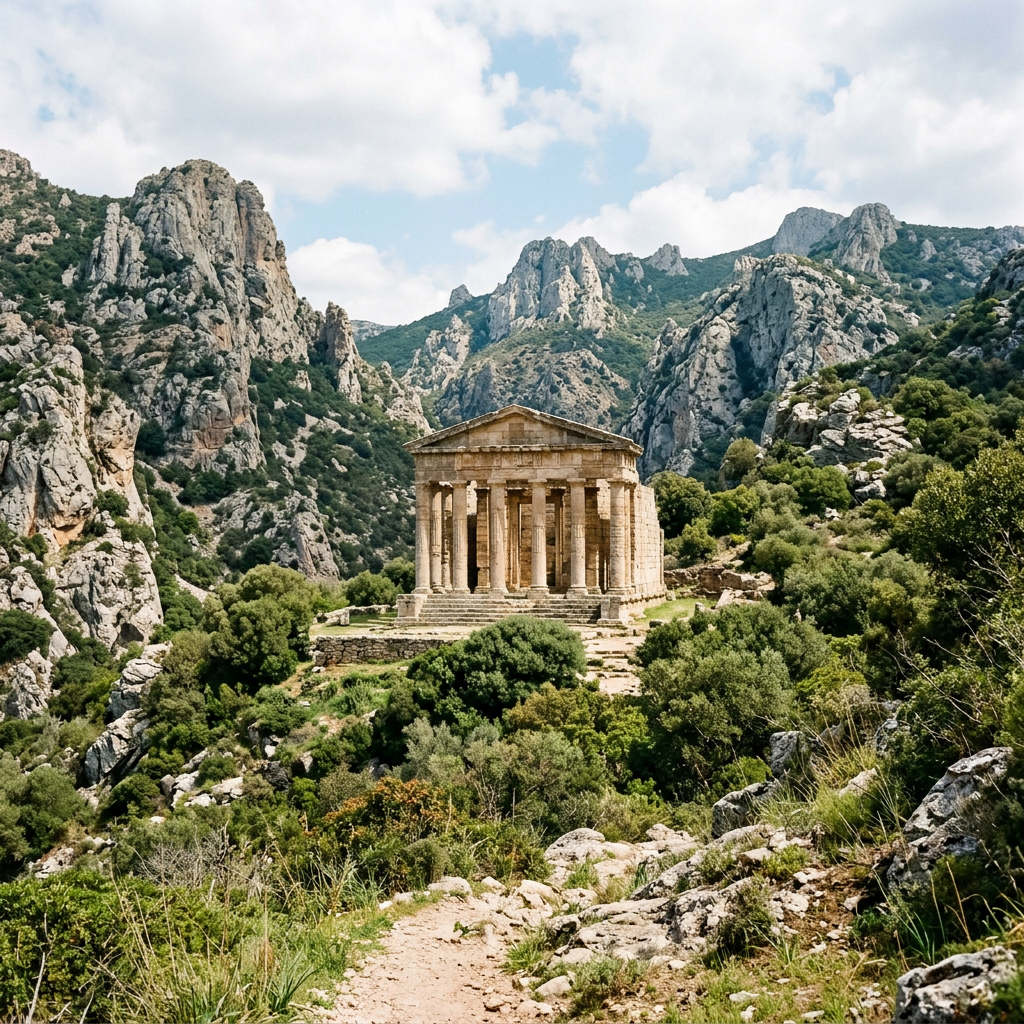
Temple of Antas: A Journey Through 2,000 Years of Sardinian History
Hidden among the limestone mountains of southwestern Sardinia, the Temple of Antas is one of the island’s most fascinating archaeological sites. Located near Fluminimaggiore, in the historic Iglesiente region, this ancient sanctuary combines the remains of Nuragic, Punic and Roman cultures in one extraordinary landscape.
The monument visible today is primarily a reconstructed Roman temple dedicated to Sardus Pater Babai, an important ancient Sardinian deity. However, the history of the sacred site is considerably older. Archaeological evidence shows that the valley was used for religious and funerary purposes long before the Romans arrived. Later, the Carthaginians established a sanctuary here dedicated to the Punic god Sid Addir Babay, before the Romans transformed the location into a monumental temple.
This remarkable succession of cultures is what makes the Temple of Antas in Sardinia so special. Rather than representing a single moment in history, the site reveals how different civilizations reused, adapted and reinterpreted an ancient sacred landscape.
Where Is the Temple of Antas?
The Temple of Antas is situated in the territory of Fluminimaggiore, approximately 10 kilometres from the town, in southwestern Sardinia. It stands in the Antas Valley beneath the limestone mountain of Monte Conca s’Omu.
The surrounding landscape is an important part of the experience. The temple is surrounded by Mediterranean vegetation, limestone formations and open countryside, creating a striking contrast between the archaeological remains and the natural environment.
The official Sardinia tourism authority describes the valley as a peaceful setting in the Iglesiente area, while Italy’s national tourism portal highlights the archaeological and natural importance of the area.
For travellers exploring southwestern Sardinia, the site is particularly worthwhile because it combines archaeology, landscape and mythology in one destination.
The Nuragic Origins of Antas
Although the monument is generally known as a Roman temple, the history of Antas goes much further back.
Archaeological research indicates that the valley was already associated with the Nuragic civilization during the Bronze Age. The Nuragic people are famous for the distinctive stone towers known as nuraghi, but their culture also included settlements, funerary monuments and sacred places.
At Antas, evidence points to early funerary and religious activity. During the Iron Age, around the 9th century BC, the area was associated with shaft tombs used for individual burials. One particularly significant discovery was a bronze figurine depicting a naked male divinity carrying a spear. Archaeologists have connected this figure with the local deity Babai and with the later Punic god Sid.
This early history is important because it demonstrates that the Temple of Antas was not created from nothing by the Romans. Instead, the Romans built their sanctuary on a location that had already possessed religious significance for centuries.

The Punic Temple of Antas
The next major chapter in the history of Antas began with the arrival and expansion of Carthaginian power in Sardinia.
Around the 5th century BC, a Punic sanctuary was established at Antas. It was dedicated to Sid Addir Babay, a warrior and hunter deity associated with the local Sardinian religious tradition.
The sanctuary subsequently underwent another building phase around the 3rd century BC, during the Punic-Hellenistic period. Archaeological remains of this earlier sanctuary can still be seen beneath and around the Roman temple. Numerous votive offerings have also been associated with the site.
The Punic phase is particularly fascinating because it illustrates cultural adaptation. Instead of simply replacing the older religious traditions, the Punic sanctuary appears to have incorporated aspects of an existing local cult.
The deity later worshipped by the Romans as Sardus Pater Babai can therefore be understood within a much longer religious tradition connecting the indigenous Sardinian world with Punic and Roman cultures.
The Roman Temple of Antas
The structure visitors see today is primarily the Roman sanctuary.
The Roman temple was initially developed during the Augustan period, around the end of the 1st century BC and beginning of the 1st century AD. It was later extensively restored and monumentalized during the reign of Emperor Caracalla in the 3rd century AD. An inscription associated with Caracalla’s restoration was placed on the temple’s pediment.
The temple was dedicated to Sardus Pater Babai, a major indigenous Sardinian deity who was identified or associated with the earlier Punic Sid.
Architecturally, the sanctuary has a rectangular plan and a monumental staircase leading toward a raised podium. The front of the temple featured four columns, creating a classic tetrastyle arrangement. The columns have Ionic capitals, while the interior includes a deep cella and an adyton divided into two rooms.
The use of locally quarried limestone gives the monument a strong connection to its surroundings. Ancient quarrying activity can also be found in the area, where stone was extracted for construction.

Who Was Sardus Pater?
One of the most intriguing aspects of the Temple of Antas is the identity of the god worshipped there.
Sardus Pater Babai, literally associated with the concept of the “Father Sardus,” was an indigenous Sardinian deity whose cult survived through different cultural periods.
During the Punic period, the sanctuary was associated with Sid, a warrior and hunter god known as Sid Addir Babay. Under Roman rule, the deity was identified as Sardus Pater Babai.
This religious evolution provides an extraordinary example of cultural continuity in ancient Sardinia. The names and architectural styles changed, but the sacred character of the location endured.
The bronze figurine discovered near the site is especially valuable for understanding these connections. Its combination of Nuragic craftsmanship and eastern Mediterranean influences demonstrates the cultural exchanges that took place across Sardinia and the wider Mediterranean world.
What Does the Temple of Antas Look Like?
The reconstructed Antas Temple stands on an elevated podium approached by a broad staircase.
The most recognizable feature is the row of four columns at the front of the building. Their elegant proportions contrast with the rugged limestone landscape surrounding the sanctuary.
The Roman structure includes:
- A monumental entrance staircase
- A raised podium
- A four-column pronaos
- Ionic capitals
- A deep cella
- An adyton with two rooms
- Remains associated with the earlier Punic sanctuary
- Nearby archaeological evidence from Nuragic and Roman periods
Parts of the structure were reconstructed during modern restoration work. The Italian national tourism authority notes that restoration began in 1967, while the official cultural heritage information records extensive reconstruction and restoration during the 1960s.
Consequently, visitors should understand that the temple they see today is not an untouched Roman building. It is a carefully reconstructed monument based on archaeological evidence.
The Valley Around the Temple
One of the biggest attractions of the Temple of Antas in Sardinia is its setting.
The sanctuary sits in a natural amphitheatre surrounded by limestone mountains and Mediterranean vegetation. Monte Conca s’Omu dominates the landscape, giving the archaeological site a dramatic backdrop.
The valley also contains evidence of other activities connected with the ancient sanctuary. Archaeological discoveries include a small necropolis, a Nuragic settlement and Roman quarrying areas. There was also an ancient route connecting the valley with the nearby Su Mannau cave.
This means that a visit to Antas can be more than a quick stop to photograph the temple. The wider landscape helps explain why this location was attractive to ancient communities.

Why Visit the Temple of Antas?
There are many archaeological sites in Sardinia, but the Temple of Antas offers something particularly unusual: several historical periods are concentrated within the same sacred landscape.
A visit allows you to explore:
- Nuragic Sardinia and its ancient funerary traditions
- Punic archaeology and the cult of Sid Addir Babay
- Roman Sardinia and the worship of Sardus Pater
- Ancient Mediterranean cultural exchange
- Roman architecture and religious practices
- The mining history of the Iglesiente region
- The spectacular natural landscape of Fluminimaggiore
For anyone interested in ancient Sardinia, Roman archaeology or Mediterranean history, Antas is one of the most rewarding archaeological destinations in the southwest of the island.
How to Visit the Temple of Antas
The archaeological area is located near Fluminimaggiore, Sardinia, and can be reached by road from the surrounding towns. The official Italian tourism portal places the site along the road toward Antas from the Iglesias area.
Opening hours can vary seasonally, so travellers should check the official cultural heritage information before visiting. The Italian Ministry of Culture currently lists the archaeological area as an established visitor site and provides seasonal opening information.
The site is also surrounded by natural scenery, so comfortable walking shoes, water and protection from the sun are sensible choices, particularly during the warmer months.
Temple of Antas: A Symbol of Sardinia’s Layered History
The real importance of the Temple of Antas lies beyond its impressive Roman columns.
This sanctuary represents thousands of years of cultural transformation. The valley was first used by Nuragic communities, later became a Punic sacred centre and was eventually transformed into a Roman temple dedicated to Sardus Pater Babai.
Each civilization left its mark, yet the religious importance of the location survived.
That continuity makes Antas one of the most compelling archaeological sites in Sardinia. It is a place where Roman architecture stands above Punic remains, while evidence of much older Nuragic traditions lies beneath the surface.
For travellers looking for the best ancient sites in Sardinia, the Temple of Antas deserves a prominent place on the itinerary. Its combination of history, mythology, archaeology and spectacular scenery makes it much more than a Roman ruin—it is a window into the many civilizations that shaped Sardinia.

Frequently Asked Questions About the Temple of Antas
Where is the Temple of Antas?
The Temple of Antas is located in the territory of Fluminimaggiore, in southwestern Sardinia, Italy. It lies in the Antas Valley beneath the limestone relief of Monte Conca s’Omu.
Who was the Temple of Antas dedicated to?
During the Roman period, the temple was dedicated to Sardus Pater Babai, an indigenous Sardinian deity associated with the earlier Punic god Sid Addir Babay.
Is the Temple of Antas Roman?
The monument visible today is primarily Roman, with an initial phase dating to the Augustan period and a major renovation during the 3rd century AD under Caracalla. However, the sacred site itself is much older and includes evidence of Nuragic and Punic occupation.
When was the Temple of Antas built?
The Roman sanctuary developed during the Augustan period and was later reconstructed in monumental form during the reign of Caracalla. The earlier Punic sanctuary dates back to around the 5th century BC, while the sacred use of the valley goes back even further to the Nuragic period.
Is the Temple of Antas worth visiting?
Yes. For visitors interested in Sardinian history, Roman archaeology, Nuragic culture, Punic civilization and ancient Mediterranean religion, Antas offers an unusually rich combination of archaeological remains and natural scenery.
Final Thoughts
The Temple of Antas is one of the places where Sardinia’s complex past becomes visible in a single landscape. From Nuragic funerary traditions to Punic religious practices and Roman monumental architecture, the sanctuary tells a story of cultural continuity and transformation.
Standing among the limestone hills of Fluminimaggiore, it is easy to understand why this valley remained sacred for so many centuries.
For anyone planning a trip through southwestern Sardinia, adding the Tempio di Antas to the itinerary is an opportunity to step beyond the island’s beaches and discover a deeper, older side of Sardinia—one shaped by ancient peoples, gods, miners, merchants and emperors.
Fortisetliber’s View
The Temple of Antas is one of those rare places where Sardinia seems to whisper its history rather than simply display it.
Hidden among the mountains near Fluminimaggiore, the ancient sanctuary stands surrounded by limestone landscapes and Mediterranean vegetation. But its importance goes far beyond the Roman columns we see today. The valley was already sacred in Nuragic times, later became a Punic sanctuary, and was eventually transformed into a Roman temple dedicated to Sardus Pater Babai.
For us at FortisLiber, this is what makes Antas truly fascinating. It is not just a monument—it is a meeting point between civilizations, beliefs and generations.
Standing there, it is easy to imagine the people who once travelled through this valley, worshipped their gods and left offerings behind. The stones may be ancient, but the feeling of the place remains remarkably alive.
The Temple of Antas reminds us that Sardinia’s story is much deeper than its beaches and beautiful coastlines. Its mountains preserve stories of Nuragic communities, Punic influence and Roman ambition, all layered into the same landscape.
Perhaps the greatest beauty of Antas is its silence.
You come to see an ancient temple, but you leave with something more—a sense of connection to a Sardinia that existed thousands of years ago and, in some small way, is still here today.
Leave a Reply