
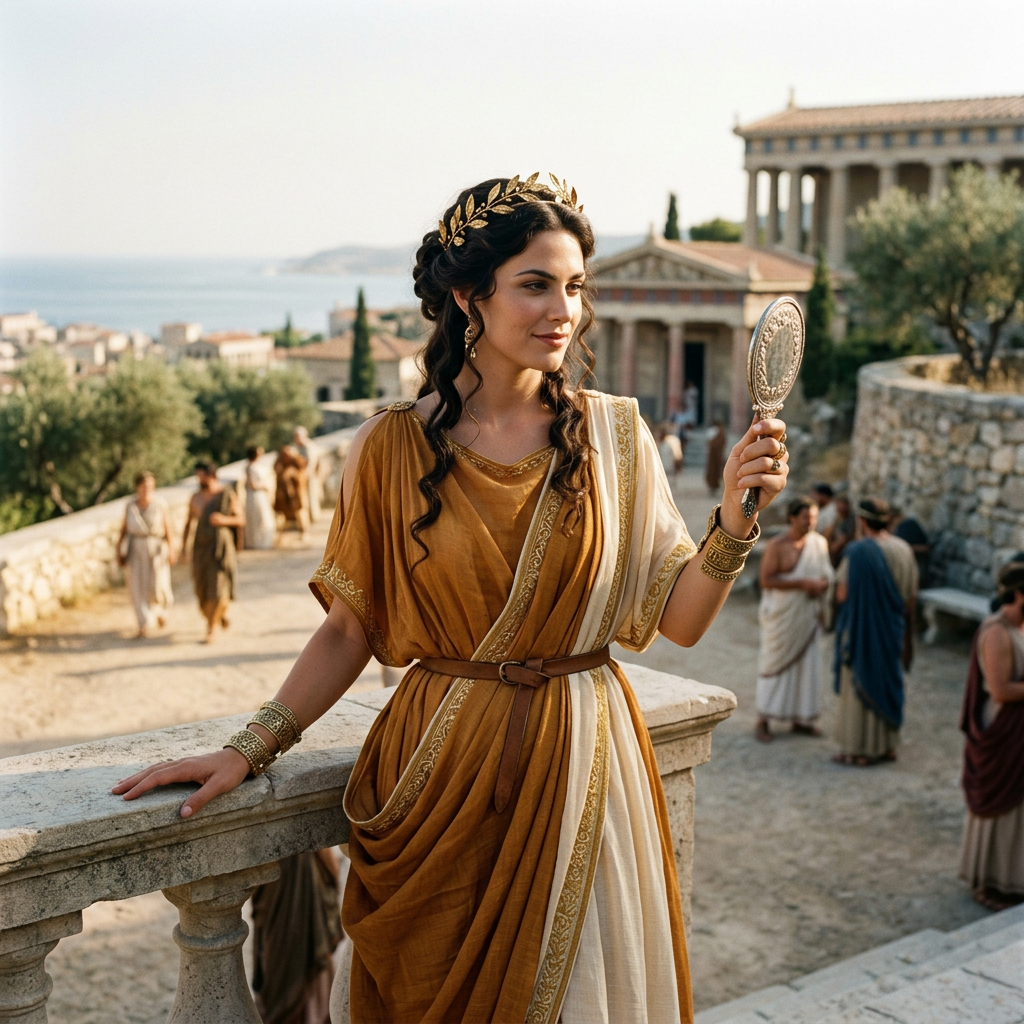
Few women of 4th-century BC Greece have attracted as much fascination as Phryne of Thespiae. Famous for her beauty, wealth, relationships with powerful men, connections with artists, and a celebrated trial for impiety, Phryne became one of the most recognizable women of the ancient Greek world.
She was a hetaira, a highly educated and socially sophisticated type of courtesan who could participate in elite male social circles in ways that respectable married women generally could not. Phryne was apparently wealthy enough to become a public figure in Athens and was associated with some of the greatest artists and intellectuals of her age.
Her name became particularly connected with the sculptor Praxiteles and the legendary Aphrodite of Knidos, one of the most influential works in the history of ancient Greek art. Ancient writers also associated her with the painter Apelles and his famous Aphrodite Anadyomene. However, modern scholarship warns that many of these stories were developed or embellished long after Phryne’s lifetime.
Perhaps the most famous story concerns her trial for impiety. According to ancient accounts, her defender, the celebrated orator Hypereides, dramatically exposed her body before the jury, supposedly persuading the judges to acquit her. This extraordinary scene has inspired countless paintings, novels, sculptures, and modern interpretations.
Yet the real Phryne is more interesting than the legend.
She offers a rare glimpse into women, wealth, sexuality, art, law, and social status in Classical Athens.
Who Was Phryne?
Phryne was a famous Boeotian hetaira active in Athens during the middle and later decades of the 4th century BC.
Ancient sources identify her birthplace as Thespiae in Boeotia, while her professional and social life was associated primarily with Athens. Her original name is generally given as Mnesarete. The nickname “Phryne,” meaning “toad,” was reportedly connected with her complexion.
Unlike an ordinary prostitute, a hetaira could occupy a more complicated position in Greek society.
Hetairai could be educated, socially accomplished, and capable of participating in elite gatherings. Some developed relationships with politicians, philosophers, artists, and wealthy citizens.
Phryne appears to have reached an exceptional level of fame.
She was not simply known for her beauty.
She became a celebrity of Classical Athens.
Ancient comic playwrights mentioned her during her own lifetime, suggesting that her reputation was already widespread in 4th-century Athens.

The World of the Greek Hetaira
Understanding Phryne requires understanding the unusual social position of the hetaira.
Women in Classical Athens generally had restricted roles in public political life. Citizen wives were expected to focus largely on the household and family.
A hetaira occupied a different social space.
She could interact with men in environments where respectable citizen women were often absent. Education, conversation, entertainment, and personal relationships could therefore become important parts of her social influence.
This did not mean that hetairai were equal to men.
They remained vulnerable to social judgment and legal restrictions.
But wealthy and famous hetairai could exercise forms of influence unavailable to many other women.
Phryne seems to have taken this possibility further than most.
Her wealth and celebrity allowed her to become associated with artists, politicians, religious events, and public monuments.
Phryne and Her Extraordinary Wealth
One of the most striking aspects of the Phryne story is the wealth she supposedly accumulated.
Ancient writers describe her as extraordinarily wealthy.
Later traditions even claim that she offered to finance the rebuilding of the walls of Thebes, which had been destroyed after Alexander the Great‘s conquest of the city in 335 BC, provided that an inscription would identify her as the woman who restored what Alexander had destroyed.
This story is famous but should be treated cautiously.
The ancient tradition surrounding Phryne contains many anecdotes that became increasingly elaborate in later literature. The Oxford Classical Dictionary notes that while Phryne herself is generally accepted as a real historical woman, many details of her biography come from Hellenistic and Imperial Greek sources, making their historicity uncertain.
Nevertheless, the story tells us something important.
Ancient audiences believed that Phryne had become wealthy enough to behave like a major public benefactor.
That alone reveals how exceptional her reputation must have been.

Phryne and Praxiteles
Perhaps no artistic relationship is more closely associated with Phryne than her connection with Praxiteles, one of the greatest sculptors of Classical Greece.
Praxiteles was active during the 4th century BC and became famous for a new approach to the human body.
His sculptures were celebrated for their graceful proportions, relaxed poses, sensuality, and idealized beauty.
Ancient tradition connected Phryne with several of his works.
The most famous is the Aphrodite of Knidos.
The statue was revolutionary.
It presented the goddess Aphrodite nude in monumental sculptural form, something that represented a major development in Greek art.
According to Athenaeus and a later source, Praxiteles used Phryne as his model.
However, this famous association is not certain. The Oxford Classical Dictionary emphasizes that the majority of the surviving biographical traditions about Phryne are late, while the specific identification of Phryne as the model for the Aphrodite of Knidos is supported by only some ancient sources.
Other ancient traditions name different women as the model.
Therefore, it is safer to say that Phryne was traditionally associated with the Aphrodite of Knidos, rather than stating definitively that her face or body was used for the statue.
The Aphrodite of Knidos
The Aphrodite of Knidos became one of the most influential sculptures of the ancient Mediterranean.
The original statue no longer survives, but numerous ancient copies and later representations preserve its general appearance.
Aphrodite is shown preparing for or emerging from a ritual bath.
One hand modestly protects part of her body while simultaneously drawing attention to her nudity.
The sculpture became famous throughout the ancient world.
Its fame also contributed to the cultural reputation of Phryne.
The connection between the courtesan and the goddess created a powerful story:
the most beautiful woman in Athens had supposedly become the model for the goddess of love.
Whether literally true or not, it was an extraordinarily effective legend.

Phryne and Apelles
Phryne was also associated with the painter Apelles, one of the most famous artists of the ancient Greek world.
According to ancient tradition, Phryne’s appearance at a festival inspired Apelles’ painting Aphrodite Anadyomene, or Aphrodite Rising from the Sea.
The story says that Phryne removed her clothing, loosened her hair, and entered the sea, inspiring the painter.
The image of a beautiful woman emerging from the water became one of the great artistic themes of classical mythology.
Again, however, caution is necessary.
Ancient sources provide competing traditions about who served as Apelles’ model. The association with Phryne is therefore part of the larger body of artistic legend surrounding her.
The Trial of Phryne
The most famous episode in her life was her trial for impiety.
Phryne was accused of asebeia, a serious religious offense.
The precise date is uncertain, but modern scholarship places the trial probably somewhere between 350 and 340 BC.
According to the surviving tradition, the prosecutor was Euthias, reportedly a former lover.
Phryne was defended by the famous Athenian orator Hypereides, who was himself said to have been associated with her.
The case became famous because of the extraordinary way in which the defense allegedly appealed to the emotions of the jury.

Did Phryne Actually Strip Before the Jury?
This is one of the most important historical questions surrounding Phryne.
The famous story says that when Hypereides believed the jury was about to condemn his client, he exposed Phryne’s breasts before the judges.
Her beauty supposedly overwhelmed the jurors, who decided that such a beautiful woman could not possibly be guilty of offending the gods.
The story has become one of the most famous anecdotes about ancient Greek women.
But modern historians are much more cautious.
The ancient evidence does not clearly establish that the famous dramatic disrobing actually happened in the way later writers described it. The Oxford research on Phryne emphasizes that the story became intertwined with later narratives about her nudity, beauty, and artistic associations.
Even the location of the trial is uncertain.
Despite the famous modern title “Phryne Before the Areopagus,” the surviving ancient sources do not securely establish that the trial took place before the Areopagus. One ancient tradition instead places it in the Heliaia, the major popular court of Athens.
So the famous image of Phryne standing naked before the Areopagus is best understood as a later artistic interpretation rather than established historical fact.
Why Was Phryne Accused of Impiety?
The exact motivation behind the prosecution is uncertain.
The charge of asebeia involved offenses against religion or the gods.
Modern scholarship has suggested several possible contexts for the accusation.
Fourth-century Athens witnessed concerns about new religious practices, foreign cults, private religious groups, and individuals whose behavior appeared to challenge traditional religious expectations.
Phryne’s public persona may have made her particularly vulnerable.
She was famous.
She was wealthy.
She participated in religious festivals.
She was associated with Aphrodite.
And her public image blurred the boundaries between sexuality, religion, and artistic representation.
The trial may therefore have involved more complicated social and religious tensions than the simple story of a jealous former lover.

Hypereides: The Orator Who Defended Phryne
Hypereides was one of the most important Athenian orators of the 4th century BC.
His defense of Phryne became famous in antiquity.
Unfortunately, his original speech survives only in fragments.
This is one reason why reconstructing the trial is so difficult.
Ancient writers remembered the dramatic conclusion far more vividly than the actual legal arguments.
The result is a fascinating problem for historians:
we know the trial was remembered as important, but we cannot reconstruct every detail of what actually happened.
Modern scholarship increasingly separates the historically plausible trial from the theatrical details added by later storytelling.
Phryne and Women in Ancient Greece
Phryne’s story is especially valuable because it reveals the complicated position of women in Classical Athens.
Citizen women generally had limited public political authority.
Yet Phryne, as a wealthy and famous hetaira, appears to have moved through elite male society in a very different way.
Her influence did not come from political office.
It came from:
- wealth;
- beauty;
- social connections;
- celebrity;
- education and conversation;
- relationships with powerful men;
- and association with the arts.
Her story demonstrates that social influence did not always depend upon formal political power.
A woman could be excluded from the Assembly and still become famous throughout Greece.

Phryne as a Patron of Art
Phryne was not merely portrayed as an artistic model.
Ancient traditions also associate her with dedications and monuments.
A particularly important piece of evidence is the tradition of a portrait statue of Phryne dedicated at Delphi, created by Praxiteles.
Modern scholarship considers some of these portrait traditions potentially important evidence for the historical Phryne. Research on her artistic reception argues that her portrait dedications were probably authentic and help support the existence of a real 4th-century hetaira from Thespiae.
This is significant.
It means that Phryne may have been more than a literary character.
She may have been a genuine public figure whose image was displayed in important Greek sanctuaries.
The Transformation of Phryne Into a Legend
Phryne’s reputation did not disappear after her lifetime.
Instead, it grew.
During the Hellenistic period, anecdotes about famous personalities became increasingly popular.
Phryne was perfectly suited to this literary tradition.
She had everything a good ancient anecdote required:
- extraordinary beauty;
- enormous wealth;
- famous lovers;
- celebrated artists;
- political connections;
- religious controversy;
- and a spectacular trial.
Over time, these elements became interconnected.
The historical woman became a cultural symbol.
The more writers repeated the stories, the more difficult it became to separate the real Phryne from the legendary one.
This process explains why historians today approach her biography with caution.
Phryne in European Art
Phryne became particularly popular among European artists many centuries later.
Painters and sculptors repeatedly depicted:
- Phryne before the judges;
- Phryne as a model for Aphrodite;
- Phryne bathing;
- and Phryne surrounded by admirers.
One of the most famous later works is Jean-Léon Gérôme’s Phryne Before the Areopagus.
The painting transformed the ancient anecdote into a spectacular 19th-century scene.
But it also reinforced an important misunderstanding.
Modern viewers often assume that the historical trial definitely occurred before the Areopagus and that Phryne definitely exposed herself before the judges.
The painting helped popularize both ideas even though the ancient evidence does not establish them securely.

The Real Phryne Behind the Myth
Perhaps the most interesting way to approach Phryne is to separate three different figures:
The historical Phryne — a real 4th-century BC hetaira from Thespiae who became famous and wealthy in Athens.
The ancient literary Phryne — a woman surrounded by stories about beauty, artists, religion, wealth, and sexuality.
The artistic Phryne — the nude heroine repeatedly portrayed by European painters and sculptors centuries later.
These three versions are not identical.
The first is difficult to reconstruct.
The second is preserved through ancient literature.
The third became an important symbol in Western art.
Together, however, they explain why Phryne remains famous.
Conclusion: Phryne, Beauty and the Power of a Legend
Phryne of Thespiae occupies a unique position in the history of ancient Greece.
She was a real woman who lived in the 4th century BC, but the details of her life became increasingly surrounded by legend.
She was remembered as a wealthy hetaira, associated with the greatest artists of Classical Greece, particularly Praxiteles and Apelles.
She became connected with the Aphrodite of Knidos and Aphrodite Anadyomene.
She was prosecuted for impiety and defended by Hypereides.
And her supposed appearance before the judges became one of the most famous courtroom stories of antiquity.
But perhaps her greatest legacy lies somewhere else.
Phryne demonstrates how beauty could become social power, how a woman outside the traditional structures of Athenian citizenship could achieve extraordinary fame, and how historical personalities can be transformed into legends.
The real Phryne may never be completely recoverable.
Yet her story continues to tell us something important about Classical Greece: its society was not defined only by philosophers, warriors, and politicians.
It was also shaped by women who operated at the edges of conventional society—and sometimes became famous enough to challenge its boundaries.
Phryne was remembered because she was beautiful. She survived because she became a legend. But behind the legend was a remarkable woman who managed to make her presence felt in the male-dominated world of Classical Greece.

Fortisetliber’s View
Phryne lived in the 4th century BC, yet her name has survived for more than two thousand years.
She was a hetaira from Thespiae, a woman who moved within the sophisticated social world of Classical Greece and became famous for her beauty, wealth, and connections with some of the greatest artists of her age.
Tradition connects her with Praxiteles, the sculptor of the celebrated Aphrodite of Knidos. She was also associated with the painter Apelles and the legendary image of Aphrodite rising from the sea.
But perhaps the most famous story is her trial for impiety.
According to a later tradition, her defender, the orator Hypereides, revealed her body before the judges, and her beauty supposedly saved her from condemnation. It is a spectacular story—but historians cannot establish that it happened exactly as later writers claimed.
And that uncertainty is what makes Phryne so fascinating.
Where does the woman end and the legend begin?
For FortisLiber, Phryne represents something deeper than beauty.
She lived in a society where political power belonged overwhelmingly to men, yet she became wealthy, famous, and influential through entirely different forms of power: beauty, intelligence, social connections, and celebrity.
Her story also reminds us how history is created.
The real Phryne left behind fragments.
Ancient writers added stories.
Artists transformed those stories into images.
And centuries later, painters turned her into a symbol of beauty, temptation, and the dramatic imagination of ancient Greece.
Perhaps we will never know exactly what happened in that famous courtroom.
But we know something more important.
Phryne refused to disappear.
The temples, statues, and cities of Classical Greece have fallen silent, but the name of a woman who lived more than two thousand years ago still provokes questions about beauty, power, society, and truth.
FortisLiber sees Phryne not simply as the beautiful woman of an ancient legend, but as a reminder that sometimes the most enduring figures in history are those who lived outside the traditional paths to power.
The marble may break. The paintings may fade. The stories may change. But the legend remains.
Leave a Reply