
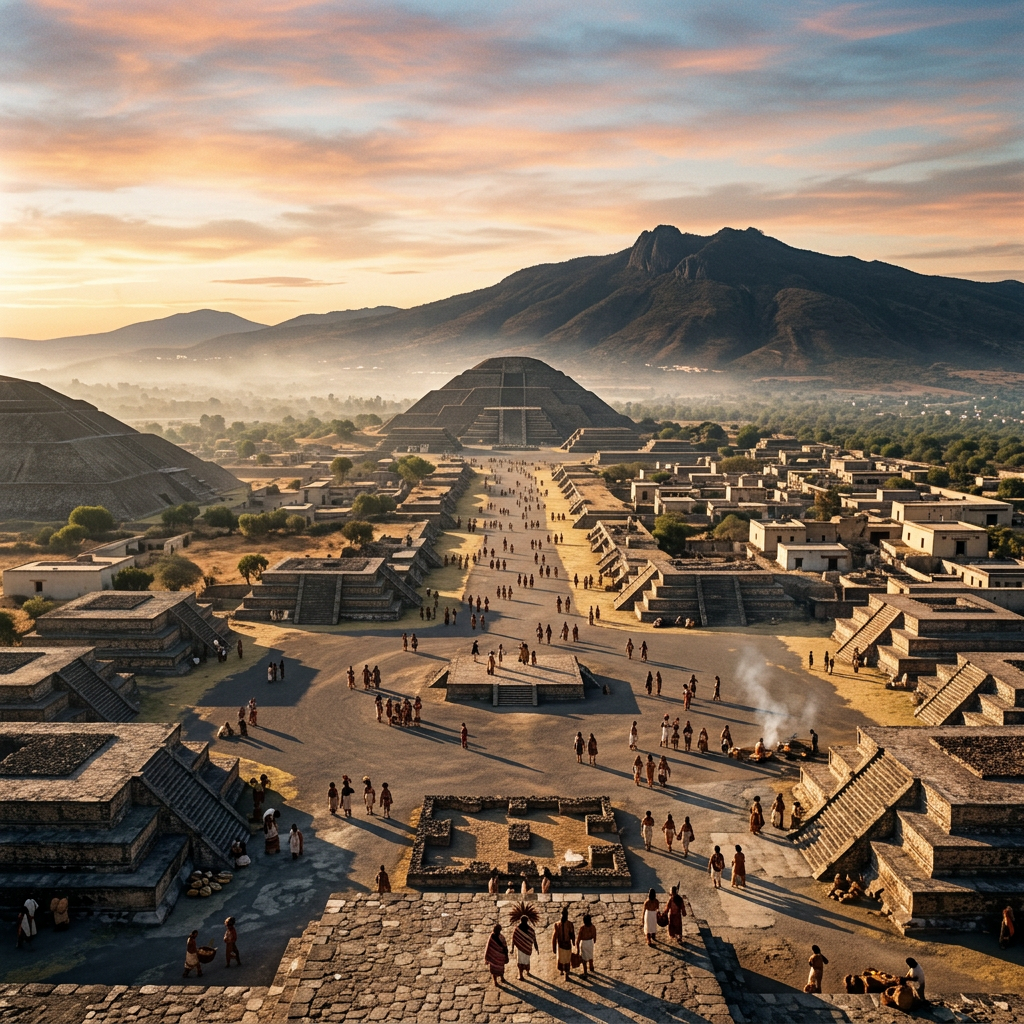
Long before the rise of the Aztec Empire, and centuries before Europeans reached the Americas, a vast metropolis emerged in the highlands of central Mexico.
Its name was Teotihuacan.
Today, the monumental ruins of ancient Teotihuacan stand roughly 50 kilometers northeast of Mexico City, dominated by enormous pyramids, broad avenues, temples, palaces, and residential compounds. Yet the people who built this extraordinary city left behind no surviving historical chronicle explaining who they were or exactly how they governed their society.
That mystery is part of Teotihuacan’s enduring fascination.
Between roughly the 1st and 7th centuries AD, Teotihuacan became one of the greatest cities of the ancient Americas and one of the most influential centers of Mesoamerican civilization. At its height, the city may have supported well over 100,000 inhabitants according to Mexican archaeological authorities, while UNESCO emphasizes its exceptional scale, urban planning, monuments, and cultural influence.
It was not simply a ceremonial center.
Teotihuacan was a true ancient city—a place of government, religion, trade, craftsmanship, agriculture, neighborhoods, and enormous architectural ambition.
The Origins of Teotihuacan
The story of Teotihuacan, Mexico, begins before the city reached its monumental form.
Human settlement in the Teotihuacan Valley existed centuries before the great metropolis emerged. According to INAH, the community that eventually developed into the city was established by populations from the southern part of the Basin of Mexico several centuries before the Common Era.
Between approximately 100 BC and 200 AD, Teotihuacan experienced extraordinary growth. Population movements from across the Basin of Mexico helped transform the settlement into a major urban center, while immense civic and religious structures began to dominate the landscape. Archaeological research suggests that warfare and political power were already important elements in the city’s early development.
The result was one of the most ambitious experiments in urban civilization in ancient Mesoamerica.
Rather than developing as an unplanned collection of settlements, the ancient city of Teotihuacan was organized according to a remarkable geometric plan.
Its streets, plazas, temples, residential compounds, and monumental structures were carefully integrated into a larger urban design.
The transformation was extraordinary.
A regional settlement had become a metropolis.

The Avenue of the Dead
At the heart of Teotihuacan ancient city was the enormous avenue now known as the Avenue of the Dead.
Running broadly north to south, this monumental axis structured the ceremonial and urban landscape. The city’s planners incorporated natural features into their design, even modifying the course of the San Juan River so that it intersected with the urban plan.
The Avenue of the Dead was not simply a road.
It was the spine of Teotihuacan.
Along it stood enormous pyramids, temples, plazas, palaces, and ceremonial complexes. The avenue connected the major monuments while simultaneously creating a powerful visual and symbolic landscape.
From the great pyramids to the residential districts beyond the ceremonial center, the city was designed on a scale rarely seen in the ancient world.
UNESCO estimates that at its height the urban area extended across roughly 36 square kilometers, while archaeological research has revealed extensive residential and palace complexes outside the monumental core.
This is one of the reasons Teotihuacan archaeology is so important.
The pyramids represent only a fraction of the ancient city.
Behind them was an enormous urban society.
The Pyramid of the Sun
The most famous monument of ancient Teotihuacan is undoubtedly the Pyramid of the Sun.
Standing beside the Avenue of the Dead, this enormous structure dominates the landscape and remains one of the largest pyramidal monuments in the ancient Americas.
UNESCO records a base measuring approximately 225 by 222 meters, with a height of around 75 meters in its current reconstructed form.
Its original appearance was different from what visitors see today. The pyramid would once have formed part of a larger sacred complex, and evidence suggests that a temple or sanctuary once stood on its summit.
The scale of the monument reveals something fundamental about Teotihuacan civilization.
Building a structure of such magnitude required enormous quantities of labor, materials, organization, engineering knowledge, and political or religious authority.
The Pyramid of the Sun was therefore not merely architecture.
It was a statement of power.
It demonstrated what an organized society could accomplish when thousands of people were brought together behind a common vision.

The Pyramid of the Moon
At the northern end of the Avenue of the Dead stands another iconic monument: the Pyramid of the Moon.
Although smaller than the Pyramid of the Sun, its position creates one of the most dramatic views in Teotihuacan ancient city.
The pyramid rises at the foot of Cerro Gordo, integrating architecture with the surrounding landscape. From its elevated position, the ceremonial avenue extends southward toward the central complexes.
The relationship between mountain, pyramid, avenue, and city was not accidental.
Teotihuacan’s builders created an environment in which urban planning, religion, architecture, and landscape were deeply connected.
The city itself became a sacred landscape.
The Temple of the Feathered Serpent
Another extraordinary monument is the Temple of Quetzalcoatl, also known as the Temple of the Feathered Serpent.
Located within the Ciudadela, or Citadel, the temple is famous for its elaborate sculptural decoration.
Stone heads representing feathered serpents and other supernatural imagery once decorated its architectural façades.
The temple provides a different impression from the immense geometric simplicity of the Pyramid of the Sun.
Here, Teotihuacan’s artistic sophistication becomes immediately visible.
The city was filled with painted and sculpted imagery, much of it connected with religion, power, nature, warfare, and supernatural forces. UNESCO describes Teotihuacan’s art as among the most developed of the Classic civilizations of Mexico.

A City of Neighborhoods
One of the greatest mistakes when imagining ancient Teotihuacan is to picture only the pyramids.
The monumental center represented only part of the city.
Beyond the ceremonial core were extensive residential districts where ordinary inhabitants lived and worked.
Archaeological investigations at places such as La Ventilla, Tetitla, Tepantitla, Zacuala, and Yayahuala have revealed apartment compounds, workshops, religious spaces, administrative buildings, courtyards, drainage systems, water facilities, and mural paintings.
La Ventilla is particularly valuable because its excavations have helped archaeologists understand the everyday structure of Teotihuacan society.
The city contained different neighborhoods and communities, including groups associated with people from other regions of Mesoamerica.
Craft production was an important part of urban life.
Artisans produced pottery, stone objects, luxury goods, and other materials, while markets and long-distance trade connected Teotihuacan to distant regions.
This was a cosmopolitan city.
People from different cultural backgrounds appear to have lived within its neighborhoods, contributing to the complexity of Teotihuacan society. INAH identifies evidence for diverse populations, including communities associated with Oaxaca and other regions.
Trade and the Power of Obsidian
The economic strength of Teotihuacan civilization was supported by agriculture, craft production, markets, and long-distance exchange.
One particularly important resource was obsidian, a volcanic glass that could be shaped into extremely sharp cutting tools.
Teotihuacan’s position in the Basin of Mexico provided access to important resources, while its location helped connect it with wider Mesoamerican exchange networks.
Archaeological research points to a combination of irrigation agriculture, household production, markets, and interregional trade as important elements of the city’s economic foundation.
Teotihuacan’s influence extended far beyond central Mexico.
Its artistic styles, architectural traditions, symbols, and political or religious imagery appeared in distant regions.
Connections reached into the Maya world, including places such as Tikal in present-day Guatemala. INAH describes Teotihuacan’s political, commercial, and cultural relationships as extending across large parts of Mesoamerica.
The city was therefore not isolated.
It was part of a vast network of ancient Mesoamerican civilizations.

Religion, Art, and the Meaning of Teotihuacan
The spiritual world of Teotihuacan remains difficult to reconstruct completely.
Unlike the Maya, who left extensive written inscriptions, the people of Teotihuacan left relatively limited readable textual evidence. Archaeologists therefore depend heavily on architecture, murals, sculpture, ceramics, burials, and symbolic imagery to reconstruct their beliefs.
Religion appears to have been deeply integrated into political and social life.
War, fertility, rain, fertility-related deities, sacred animals, and supernatural beings appear repeatedly in Teotihuacan art.
The city’s murals are especially important.
Painted walls reveal a world of ritual processions, sacred symbols, animals, plants, priests, warriors, and supernatural imagery.
Teotihuacan was not a city of bare stone alone.
It was once a city of color.
The pyramids and temples were decorated, while palaces and residential compounds contained richly painted murals.
The monumental ruins we see today represent only the surviving skeleton of a much more vibrant ancient metropolis.
The Mystery of the Teotihuacan Rulers
Perhaps one of the greatest mysteries of ancient Teotihuacan is the identity of its rulers.
Who commanded the construction of the pyramids?
Who organized the city’s enormous workforce?
Who controlled the trade networks?
And how was such a huge population governed?
Unlike many later Mesoamerican civilizations, Teotihuacan did not leave behind an easily identifiable sequence of kings whose names dominate the historical record.
This has led archaeologists to debate the city’s political structure.
Some interpretations emphasize powerful rulers and elites, while others suggest a more collective form of governance in later periods.
The archaeological evidence remains complex.
That uncertainty makes Teotihuacan even more fascinating.
We know that an extraordinarily organized state or political system existed.
But we still do not fully understand the people who stood at its summit.

The Fall of Teotihuacan
Like many great cities of antiquity, Teotihuacan eventually declined.
During the 7th century AD, parts of the city were burned and the metropolis was abandoned.
The reasons remain debated.
Political instability, internal conflict, environmental pressures, economic disruption, and changes in regional power may all have contributed.
What is certain is that the great urban system did not simply disappear overnight.
Its decline was part of a broader transformation in central Mexico.
The city that had once dominated the region gradually lost its central position.
Its monumental architecture remained behind.
Its people moved elsewhere.
And Teotihuacan entered a new existence—not as a living city, but as a sacred landscape remembered by later civilizations.
The Aztecs and the “Place Where the Gods Were Created”
Centuries after Teotihuacan had been abandoned, the Mexica (Aztecs) encountered its ruins.
They did not know the identity of the civilization that had built the enormous city.
Instead, they incorporated the ruins into their own mythology.
The name Teotihuacan is generally translated as “the place where the gods were created” or “the place where humans become gods,” reflecting its later sacred interpretation in Nahuatl tradition. UNESCO and INAH both emphasize that the name was given long after the city’s abandonment.
For the Aztecs, the ruins were not simply archaeological remains.
They were evidence of a mythical age.
The abandoned city became part of the sacred geography of Mesoamerica.
And that memory helped ensure that Teotihuacan never completely disappeared.

Teotihuacan Today
Today, the archaeological site of Teotihuacan is one of the most important ancient sites in Mexico.
UNESCO placed the Pre-Hispanic City of Teotihuacan on the World Heritage List in 1987, recognizing its monumental architecture, urban planning, art, and extraordinary influence throughout Mesoamerica.
Modern archaeology continues to reveal new aspects of the city.
Technologies such as LiDAR, which uses laser scanning to detect structures beneath vegetation and soil, are opening new possibilities for understanding the enormous urban landscape. UNESCO reported in 2025 that laser-based mapping was providing archaeologists with new information about buried and previously hidden structures.
This is an important reminder:
Teotihuacan is not simply a city that belongs to the past.
It is still being discovered.
The Legacy of Ancient Teotihuacan
The true importance of ancient Teotihuacan lies beyond the spectacular pyramids.
It represents one of humanity’s great experiments in urban civilization.
Its builders created a planned metropolis of enormous scale.
They organized neighborhoods, markets, temples, palaces, workshops, water systems, and ceremonial spaces into a coherent urban landscape.
They developed an artistic tradition whose influence traveled across Mesoamerica.
They built monuments that still dominate the landscape almost two thousand years later.
And yet, despite all their achievements, they left behind surprisingly few written explanations of themselves.
That silence is part of Teotihuacan’s mystery.
We can walk along the Avenue of the Dead.
We can stand beneath the Pyramid of the Sun.
We can study the murals and temples.
We can trace the streets where families once lived and craftsmen once worked.
But the voices of the people themselves remain distant.
Perhaps that is why Teotihuacan continues to capture the imagination.
It is simultaneously monumental and mysterious.
A city that once stood at the center of Mesoamerican civilization eventually became a ruin.
But its architecture survived.
Its artistic influence survived.
Its name survived.
And thousands of years later, the great pyramids of Teotihuacan, Mexico, still rise above the valley as a reminder of what an ancient civilization could achieve.
The city of the gods is silent now—but its stones continue to speak.

Conclusion
Ancient Teotihuacan was more than a city of enormous pyramids. It was one of the greatest achievements of ancient Mesoamerican civilization—a vast metropolis where architecture, religion, trade, craftsmanship, politics, and urban planning came together on an extraordinary scale.
Its builders transformed the landscape into a carefully ordered sacred city. Along the Avenue of the Dead, temples and pyramids expressed a vision of the universe, while behind the monumental center thousands of people lived, worked, traded, raised families, and contributed to the life of one of the ancient world’s most remarkable urban societies.
And yet, the people who created this magnificent civilization remain largely anonymous.
We know their monuments, their murals, their crafts, and their cities. We can reconstruct aspects of their economy and trace their influence across Mesoamerica. But their own voices are strangely quiet. The absence of a surviving historical narrative leaves Teotihuacan suspended between archaeology and mystery.
Perhaps that is what makes the city so powerful.
Its civilization eventually declined. Its inhabitants disappeared from the great avenues. The temples fell silent, and nature slowly reclaimed parts of the city. Centuries later, the Aztecs would encounter the ruins and look upon them not as the remains of an ordinary civilization, but as the work of gods.
They gave the ancient metropolis the name by which the world knows it today: Teotihuacan, the place where the gods were created.
The name endured.
The pyramids endured.
And the city endured in memory.
Today, visitors can walk along the same monumental avenues, stand before the Pyramid of the Sun, and look toward the Pyramid of the Moon. Archaeologists continue to uncover neighborhoods, murals, temples, and objects that slowly reveal the complexity of the civilization that once occupied this extraordinary landscape.
But perhaps the greatest legacy of ancient Teotihuacan is not any single pyramid.
It is the idea of the city itself.
Teotihuacan demonstrates that nearly two thousand years ago, societies in the Americas were capable of creating enormous, sophisticated urban centers whose influence reached far beyond their own borders. Its streets and monuments were designed not simply to accommodate people, but to express an entire vision of society and the cosmos.
The builders of Teotihuacan are gone.
Their rulers are forgotten.
Their language remains largely undeciphered.
But their city still stands.
And across the highlands of Mexico, beneath the enormous pyramids and the endless sky, the stones of Teotihuacan continue to ask the same question they have asked for centuries:
Who were the people who built a city worthy of the gods?
Fortisetliber’s View
There are ancient cities that impress us with their ruins.
And then there is Teotihuacan.
To walk along the Avenue of the Dead is to experience something different from simply visiting an archaeological site. The enormous pyramids rise from the Mexican landscape with a scale that makes the modern world seem strangely distant. The Pyramid of the Sun dominates the horizon, while the Pyramid of the Moon stands at the opposite end of the great ceremonial axis, watching over a city that has been silent for centuries.
But Teotihuacan was never only about monuments.
Behind the pyramids was a living metropolis.
People walked these streets. Craftsmen shaped stone and pottery. Merchants carried goods across Mesoamerica. Families lived within carefully organized residential compounds. Priests performed rituals, administrators managed the city’s affairs, and artists covered walls with brilliant murals.
For centuries, ancient Teotihuacan was one of the great centers of the ancient Americas.
Then, gradually, it fell silent.
The people disappeared, the buildings were abandoned, and the city became a memory buried beneath the landscape. Yet something remarkable happened afterward. The civilization vanished, but the city continued to possess power.
Centuries later, the Aztecs encountered Teotihuacan and could not fully explain who had built it. To them, the immense ruins belonged to a mythical age—a place associated with the creation of the gods.
Perhaps they were not entirely wrong.
Not because gods built Teotihuacan, but because the city represents something deeply human: the desire to create something greater than a single lifetime.
The builders of Teotihuacan could not have known that people thousands of years later would still climb their pyramids, walk their avenues, study their murals, and wonder about their lives.
They built for their own world.
But they left something for ours.
That is the strange power of ancient cities. Their builders disappear, their languages become forgotten, and their political systems collapse. Yet stones remain. Roads remain. A wall, a temple, or a pyramid can carry a fragment of a civilization across centuries.
At Teotihuacan, those fragments are enormous.
Standing beneath the Pyramid of the Sun, one cannot help but wonder what the city looked like at its height—filled with people, color, movement, ritual, commerce, and sound.
Today, there is mostly silence.
But perhaps silence is not the absence of history.
Perhaps it is the place where history waits to be heard.
FortisLiber — where the ruins of Teotihuacan remind us that even when the people who built a civilization are forgotten, their dreams can remain standing beneath the sky.
Leave a Reply