
Introduction
Few ancient documents have had such a lasting influence on our understanding of early civilization as the Code of Hammurabi. Created in ancient Babylon during the reign of King Hammurabi, around the 18th century BCE, the collection of laws provides an extraordinary glimpse into the society, economy, justice system and values of ancient Mesopotamia.
Often described as one of the oldest surviving written legal codes, Hammurabi’s Code was not simply a list of punishments. It was a carefully presented collection of legal decisions covering subjects ranging from property and trade to marriage, inheritance, agriculture and personal injury.
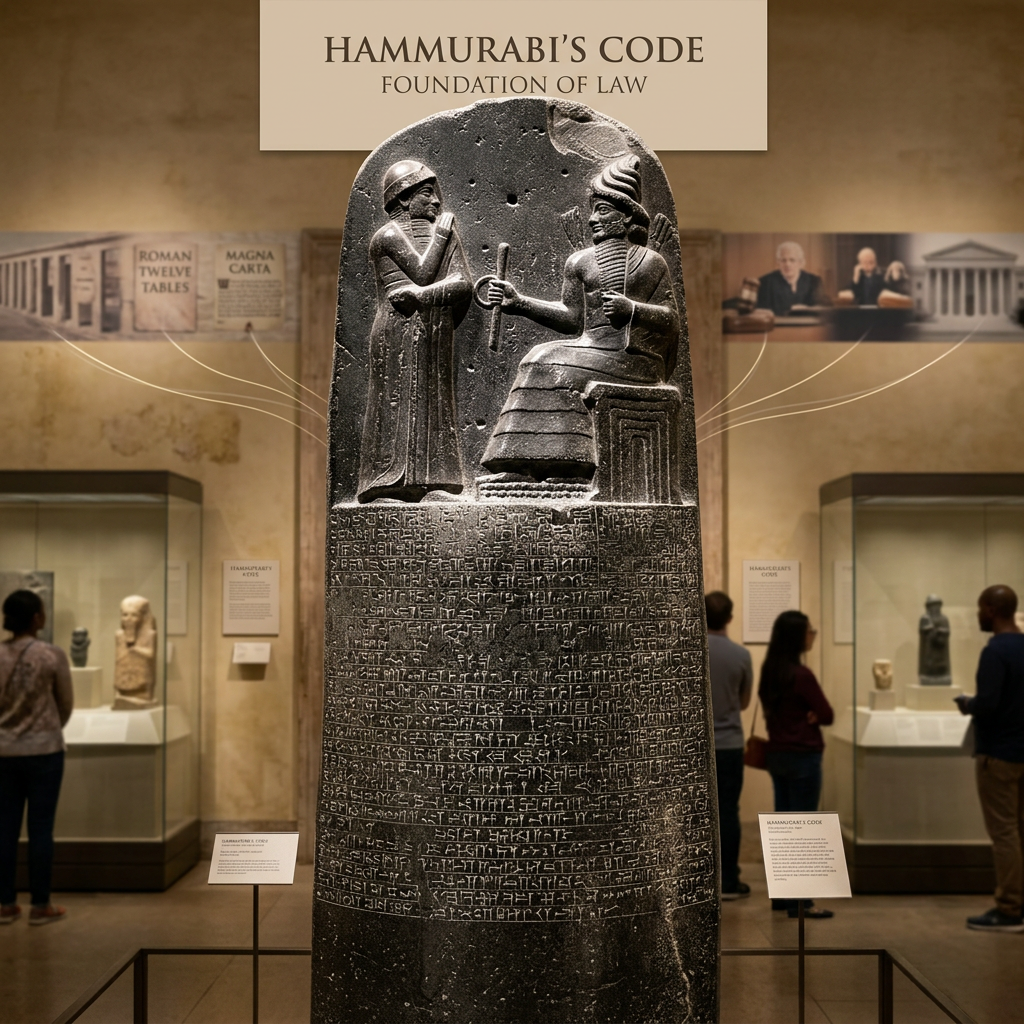
At the center of the monument is an imposing image of Hammurabi standing before the Mesopotamian sun god and deity of justice, Shamash. The scene makes the purpose of the monument clear: the king presents himself not merely as a ruler, but as the guardian of justice.
More than 3,700 years later, Hammurabi’s Code remains one of the most famous symbols of ancient law and the remarkable civilization that flourished in Babylon.
Who Was Hammurabi?
Hammurabi was the sixth king of the First Dynasty of Babylon. He ruled approximately from 1792 to 1750 BCE, although dates for the ancient Near East can vary depending on the chronology used.
When Hammurabi came to power, Babylon was one of several competing kingdoms in Mesopotamia. During his reign, however, Babylon expanded dramatically. Through a combination of military campaigns, alliances and political strategy, Hammurabi brought much of southern and central Mesopotamia under Babylonian control.
His achievements extended beyond warfare.
Hammurabi was also responsible for major building projects, irrigation works and administrative reforms. His reign transformed Babylon into a major political power and established the foundations for what historians often call the Old Babylonian Empire.
The Code of Hammurabi should therefore be understood within this wider context. It was produced during a period when Babylon was becoming increasingly powerful and required systems for governing a diverse and expanding population.

What Is the Code of Hammurabi?
The Code of Hammurabi is a collection of approximately 282 legal provisions inscribed in cuneiform on a large black stone monument, commonly known as a stele.
The text is written in Akkadian, the language widely used for administration in Babylon at the time.
Rather than functioning like a modern legal code, the provisions generally take the form of conditional statements. A typical law essentially follows the pattern: if a particular situation occurs, then a specific legal consequence follows.
These laws address a remarkably broad range of everyday situations.
They deal with:
- Theft and property
- Agriculture and irrigation
- Debt and commerce
- Marriage and divorce
- Inheritance
- Adoption
- Slavery
- Wages and employment
- Construction
- Personal injury
- Criminal offenses
- Responsibilities of officials and professionals
The surviving monument is therefore an invaluable source for understanding Babylonian society and Mesopotamian law.
The Famous Principle of “An Eye for an Eye”
The Code of Hammurabi is perhaps best known for the principle often summarized as “an eye for an eye.”
This idea is associated with a form of proportional punishment in which the penalty corresponds to the injury committed. However, the actual Babylonian legal system was considerably more complicated than this famous phrase suggests.
Punishments could differ depending on the social status of the people involved.
Ancient Babylonian society was highly stratified. The laws recognized different categories of people, and penalties could vary between members of the elite, free people of lower status and enslaved people.
This is one of the most important aspects of Hammurabi’s laws for modern readers. The Code does not describe a society based on modern concepts of equality before the law. Instead, it reflects the social hierarchy of ancient Babylon.
The famous principle of proportional punishment therefore needs to be understood within its historical context.

Justice in Ancient Babylon
The prologue of the Code of Hammurabi presents the king as a divinely appointed ruler whose responsibility was to establish justice.
Hammurabi declares that he was chosen by the gods to ensure that the strong would not oppress the weak.
This message is extremely important.
The monument was not simply designed to tell ordinary Babylonians what they could and could not do. It also communicated an image of kingship. Hammurabi wanted to be remembered as a ruler who maintained order, protected his people and established justice throughout his kingdom.
At the top of the stele, Hammurabi is shown receiving authority from Shamash, the god associated with justice and the sun.
The image reinforces the idea that Babylonian law was connected to divine authority.
For an ancient Mesopotamian king, maintaining justice was not merely an administrative responsibility. It was part of the cosmic and religious order.
What Did Hammurabi’s Laws Cover?
One reason the Code of Hammurabi remains so fascinating is its extraordinary variety.
Some laws concern agriculture and irrigation. Mesopotamian civilization depended heavily on controlled water systems, and negligence could have serious consequences for neighboring farmers.
Other laws deal with trade and debt. Merchants, loans, payments and commercial agreements were important parts of Babylonian economic life.
The Code also addresses marriage and family relationships. It contains provisions concerning divorce, inheritance, adoption and the responsibilities of husbands and wives.
There are even laws dealing with professional responsibilities.
Builders, for example, could face severe consequences if a poorly constructed building collapsed and caused death. Physicians could also face penalties when a medical procedure resulted in serious harm.
These provisions demonstrate that Hammurabi’s government was concerned with regulating not only major crimes but also the practical problems of everyday life.

The Stele of Hammurabi
The most famous surviving copy of the Code is a large diorite stele standing more than two meters tall.
The monument was discovered in Susa, in present-day Iran, in 1901 by a French archaeological expedition. It had been transported there in antiquity, probably as booty from Babylonian territory.
Today, the famous stele is preserved at the Louvre Museum in Paris.
Its physical design is as important as its written content.
At the top, Hammurabi stands before Shamash. Beneath the relief is a long inscription containing the laws.
The monument is therefore simultaneously a work of art, a royal proclamation, a religious statement and a historical document.
Its survival gives modern historians an unusually detailed window into the institutions and social structures of ancient Mesopotamia.
Was Hammurabi’s Code the First Law Code?
Despite often being called the world’s first written law code, Hammurabi’s Code was not actually the earliest known collection of Mesopotamian laws.
Earlier legal collections existed.
One important example is the Code of Ur-Nammu, created centuries before Hammurabi in the city of Ur. Other collections, including the laws associated with Lipit-Ishtar, also predate Hammurabi.
What makes Hammurabi’s Code particularly famous is its size, preservation, historical importance and monumental presentation.
The Code is therefore better described as one of the oldest and most important surviving written legal collections rather than simply the first law code in human history.
This distinction is important when discussing ancient legal history accurately.

Hammurabi’s Code and Everyday Life
For historians, the real value of Hammurabi’s laws lies in what they reveal about ordinary life.
The Code provides evidence of a society in which agriculture, property ownership, family structures and commerce were central to economic and social organization.
It also shows how deeply social status influenced legal relationships.
The laws mention farmers, merchants, craftsmen, landowners, tenants, slaves, soldiers, physicians and builders. Together, these references reveal a complex society with a wide range of professions and responsibilities.
The Code also demonstrates the importance of written agreements and formal procedures.
In a world without modern courts, police forces or centralized bureaucracies as we know them today, written documentation could provide evidence in disputes.
The existence of such detailed laws suggests that Babylonian society possessed sophisticated administrative institutions capable of recording transactions, managing property and resolving conflicts.
Cuneiform and the Birth of Written Law
The Code of Hammurabi was written in cuneiform, one of the world’s earliest writing systems.
Cuneiform developed in Mesopotamia several centuries before Hammurabi and was originally used primarily for administrative and economic purposes. Over time, it became a versatile writing system capable of recording literature, religion, diplomacy and law.
The Code demonstrates how writing had evolved into an instrument of government.
By placing laws in written form, Hammurabi created a durable expression of royal authority.
The monument also illustrates an important transformation in human history: societies were increasingly able to preserve complex information outside the human memory.
Contracts, accounts, laws and royal proclamations could now survive beyond the individual who created them.
The Legacy of Hammurabi’s Code
The influence of Hammurabi’s Code is difficult to overstate.
Modern legal systems are not direct descendants of Hammurabi’s laws, and it would be misleading to suggest that today’s laws simply evolved from this ancient Babylonian text.
Its importance is instead historical and intellectual.
The Code provides evidence that ancient civilizations had developed sophisticated concepts of legal responsibility, contracts, property, professional duties and proportional punishment thousands of years ago.
It also challenges the assumption that organized legal systems are a relatively recent development.
More than three millennia before modern constitutional states, Babylonian administrators were already dealing with questions that remain familiar today: Who owns property? What happens when a contract is broken? Who is responsible when a building collapses? How should inheritance be divided? What constitutes a fair punishment?
The answers were very different from those of the modern world, but the questions themselves reveal something fundamental about human society.

Where Is Hammurabi’s Code Today?
The most famous surviving stele of the Code of Hammurabi is displayed at the Louvre Museum in Paris.
For visitors interested in ancient history, the monument is one of the most important surviving artifacts of Mesopotamian civilization.
Seeing the stele in person provides a powerful sense of its scale. It is not simply a text preserved in a book. It was deliberately created as a monumental object, designed to communicate the authority of a king and the importance of justice.
Its journey from ancient Babylon to Susa and eventually to Paris is also part of its fascinating history.
Frequently Asked Questions About Hammurabi’s Code
When was Hammurabi’s Code written?
The Code was created during the reign of King Hammurabi of Babylon, around 1754 BCE, although the precise dating can vary depending on the chronology used.
Where was Hammurabi’s Code found?
The famous stele was discovered at Susa, in present-day Iran, in 1901. It had apparently been transported there from Babylon in antiquity.
Where is the Code of Hammurabi today?
The famous stele is preserved and displayed at the Louvre Museum in Paris, France.
How many laws are in Hammurabi’s Code?
The surviving collection contains approximately 282 legal provisions, although some sections of the inscription are damaged.
Why is Hammurabi’s Code important?
It provides exceptional evidence about ancient Babylonian law, social hierarchy, commerce, family life, property, agriculture and concepts of justice.
Was Hammurabi’s Code the first law code?
No. Earlier Mesopotamian law collections are known, including the Code of Ur-Nammu. Hammurabi’s Code is nevertheless one of the best-known and most extensively preserved ancient legal collections.
Conclusion
The Code of Hammurabi is far more than an ancient list of punishments carved into stone.
It is a portrait of Babylonian civilization at a pivotal moment in Mesopotamian history. Through its laws, religious imagery and royal proclamation, the monument reveals how ancient Babylonians understood justice, authority, property, family and social responsibility.
Hammurabi wanted his name to endure as the ruler who established justice. More than 3,700 years later, his monument still stands as one of the world’s most recognizable symbols of ancient law.
The empire that Hammurabi built disappeared. Babylon itself became a ruin. Languages changed and generations passed.
But the words carved into stone survived.
And in those words, we can still hear the voice of one of Mesopotamia’s most powerful kings—and glimpse the complex society he ruled.
Fortisetliber’s View
Hammurabi’s Code is not only a monument to ancient law. It is a monument to humanity’s eternal struggle to define justice.
Almost four thousand years ago, in the heart of Babylon, King Hammurabi ordered laws to be carved into stone. They governed property, trade, family, work, punishment and responsibility. Yet behind these rules was something more profound: the belief that a kingdom could not survive without order.
Hammurabi presented himself before the god Shamash, the divine source of justice. The message was unmistakable—the king was not merely exercising power; he was claiming a responsibility to protect order and restrain injustice.
Of course, Babylonian justice was not equal by modern standards. Social status mattered, punishments could be severe, and the world described by the Code was one of hierarchy and power.
But perhaps that is precisely why the monument still matters.
Fortis et Liber sees in Hammurabi’s Code a timeless question: What makes justice just?
Civilizations change. Kings disappear. Cities fall. Languages become forgotten. Yet humanity continues to wrestle with the same fundamental questions—what we owe one another, how power should be controlled, and where justice should stand between the strong and the weak.
The stone remains.
And so does the question.
Leave a Reply