
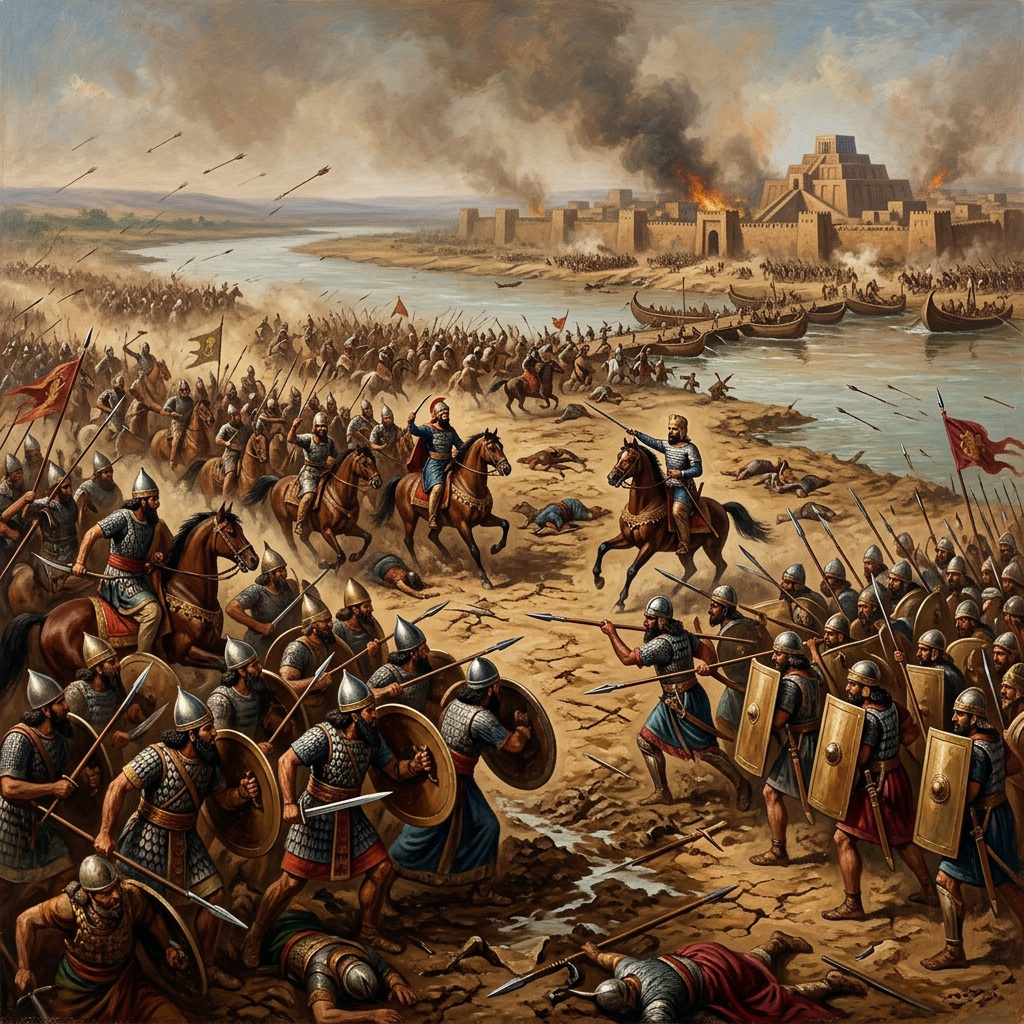
In 539 BC, Cyrus the Great defeated the Babylonian army at Opis—and the ancient world changed forever.
In the autumn of 539 BC, two great powers met beside the Tigris River.
On one side stood the army of Cyrus the Great, ruler of the expanding Persian Empire. On the other was the army of Nabonidus, the last king of the Neo-Babylonian Empire.
The place was Opis, an ancient city on the Tigris, northeast of Babylon.
The battle itself is poorly described by the surviving sources. We do not know every movement of the armies, the exact size of the forces, or the precise tactics used on the battlefield. Yet its consequences are much clearer.
The Babylonians were defeated.
Soon afterward, Sippar fell, and Babylon itself was taken with little or no fighting according to the Babylonian Chronicle. Within weeks, the independent Babylonian kingdom had become part of the empire of Cyrus the Great.
The Battle of Opis was therefore more than another battle in the wars of the ancient Near East.
It was the doorway through which the Persian Empire entered Mesopotamia.
The World Before Opis
By the middle of the 6th century BC, the political map of the ancient Near East was changing rapidly.
The Neo-Babylonian Empire, established by Nabopolassar and expanded dramatically under his son Nebuchadnezzar II, had become one of the most powerful states of the region. Its capital, Babylon, was a monumental city whose temples, palaces, walls, and religious traditions made it one of the great centers of the ancient world.
But by 539 BC, Babylon faced a new threat.
From the east came Cyrus II of Persia, better known as Cyrus the Great.
Cyrus had already created one of the most remarkable empires of the ancient world. He had defeated the Median king Astyages, expanded Persian authority across much of the Iranian plateau, and conquered the Lydian kingdom in Anatolia.
Now his attention turned toward Babylonia.
For Cyrus, the conquest of Babylon would represent another enormous expansion of Persian power.
For Nabonidus, it was a struggle for survival.

Nabonidus: The Last King of Babylon
Nabonidus was an unusual figure in Babylonian history.
He became king in 556 BC and developed a particular interest in the ancient moon god Sîn, whose cult he promoted at Harran and elsewhere. His religious policies and long absence from Babylon have been the subject of considerable historical discussion.
During the final years of his reign, Nabonidus spent significant time at Tayma, in northern Arabia, while his son Belshazzar played an important role in the administration of Babylonia.
When Cyrus began his final campaign against Babylon in 539 BC, Nabonidus returned to confront the Persian advance.
The Babylonian Chronicle provides the most important contemporary account of the campaign.
It records that the Persian army moved through the Diyala region before reaching the area around Opis. There, the armies of Persia and Babylonia met.
The result was devastating for Babylon.

The Battle of Opis
The exact details of the Battle of Opis remain uncertain.
The Babylonian Chronicle does not provide a long narrative describing formations, commanders, cavalry movements, or the number of casualties. What it does record is decisive: the Persian army defeated the Babylonian forces at Opis.
Later historical accounts provide additional traditions about Cyrus’s conquest, but they do not allow us to reconstruct the battle with complete confidence.
What is clear is that Opis broke Babylonian military resistance in the region.
Encyclopaedia Iranica describes the Persian victory as a severe defeat for the Babylonians, with substantial Babylonian losses and booty taken by Cyrus’s forces.
The battle therefore had consequences far beyond the battlefield.
Once the Babylonian army had been defeated, the road toward the heart of the empire was open.

Why Was Opis So Important?
Geography explains much of Opis’s importance.
The city stood on the Tigris River, in a strategic position connected with routes into central Babylonia. Control of the region gave the Persians access to the river system and to the territories surrounding Babylon.
After the defeat at Opis, the Persian army continued its advance.
The next major objective was Sippar, an important Babylonian city located north of Babylon.
According to the Babylonian Chronicle, Sippar fell shortly after the battle. Nabonidus fled, and the Persian advance continued toward Babylon.
The sequence was remarkably rapid:
Opis fell.
Sippar fell.
Babylon followed.
The Neo-Babylonian Empire effectively collapsed within a matter of weeks.

The Fall of Babylon
Babylon was one of the most heavily fortified cities of the ancient world.
Its massive walls and impressive defenses had given the city a reputation for strength. Yet when Cyrus approached, Babylon did not experience the kind of prolonged siege that might have been expected.
The Nabonidus Chronicle states that the Persian forces entered Babylon without a major battle and that Nabonidus was captured.
This is one of the most remarkable aspects of the Persian conquest.
The city that represented the power of the Babylonian Empire changed rulers with surprisingly little destruction.
The Cyrus Cylinder, produced after the conquest, presents Cyrus as a legitimate ruler favored by the Babylonian god Marduk. It describes his entry into Babylon as peaceful and emphasizes his restoration of temples and religious cults.
However, the Cyrus Cylinder should be read as a royal inscription rather than a neutral historical account. It was produced in a Babylonian religious and political context and presents Cyrus’s conquest in a strongly legitimizing framework.
This distinction matters.
Ancient rulers did not write history in the modern sense.
They wrote about their victories in ways that justified their rule.
Cyrus the Great and the Babylonian Conquest
The victory at Opis helped establish Cyrus the Great as the ruler of one of the most extensive empires the ancient world had yet seen.
The conquest of Babylonia brought enormous economic, political, and cultural resources under Persian control.
But Cyrus did not simply destroy the institutions of Babylon.
Instead, he presented himself as a legitimate successor to the Babylonian kings.
The Cyrus Cylinder portrays Marduk as choosing Cyrus and granting him authority over Babylon. It also describes the restoration of temples and the return of displaced religious images to their sanctuaries.
This policy helped Cyrus integrate Babylon into the expanding Achaemenid Empire.
Rather than treating conquest as the end of Babylonian civilization, the Persians incorporated Babylon into a larger imperial system.
The city remained an important center for centuries.

The Battle That Changed Mesopotamia
The significance of the Battle of Opis becomes clearer when viewed from a wider perspective.
Before Opis, Babylon was an independent imperial power.
After Opis, its independence was effectively finished.
The victory opened the way for Cyrus to take control of Babylonia, and the Persian Empire inherited one of the oldest and richest civilizations of the ancient Near East.
Mesopotamian traditions did not disappear.
Cuneiform writing continued.
Babylonian temples remained active.
Local administrative practices continued.
And Babylon itself remained an important city under Persian rule.
In this sense, the Persian conquest was not simply the destruction of one civilization by another.
It was also an example of imperial transformation.
The Persian Empire absorbed Babylonian institutions while placing them under a new political authority.
What Do We Actually Know About Opis?
One of the fascinating aspects of ancient history is the difference between what we know and what we imagine.
The Nabonidus Chronicle is our key source for the final campaign. It explicitly records the Babylonian defeat at Opis, the capture of Sippar, and the subsequent occupation of Babylon.
But it does not give us a complete battlefield narrative.
That means many popular descriptions of the Battle of Opis—precise troop numbers, elaborate tactical maneuvers, or detailed battlefield scenes—should be treated cautiously unless supported by evidence.
What can be established with confidence is enough to make the battle historically extraordinary.
Cyrus defeated the Babylonian army at Opis in 539 BC.
That defeat was followed by the fall of Sippar and the capture of Babylon.
Within a short period, the Neo-Babylonian Empire had become part of the Persian world.
Sometimes the most important battles are the ones for which we have the fewest dramatic details.

The Legacy of Opis
The fall of Babylon changed the political history of the ancient Near East.
Under Cyrus and his successors, the Achaemenid Persian Empire expanded across an enormous territory. Babylon became one of its major administrative and cultural centers, while Persian rulers inherited and adapted many of the traditions of Mesopotamian kingship.
Cyrus’s conquest also became part of a larger historical tradition surrounding the rise of the Persian Empire.
Later generations remembered Cyrus as a remarkable conqueror and founder, while Babylon remained one of the great cities of antiquity.
But between those two famous names—Cyrus and Babylon—stands Opis.
A battle beside the Tigris.
A defeated army.
And an empire beginning to change hands.
Conclusion: The Road to Babylon
The Battle of Opis is sometimes overshadowed by the more famous fall of Babylon.
Yet the sequence of events tells a different story.
Babylon did not simply fall in isolation.
Its fate had already been decided on the battlefield.
At Opis, the army of Cyrus the Great broke the military resistance of Nabonidus. Sippar followed. Then Babylon itself passed into Persian hands.
The battle marked the end of the Neo-Babylonian Empire as an independent power and the beginning of a new chapter under the Achaemenids.
The soldiers who fought at Opis could not have known how far the consequences of their battle would reach.
They were fighting for kings.
But history remembers the battle as something larger.
At Opis, the old order of Mesopotamia met the rising power of Persia—and the ancient world changed forever.
Fortisetliber’s View
At Fortis et Liber, we look beyond the famous names and monuments of history to the moments when civilizations changed direction. Opis was one of those moments: a battle whose details remain partly hidden, but whose consequences reshaped the ancient Near East.
Empires are often remembered by their capitals. History, however, is sometimes decided on the battlefield before the gates are ever reached.
Leave a Reply