
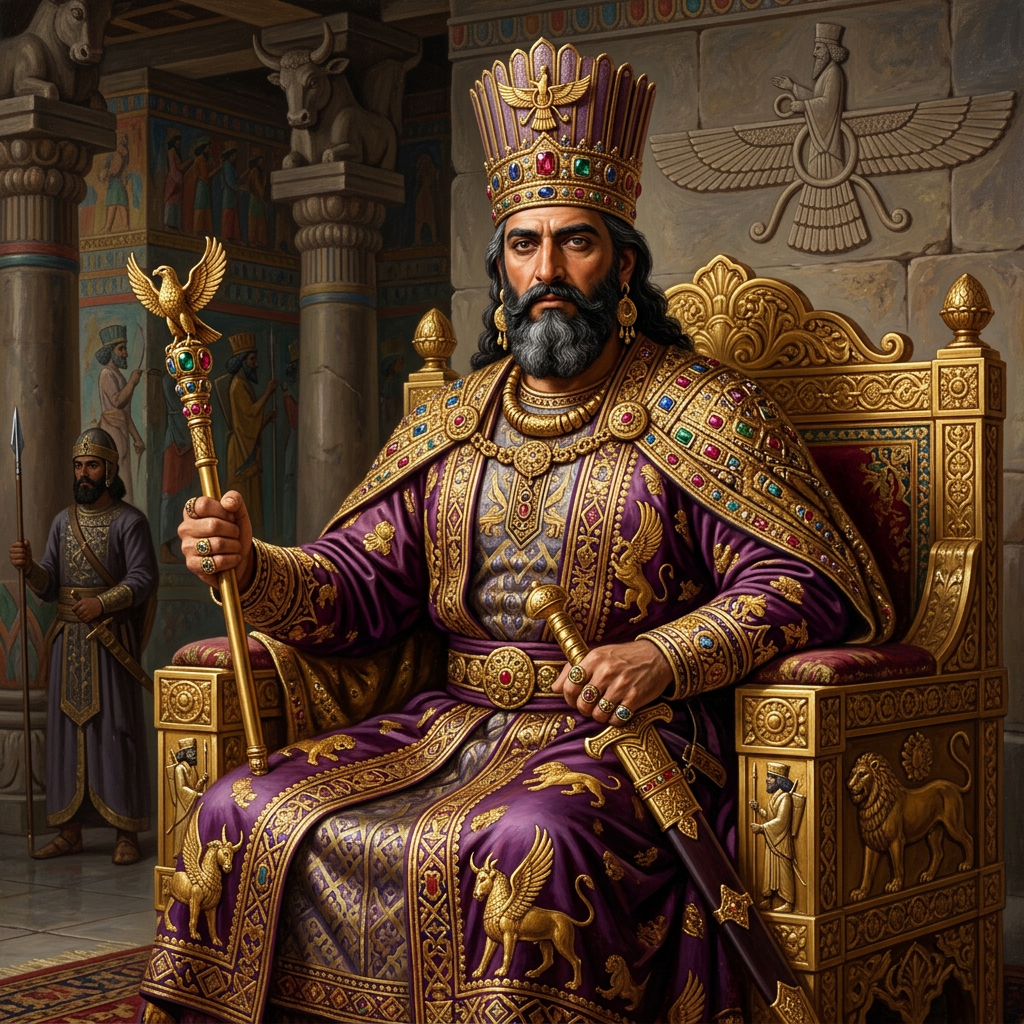
Introduction: The King Who Faced History’s Greatest Conqueror
Few rulers have been remembered through the victories of their enemies as much as Darius III, the final king of the Achaemenid Empire.
To many, he is simply the monarch defeated by Alexander the Great.
Yet this image tells only part of the story.
When Darius III ascended the Persian throne in 336 BCE, he inherited the largest empire on Earth. Stretching from the Mediterranean coast to the Indus Valley and from Egypt to Central Asia, the Achaemenid Empire governed millions of people representing dozens of cultures, languages, and religions.
For more than two centuries, Persian kings had ruled an empire unlike any the ancient world had ever seen.
But by the time Darius became king, internal conspiracies, regional unrest, and the sudden rise of a young Macedonian commander threatened everything his ancestors had built.
That commander was Alexander III of Macedon.
Their struggle would decide not only the fate of Persia but also the future of the ancient world.
The Achaemenid Empire at Its Peak
Before understanding Darius III, it is essential to appreciate the empire he inherited.
Founded by Cyrus the Great in the 6th century BCE, the Achaemenid Empire revolutionized imperial government.
Persian rulers developed an efficient administrative system based on provinces known as satrapies, connected by the famous Royal Road.
The empire encouraged commerce, respected local traditions, and permitted remarkable religious tolerance for its time.
Under kings such as Darius I and Xerxes I, Persia became the dominant superpower of the ancient Near East.
However, after decades of palace intrigue and succession disputes, imperial stability gradually weakened.
By the fourth century BCE, the empire remained immensely wealthy but politically fragile.
It was into this uncertain world that Darius III emerged.
Who Was Darius III?
Originally known as Artashata, Darius belonged to a distant branch of the royal Achaemenid family.
Unlike several earlier Persian kings, he was not initially expected to inherit the throne.
Ancient sources describe him as courageous, physically impressive, and experienced in military affairs.
He reportedly distinguished himself before becoming king through acts of personal bravery, earning recognition within the Persian court.
Following the assassination of Artaxerxes III and the brief reign of Arses, political instability engulfed the empire.
The influential court official Bagoas elevated Artashata to the throne, believing he would be easy to control.
Instead, the new king quickly asserted his independence.
He adopted the royal name Darius III and reportedly eliminated Bagoas after uncovering another assassination plot.
His reign had begun with determination—but far greater challenges were already approaching.

A King Facing Multiple Crises
From the beginning, Darius III confronted problems on several fronts.
The empire’s enormous size made administration increasingly difficult.
Regional governors possessed considerable autonomy.
Some provinces showed signs of unrest, while others struggled with external threats.
Most importantly, events unfolding across the Aegean Sea demanded immediate attention.
In Macedonia, the assassination of Philip II had brought his twenty-year-old son Alexander to the throne.
Many Persian officials believed the young king would face rebellion at home.
Instead, Alexander secured Greece, strengthened his army, and prepared to invade Asia.
In 334 BCE, Macedonian forces crossed the Hellespont, beginning one of history’s most extraordinary military campaigns.
The Macedonian Invasion Begins
Alexander’s invasion initially appeared to be another Greek expedition against Persian territory.
Few imagined it would destroy the empire.
The first major engagement occurred at the Battle of the Granicus River, where Macedonian forces defeated Persian satraps defending Asia Minor.
Although Darius III was not personally present at Granicus, the defeat had enormous consequences.
It opened western Asia Minor to Macedonian conquest and demonstrated Alexander’s willingness to take extraordinary battlefield risks.
As city after city accepted Macedonian control, Darius recognized that the conflict could no longer be left to regional governors.
The Great King would have to lead his empire personally.
Preparing for the Clash of Empires
Determined to stop Alexander’s advance, Darius assembled one of the largest armies of the ancient world.
From every corner of the empire came soldiers representing its remarkable diversity:
- Persian Immortals
- Elite royal cavalry
- Greek mercenaries
- Bactrian horsemen
- Egyptian troops
- Babylonian infantry
- Armenian contingents
- Archers from across the empire
- Noble cavalry units
The sheer size of the Persian army reflected the vast resources available to the Great King.
Meanwhile, Alexander commanded a much smaller but highly disciplined force built around the famous Macedonian phalanx, elite Companion Cavalry, and experienced officers who had campaigned together for years.
Two of the greatest armies of antiquity were now moving toward their first direct confrontation.
History would remember it as the Battle of Issus.

The Battle of Issus: The First Meeting of Two Kings
In 333 BCE, the armies of Darius III and Alexander the Great finally met near the coastal plains of Issus in southern Anatolia.
Although Darius commanded a much larger force, the battlefield itself favored the Macedonians. The narrow terrain limited the Persian army’s numerical advantage and prevented its cavalry from fully exploiting the open maneuvering space that larger plains would have provided.
Alexander recognized the opportunity immediately.
Leading the elite Companion Cavalry, he launched a decisive attack against the Persian center, driving directly toward Darius himself.
As fighting intensified around the royal chariot, confusion spread throughout the Persian ranks.
Ancient sources describe Darius abandoning the battlefield after his position became untenable. Whether viewed as a tactical withdrawal or an act of desperation, his departure shattered morale among many Persian units and transformed the battle into a Macedonian victory.
One of the most significant consequences of Issus was the capture of the Persian royal family, including Darius’ mother, wife, and daughters.
Alexander treated them with remarkable respect, preserving their royal status and demonstrating that his war was directed against the Persian king rather than his family.
Rebuilding an Empire at War
Despite the defeat at Issus, Darius III refused to surrender.
Instead, he returned east and began assembling another army.
The Achaemenid Empire still possessed immense financial resources, loyal provinces, and vast reserves of manpower.
While Alexander campaigned through Phoenicia, Egypt, and the eastern Mediterranean, Darius prepared for a final confrontation.
He selected a battlefield that would maximize Persia’s strengths.
The plains near Gaugamela, close to modern Mosul in Iraq, offered ideal terrain for cavalry and war chariots.
Unlike Issus, there would be no narrow passes to favor the Macedonian army.
Here, Darius intended to defeat Alexander once and for all.
The Battle of Gaugamela
The Battle of Gaugamela (331 BCE) became one of the most decisive military engagements in world history.
Darius carefully prepared the battlefield, reportedly ordering the ground leveled to improve the effectiveness of his cavalry and scythed chariots.
His army represented the extraordinary diversity of the Persian Empire, bringing together soldiers from nearly every province.
Alexander once again relied on discipline rather than numbers.
Using flexible formations, coordinated cavalry attacks, and the strength of the Macedonian phalanx, he searched for weaknesses in the Persian line.
When an opening appeared near the Persian center, Alexander personally led a charge toward Darius.
Faced with the immediate danger of capture or death, Darius withdrew from the battlefield.
The Persian army gradually disintegrated, leaving Alexander with a victory that effectively ended organized Achaemenid resistance.
Although isolated fighting continued, Gaugamela sealed the fate of the Persian Empire.

The Fall of Persepolis
Following Gaugamela, the great ceremonial capitals of the Achaemenid Empire lay open before Alexander.
Among them stood Persepolis, the magnificent royal city founded by Darius I and enriched by generations of Persian kings.
Its monumental palaces, reliefs, and vast treasury symbolized the wealth and authority of the Achaemenid dynasty.
Alexander entered Persepolis in triumph.
Soon afterward, parts of the palace complex were consumed by fire.
Ancient writers offer differing explanations.
Some claim the destruction was a deliberate act of revenge for the Persian invasion of Greece more than a century earlier.
Others argue it resulted from a drunken celebration that spiraled beyond control.
Whatever the cause, the burning of Persepolis became one of antiquity’s most enduring symbols—the visible end of the Persian imperial age.
The Final Flight of Darius III
Even after Gaugamela, Darius did not abandon hope.
He retreated eastward through Media and into the Iranian plateau, seeking to gather loyal satraps and rebuild resistance.
However, the empire was collapsing around him.
Many governors recognized Alexander as the inevitable victor.
Others began pursuing their own ambitions.
Among them was the satrap Bessus, who commanded eastern forces.
As Alexander continued the pursuit, Bessus and several conspirators arrested Darius, hoping to preserve their own authority by controlling the king.
When Macedonian forces approached, the conspirators abandoned their prisoner.
Before fleeing, they fatally wounded the last Great King of Persia.
According to ancient tradition, Alexander discovered the dying Darius shortly afterward.
Whether every detail recorded by classical historians is exact remains uncertain, but many accounts describe Alexander honoring his fallen rival with royal respect and arranging for his body to receive a proper Persian burial.
Thus ended the reign of the final king of the Achaemenid Empire.
The Legacy of Darius III
History has often judged Darius III through the lens of Alexander’s extraordinary achievements.
Yet such a comparison can overshadow the immense challenges he inherited.
Darius ruled an empire already weakened by court intrigue, succession crises, and administrative instability.
He faced an opponent whose military innovation, leadership, and strategic vision changed the course of history.
Rather than viewing Darius solely as the defeated king of Persia, modern historians increasingly recognize him as the final guardian of one of antiquity’s greatest empires.
His determination to continue resisting after repeated defeats reflected not weakness, but resilience.
His reign marked the end of the Achaemenid Empire, yet Persian administrative traditions, culture, and political ideas continued to influence later empires for centuries, including the Seleucid and Parthian kingdoms.

Conclusion
The story of Darius III (336–330 BCE) is not merely the story of defeat.
It is the story of a king who inherited the world’s largest empire at a moment of profound uncertainty and faced one of history’s greatest military commanders.
Although unable to halt Alexander’s advance, Darius fought to preserve a civilization that had shaped the ancient Near East for more than two centuries.
His courage during crisis, his determination to rebuild after defeat, and his tragic end transformed him into one of history’s most compelling rulers.
The fall of Darius did not simply mark the death of a king—it marked the conclusion of the Achaemenid Empire, one of humanity’s greatest imperial achievements.
As Alexander opened the door to a new Hellenistic world, Darius III closed the final chapter of ancient Persia’s first great empire, ensuring that his legacy would forever remain intertwined with one of history’s greatest turning points.
Fortisetliber’s View
History often celebrates the conquerors while quietly overlooking those who stood in their path. Few rulers illustrate this better than Darius III, the last king of the Achaemenid Empire.
For generations, Darius has been remembered primarily as the monarch defeated by Alexander the Great. Yet reducing his legacy to military defeat ignores the immense responsibility he carried. He inherited an empire that had ruled the ancient Near East for more than two centuries—an empire already weakened by internal rivalries, political instability, and the growing ambitions of a rising Macedonian kingdom.
Facing Alexander meant confronting one of history’s greatest military commanders at the height of his brilliance. Despite suffering defeats at Issus and Gaugamela, Darius refused to surrender easily. He rebuilt armies, sought support from loyal satraps, and continued resisting even as the foundations of his empire crumbled around him.
From the perspective of FortisLiber, Darius III should not be remembered merely as the king who lost Persia, but as the final guardian of one of antiquity’s greatest civilizations. His struggle represents the difficult reality faced by many rulers throughout history: defending inherited institutions during periods of overwhelming change.
The fall of Darius marked far more than the end of a dynasty. It closed the chapter of the Achaemenid Empire, a state that pioneered efficient administration, respected cultural diversity across vast territories, and shaped imperial governance for centuries to come. While Alexander’s victories opened the Hellenistic Age, they also brought to an end one of the ancient world’s most remarkable political achievements.
The story of Darius III reminds us that history is not written only by those who triumph. It is also preserved through those who fought with determination against impossible odds, leaving behind a legacy measured not by victory alone, but by resilience, dignity, and unwavering duty.
Leave a Reply