
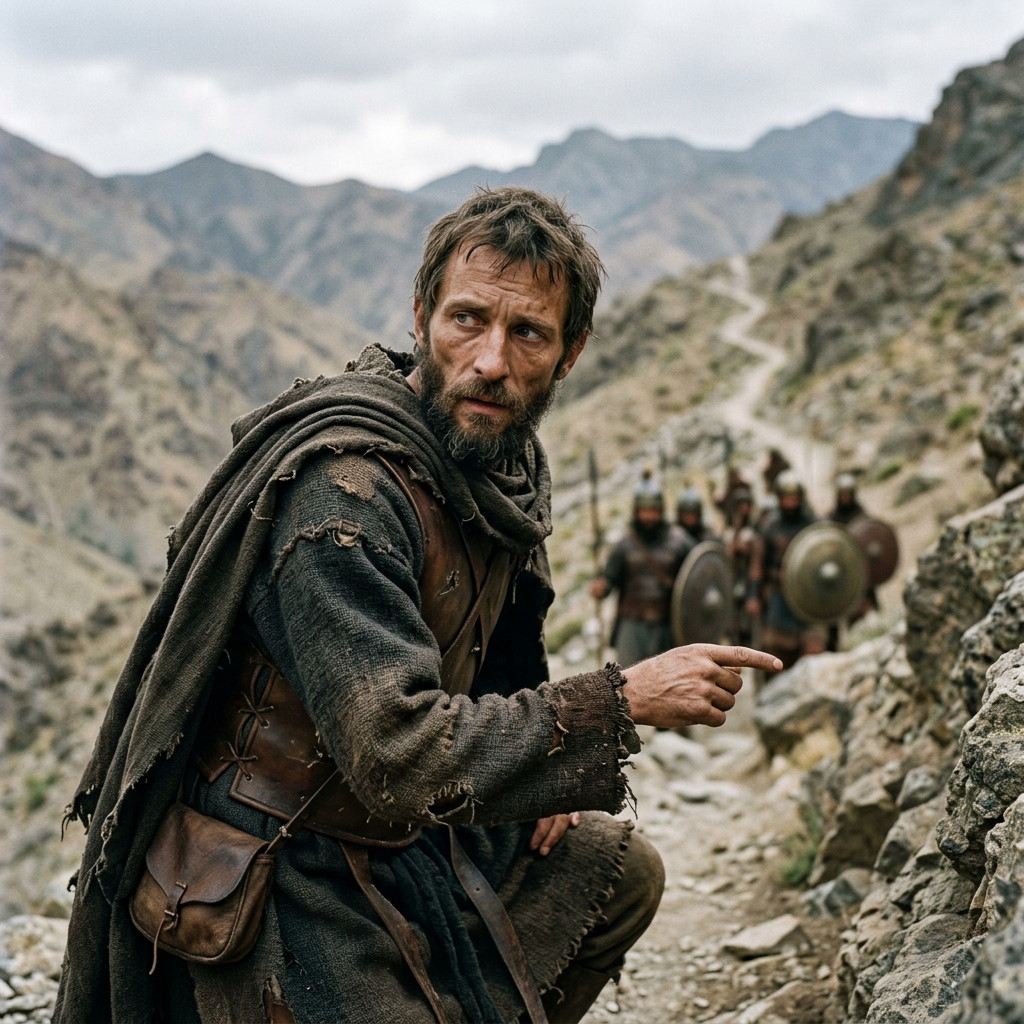
Few names in ancient Greek history are remembered with such lasting bitterness as Ephialtes of Thermopylae. More than 2,500 years after the Persian invasion of Greece, his name remains closely associated with betrayal, secrecy, and the dramatic fall of the Greek defenders at the Battle of Thermopylae in 480 BCE.
Ephialtes was a local Greek from the region of Trachis who revealed to the Persian army of King Xerxes I a mountain path that allowed Persian troops to outflank the Greek forces commanded by King Leonidas of Sparta. His information transformed the strategic situation at Thermopylae and contributed directly to the destruction of the Greek force that remained in the pass.
But who was Ephialtes? Why did he betray the Greeks? What exactly did he tell the Persians? And what happened to him afterward?
The story, preserved most famously by the historian Herodotus, is one of the most dramatic episodes of the Greco-Persian Wars.
Who Was Ephialtes of Thermopylae?
Ephialtes, whom Herodotus identifies as the son of Eurydemus, was a local man from the region around Trachis. Herodotus describes him as a Malian, meaning that he belonged to the local population of Malis in central Greece.
Unlike Leonidas, the Spartan king who became famous for leading the Greek defenders at Thermopylae, Ephialtes was not a great military commander or political leader. His importance came from his knowledge of the local terrain.
The mountains surrounding Thermopylae contained paths that were known to local inhabitants. One of these routes, called Anopaea, passed over the mountains and could be used to bypass the main Greek defensive position.
This geographical knowledge became decisive during the Persian invasion.
Today, the name Ephialtes the traitor is often used when discussing the Battle of Thermopylae because his actions provided the Persian army with the opportunity to attack the Greeks from behind.

The Battle of Thermopylae
To understand Ephialtes’ role, it is necessary to understand the strategic importance of Thermopylae.
In 480 BCE, Xerxes I launched a massive invasion of Greece. His objective was to defeat the Greek states that resisted Persian expansion and extend Persian power into mainland Greece.
The Greeks attempted to slow the Persian advance by defending strategically important positions. One of the most famous was the narrow coastal pass of Thermopylae.
The Greek force was commanded by Leonidas I of Sparta and included Spartans as well as soldiers from several other Greek communities. Thermopylae was valuable because its narrow terrain reduced the Persian numerical advantage.
For two days, the Greek defenders managed to resist the Persian attacks.
The narrow battlefield prevented the enormous Persian army from simply overwhelming the defenders with its numbers. Greek hoplites, protected by heavy armor and fighting in organized formations, were able to make effective use of the restricted terrain.
The Persian army, however, had not yet found a way to surround the Greek position.
That changed because of Ephialtes.

Ephialtes and the Secret Mountain Path
According to Herodotus, Ephialtes approached Xerxes because he expected to receive a substantial reward.
He told the Persian king about a path over the mountains leading around the Greek defensive position. Herodotus identifies this route as Anopaea.
The importance of this information was enormous.
The Greek strategy depended heavily on the narrowness of Thermopylae. As long as the Greeks could prevent the Persians from getting behind their lines, the terrain favored the defenders.
The mountain path offered the Persians another option.
Xerxes ordered Hydarnes, a Persian commander, to take troops along the route during the night. The soldiers crossed the Asopus River and followed the mountain path toward the rear of the Greek position.
A Phocian contingent had been stationed in the mountains to guard the route. However, when the Phocians discovered the approaching Persians, they were surprised and withdrew to higher ground.
The Persian troops therefore continued down the mountain.
The Greek position at Thermopylae was now in danger of being surrounded.
Why Did Ephialtes Betray the Greeks?
One of the most fascinating questions surrounding Ephialtes of Thermopylae is his motivation.
Herodotus gives a relatively straightforward explanation: Ephialtes expected a reward from Xerxes.
This is important because many later retellings portray Ephialtes as a purely ideological enemy of Greece. The surviving ancient evidence, however, does not establish such a simple explanation.
Herodotus presents Ephialtes as a man seeking personal gain.
There was also another ancient version of the story. Herodotus mentions claims that two other men, Onetes of Carystus and Corydallus of Anticyra, had revealed the route to the Persians. However, Herodotus explicitly rejects this alternative and argues that Ephialtes was the responsible guide.
This distinction matters.
The image of Ephialtes the traitor comes primarily from the historical tradition that identifies him as the man who personally revealed and guided the Persians along the route.

The Fall of the Greek Position
Once the Persians had passed over the mountain, the strategic situation became almost impossible for the defenders.
Leonidas learned that the Greek position was being outflanked.
According to the traditional account, Leonidas ordered much of the Greek force to withdraw while a smaller group remained behind. The remaining defenders included the famous 300 Spartans, as well as other Greek troops.
The final defense became one of the most famous episodes of the Battle of Thermopylae.
Leonidas and his remaining soldiers fought knowing that the Persian army was approaching from both sides.
Thermopylae was eventually captured by the Persians, and Leonidas was killed along with the troops who remained with him.
The betrayal by Ephialtes therefore did not single-handedly “defeat” the Greeks. The Persian invasion was a much larger military and political conflict involving enormous forces, multiple Greek states, naval warfare, and complicated strategic decisions.
Nevertheless, the information provided by Ephialtes was crucial because it allowed the Persians to bypass the main defensive advantage of Thermopylae.
What Happened to Ephialtes?
The story of Ephialtes did not end with the Persian victory at Thermopylae.
Herodotus states that Ephialtes fled to Thessaly, fearing retaliation from the Lacedaemonians, or Spartans. While he was away, a price was placed on his head by the Pylagori, representatives associated with the Amphictyonic organization around the sanctuary of Delphi and Thermopylae.
Eventually, Ephialtes returned from exile to Anticyra.
There he was killed by a man named Athenades, a Trachinian.
Interestingly, Herodotus explains that Athenades did not kill Ephialtes specifically because of the betrayal at Thermopylae. Instead, Athenades killed him for another reason, which Herodotus says he would explain elsewhere.
Nevertheless, the Lacedaemonians honored Athenades after the killing.
Thus, the man remembered as the traitor of Thermopylae ultimately met a violent death at the hands of another Greek.

Was Ephialtes Really a “Traitor”?
Calling Ephialtes a Greek traitor is deeply rooted in the historical tradition, but it is useful to understand what that label means.
Ancient Greece was not a unified nation-state in the modern sense. It consisted of numerous independent city-states and regions with different political interests.
During the Persian invasion, however, many Greek communities cooperated against the Persian army. The defense of Thermopylae became part of this wider resistance.
From the perspective of the Greek coalition defending the pass, Ephialtes’ decision to help Xerxes was therefore an act that directly assisted the invading army.
Herodotus himself uses exceptionally clear language when identifying Ephialtes as responsible for guiding the Persians around the Greek position.
At the same time, historians must distinguish between the ancient source and later popular storytelling.
Modern films, novels, video games, and historical fiction have often expanded Ephialtes’ character far beyond what the ancient evidence actually tells us.
The historical Ephialtes remains a comparatively mysterious figure.
We know considerably more about his action than about his personality.
Ephialtes in the Story of Leonidas
The contrast between Ephialtes and Leonidas has helped make both men enduring historical figures.
Leonidas represents the defenders of Thermopylae, while Ephialtes represents the man who revealed the weakness in their position.
The two figures therefore occupy opposite sides of the traditional story.
Yet their historical importance is connected.
Without the mountain path revealed by Ephialtes, the Persian army would have faced a much more difficult tactical problem. Without Leonidas and the Greek defenders, Thermopylae would not have become one of the most famous battles of the ancient world.
The story is consequently not simply about one man betraying another.
It is about geography, military strategy, local knowledge, political loyalties, and the enormous Persian-Greek conflict of the fifth century BCE.

The Legacy of Ephialtes
More than two millennia later, Ephialtes of Thermopylae remains one of the most recognizable names associated with betrayal in ancient history.
His name has even acquired a broader symbolic meaning. In modern Greek usage, the name “Ephialtes” can evoke the idea of a traitor, largely because of the enduring memory of the Thermopylae episode.
Yet his historical legacy is more complicated than a simple villain’s story.
The surviving account comes overwhelmingly through ancient writers, above all Herodotus. His Histories preserves the central narrative: Ephialtes approached Xerxes, revealed the mountain route, and guided the Persians toward the rear of the Greek forces. Herodotus also records an alternative tradition but rejects it in favor of Ephialtes’ responsibility.
That makes Ephialtes an excellent example of how history is remembered.
The battlefield at Thermopylae has become a symbol of resistance and sacrifice, while the man who revealed the path around it became a symbol of betrayal.
Conclusion: Ephialtes, Thermopylae, and the Persian Invasion
Ephialtes of Thermopylae occupies a unique place in the history of ancient Greece.
He was not a king, a general, or a famous statesman. He was a local man whose knowledge of a mountain route had enormous consequences during the Persian invasion of Greece in 480 BCE.
By revealing the Anopaea path to Xerxes’ forces, Ephialtes helped the Persians outflank the Greek defenders at Thermopylae. The maneuver contributed directly to the collapse of the Greek defensive position and the death of Leonidas and the troops who remained with him.
Herodotus later recorded that Ephialtes fled, was placed under a price, and was eventually killed at Anticyra.
His story has survived because Thermopylae itself became far more than an ancient battle. It became a powerful historical symbol of courage, sacrifice, military strategy, and resistance.
And standing on the opposite side of that legend is Ephialtes—the man whose knowledge of a hidden mountain path changed the course of the battle.
For anyone interested in Ancient Greece, the Battle of Thermopylae, Leonidas, Xerxes, the Persian Wars, and Greek military history, the story of Ephialtes offers an extraordinary reminder of how one individual’s decision can become part of history for thousands of years.
Fortisetliber’s View
In the long history of ancient Greece, few names became as closely associated with betrayal as Ephialtes of Trachis.
In 480 BC, the Persian king Xerxes invaded Greece with a vast army. At Thermopylae, a relatively small Greek force under the Spartan king Leonidas attempted to block the Persian advance. The narrow mountain pass gave the defenders an important strategic advantage.
For two days, the Greeks resisted.
Then Ephialtes appeared.
A local Greek who knew the surrounding mountains, Ephialtes revealed to the Persians the existence of the Anopaea mountain path, a route that allowed Persian troops to move around the Greek position. According to Herodotus, Ephialtes hoped to receive a reward from Xerxes for his information.
During the night, Persian troops followed the path and approached the Greek forces from the rear.
Leonidas soon realized that Thermopylae could no longer be held.
Most of the Greek defenders withdrew. Leonidas and those who remained stayed behind to fight, knowing that they were surrounded. Their final stand became one of the most famous episodes in military history.
Ephialtes escaped after the battle, but his story did not end there. A price was eventually placed on his head, and he was later killed at Anticyra by a man named Athenades.
His name survived.
But not as the name of a hero.
Ephialtes became a symbol of betrayal.
Thermopylae is remembered for Leonidas and the men who chose to stand and fight. Ephialtes is remembered for the path he revealed.
The contrast is enduring: one man became a symbol of sacrifice; the other, a symbol of betrayal.
And perhaps that is why the story of Ephialtes still matters today. History does not remember only those who stood on the battlefield. It also remembers the choices made before the battle was decided.
At Thermopylae, a single path changed everything.
And a single man showed the enemy the way.
Fortis et Liber — Strong and Free.
Leave a Reply