
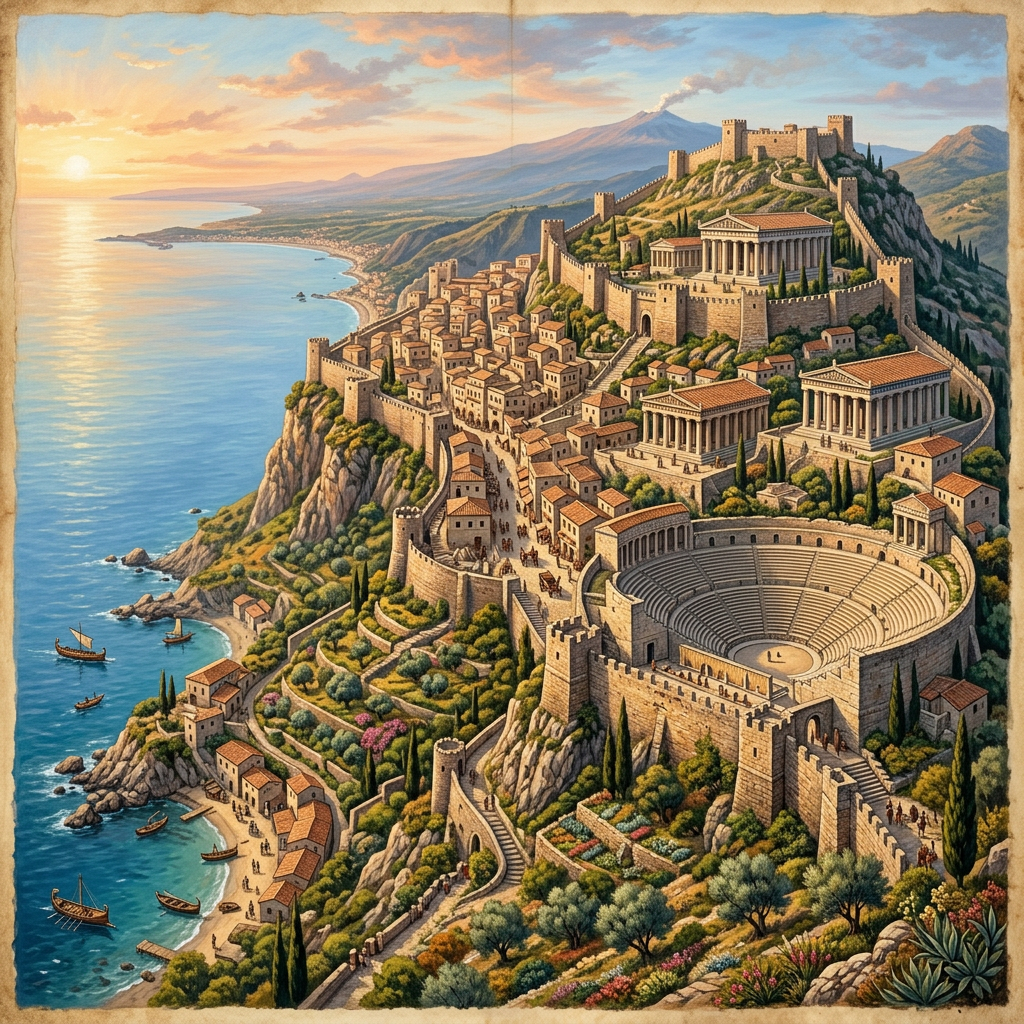
Introduction: Discovering Ancient Tauromenion
Perched on a hillside above the Ionian Sea, modern Taormina is one of Sicily’s most celebrated historic towns. Beneath its picturesque streets and panoramic terraces lies a much older story: that of Tauromenion, the ancient Greek city that developed into the Roman settlement known as Tauromenium.
The history of ancient Taormina reflects the wider history of Sicily, an island shaped by indigenous communities, Greek colonization, rival Mediterranean powers, and Roman expansion. Its strategic position above the coast made it valuable for defense and communication, while its architecture and religious traditions connected it to the cultural world of the ancient Greeks.
Today, the Ancient Theatre of Taormina is the city’s most famous surviving monument. Yet the theatre represents only one part of a much broader archaeological landscape that includes religious buildings, Roman domestic architecture, baths, and traces of successive urban transformations.
To understand Tauromenion is to discover how geography, politics, and cultural exchange shaped one of the most remarkable ancient cities in eastern Sicily.
1. The Origins of Tauromenion: Before the Greeks
The story of Tauromenion begins before the establishment of a Greek city. Eastern Sicily was inhabited by the Sicels, an indigenous population whose communities occupied the island before and during the period of Greek colonization.
The surrounding coastline became an important destination for Greek settlers during the eighth century BC. Nearby Naxos, generally regarded as the earliest Greek colony in Sicily, was established on the coast near present-day Giardini Naxos. Its proximity would later prove significant for the development of Tauromenion.
The origins of Tauromenion are described differently in ancient historical traditions. Accounts associated with Diodorus Siculus connect the settlement’s early history with events around 396 BC, when the Syracusan ruler Dionysius I was expanding his power across eastern Sicily. The later establishment of a Greek community under Andromachus, conventionally dated to 358 BC, is an important stage in the city’s development.
According to this tradition, Andromachus gathered exiles and descendants of the inhabitants of Naxos and established them at Tauromenion. The settlement therefore emerged from a complicated mixture of indigenous Sicilian history, Greek migration, and regional political conflict.
This background makes ancient Taormina particularly interesting. It was not simply an isolated Greek colony, but a community whose identity developed through contact between different peoples and political traditions.

2. Why Tauromenion Was Built on Mount Taurus
One of the most important factors in the success of ancient Tauromenion was its geographical position.
The city occupied elevated ground above the coastal plain, offering commanding views over the Ionian Sea and the surrounding countryside. The slopes and rocky terrain provided natural defensive advantages, while access to the coast connected the settlement with maritime routes and nearby communities.
From its elevated position, Tauromenion could maintain links with Naxos, the Strait of Messina, and other settlements along Sicily’s eastern coast. These connections mattered for trade, travel, and military operations.
The name Tauromenion is associated with Mount Taurus, the hill on which the ancient settlement developed. Its elevated setting helped define the character of the city throughout antiquity.
However, the landscape presented challenges as well as advantages. Building on steep terrain required careful planning, terraces, retaining structures, and routes adapted to the hillside. The city’s architecture consequently developed in close relationship with the natural environment.
This combination of defensible terrain and access to coastal networks helps explain why the site remained important through successive periods of Greek and Roman rule.
3. Tauromenion and the Political Struggles of Greek Sicily
Ancient Sicily was a region of competing interests. Greek cities, indigenous communities, Carthaginian forces, and powerful rulers frequently struggled for territory and influence.
Tauromenion developed within this turbulent political environment. Its relationship with Syracuse, one of the most powerful Greek cities in the western Mediterranean, was particularly important.
Dionysius I of Syracuse sought to consolidate his control over eastern Sicily during the late fifth and early fourth centuries BC. The history of Tauromenion’s foundation and early development is closely connected with these conflicts, although the precise sequence of events remains debated in the historical sources.
The city’s elevated position made it a valuable strategic location. Control of the settlement could strengthen a ruler’s influence over neighboring communities and coastal routes.
The arrival of Andromachus and the Naxian exiles around 358 BC marks a significant point in the traditional account of the city’s Greek development. Later ancient tradition associates Andromachus with comparatively moderate leadership, in contrast to the tyrannical governments that dominated parts of Sicily.
Tauromenion subsequently experienced changing political relationships as regional powers competed for control. Its history illustrates a central feature of ancient Sicily: cities could preserve distinctive local identities while repeatedly adapting to new military and political realities.

4. The Ancient Theatre of Taormina
The most recognizable monument of ancient Tauromenion is the Ancient Theatre of Taormina, often called the Greek Theatre of Taormina.
Built into the hillside, the theatre combines monumental architecture with a dramatic natural setting. From its seating area, visitors can look toward the Ionian Sea, the coastline of eastern Sicily, and Mount Etna.
The monument’s earliest architectural phase dates to the Hellenistic period, generally the third or second century BC. However, the surviving structure reflects extensive Roman reconstruction, particularly during the second century AD.
This distinction is essential for understanding the monument. Although the theatre originated in the Greek period, much of what visitors see today belongs to its later Roman transformation.
The Romans adapted the building to accommodate changing forms of public entertainment and architectural display. These alterations demonstrate how Roman cities frequently preserved earlier Greek structures while reshaping them according to Roman tastes and requirements.
The theatre’s auditorium measures approximately 109 metres in diameter, making it one of the largest ancient theatres in Sicily. Its scale reveals the importance of public performance and civic architecture in the history of Tauromenion.
The surviving remains also provide evidence of construction techniques, changing architectural forms, and the relationship between buildings and their natural surroundings.
Today, the Ancient Theatre of Taormina remains an extraordinary monument because it preserves both the physical evidence of ancient construction and the broader cultural history of Greek and Roman Sicily.
5. Religion, Temples, and Sacred Spaces
Religion played an important role in the public life of ancient Tauromenion. Like other Greek cities, it developed sacred spaces in which religious ceremonies, offerings, and communal activities could take place.
Archaeological research has identified evidence of Hellenistic religious architecture in the vicinity of the ancient civic centre. These discoveries help reconstruct the city’s sacred landscape, even though many original buildings have not survived intact.
One important aspect of the archaeological evidence is the relationship between temples and later public buildings. Research on the area near the church of Santa Caterina has examined a Hellenistic sacred complex that underwent substantial changes during the Roman Imperial period.
Around the early second century AD, an odeon was constructed against the southern side of an earlier temple. This transformation altered the organization and function of the surrounding space.
Such changes reveal how Roman urban development could reshape places that already possessed religious significance. Rather than replacing every earlier structure, Roman builders sometimes incorporated existing architecture into new arrangements.
The archaeological record therefore shows that the religious history of Tauromenion was not static. Sacred spaces evolved alongside political institutions, public entertainment, and changing cultural practices.

6. Tauromenion Under Roman Rule
Rome’s expansion into Sicily transformed the political landscape of the island. After the First Punic War, which ended in 241 BC, Rome established control over much of Sicily, although the status and internal arrangements of individual cities varied.
Tauromenion eventually entered the Roman political system while retaining aspects of its established urban identity. Its later history included its transformation into a Roman colony under Augustus, following the conflicts associated with the end of the Roman Republic.
The Augustan period brought significant changes to many Sicilian cities. Roman colonies could receive new settlers, administrative arrangements, and building projects that altered the composition and appearance of urban communities.
At Tauromenion, the Roman period is particularly visible in the transformation of monumental architecture. The Ancient Theatre was extensively reconstructed, while other buildings and urban spaces reflected Roman practices of public life.
The city’s strategic position remained valuable, connecting it to the wider Mediterranean world. Its location above the coast provided a distinctive setting for settlement and communication, while its architectural monuments expressed the status and cultural ambitions of the community.
Roman Taormina should therefore not be understood simply as a Greek city that disappeared after conquest. Instead, it represents a continuing process of adaptation in which Greek traditions, Roman institutions, and local practices interacted over centuries.
7. Everyday Life in Ancient Taormina
Monumental theatres and temples provide only part of the picture of ancient Tauromenion. Archaeological evidence from domestic buildings helps reveal how people lived within the city.
Excavations at Villa San Pancrazio have uncovered remains of Roman residential architecture, including a house organized around a peristyle, or colonnaded courtyard. The excavated complex contained numerous rooms arranged around this central space.
A peristyle house was more than a private residence. Its layout could provide areas for receiving guests, conducting household activities, and displaying wealth and social standing.
The discovery of multiple residential structures and streets also contributes to the reconstruction of the ancient urban landscape. Such remains demonstrate that Roman Tauromenion included ordinary residential districts as well as major public monuments.
Everyday life would have depended on household resources, work, trade, family relationships, and participation in religious and civic activities. The experiences of residents varied according to wealth, legal status, occupation, and gender.
Although the surviving evidence cannot reconstruct every aspect of daily life, residential archaeology adds an essential human dimension to the city’s history. It helps move the story beyond famous monuments and toward the communities that inhabited them.

8. Archaeological Remains of Ancient Tauromenion Today
Modern Taormina preserves several important traces of its ancient past. The Ancient Theatre remains the principal attraction, but other archaeological sites provide a broader view of the city’s development.
The Odeon of Taormina offers evidence of Roman public architecture and the transformation of earlier urban spaces. The Roman baths and remains of domestic buildings reveal aspects of infrastructure and private life, while surviving walls and architectural fragments help reconstruct the city’s layout.
These monuments belong to different periods, and their remains vary in completeness. Some structures have been substantially altered by later construction, while others survive mainly through foundations, architectural fragments, or archaeological interpretation.
The surrounding landscape is equally important. The relationship between the ancient city, its hillside position, and the nearby coast explains much of Tauromenion’s historical significance.
For anyone interested in ancient Greek cities in Sicily, Taormina provides an especially valuable opportunity to examine how an urban community developed from the Hellenistic period into the Roman Empire.
Its archaeological remains are not simply isolated ruins. Together, they document the changing priorities of a city that adapted to new political authorities while retaining the advantages of its remarkable location.
Conclusion: The Enduring Legacy of Tauromenion
Tauromenion, the ancient predecessor of modern Taormina, occupies an important place in the history of Greek and Roman Sicily.
Its origins reflect the interaction of indigenous Sicilian communities, Greek settlers, and regional political struggles. Its elevated position shaped its defensive advantages and urban development, while its monumental architecture reveals the cultural changes that accompanied Roman rule.
The Ancient Theatre of Taormina remains the most powerful symbol of this history. Its Greek origins and extensive Roman reconstruction demonstrate how successive civilizations reshaped existing urban spaces rather than simply erasing the past.
Yet the story of Tauromenion extends beyond its theatre. Sacred complexes, residential buildings, and other archaeological remains reveal a city whose religious practices, domestic life, and public institutions evolved over many centuries.
For modern visitors and students of ancient history, Taormina offers an opportunity to explore the complex heritage of the Mediterranean. Its enduring appeal lies not only in its spectacular views but also in the historical layers preserved within its streets, monuments, and surrounding landscape.
Ancient Tauromenion remains a remarkable example of how geography, cultural exchange, and political change shaped the cities of the ancient world.

Frequently Asked Questions About Ancient Tauromenion
What was Tauromenion?
Tauromenion was the ancient Greek name of the city associated with modern Taormina in eastern Sicily. Under Roman rule, its name was commonly Latinized as Tauromenium.
When was Tauromenion founded?
The city’s origins are complex. Ancient traditions connect its early development with events around 396 BC, while the establishment of a Greek community under Andromachus is conventionally dated to 358 BC.
Was Taormina a Greek or Roman city?
It was both at different stages of its history. Tauromenion developed as a Greek city and later became part of the Roman world. Its surviving architecture reflects both Greek origins and Roman modifications.
Is the Ancient Theatre of Taormina Greek or Roman?
The theatre originated during the Hellenistic period, but much of the surviving structure reflects extensive Roman reconstruction, particularly in the second century AD.
What can visitors see from ancient Tauromenion today?
Visitors can explore the Ancient Theatre, the Odeon, Roman architectural remains, and archaeological sites associated with the city’s domestic and religious life.
Fortisetliber’s View
High above the Ionian Sea, ancient Tauromenion reminds us that history is rarely the story of a single civilization. Modern Taormina, in Sicily, preserves the legacy of a city shaped by Greek settlers, indigenous Sicilian communities, and Roman power.
Its famous ancient theatre is more than a monument overlooking a spectacular landscape. It represents centuries of cultural transformation, from its Hellenistic origins to its extensive reconstruction during the Roman period. The stones reveal how one civilization could inherit the achievements of another and reshape them for a changing world.
Tauromenion also invites us to look beyond emperors, wars, and political victories. Behind its temples and public buildings were ordinary people whose work, beliefs, families, and ambitions gave the city its life.
Perhaps this is the most enduring lesson of ancient Taormina: civilizations do not simply disappear when new powers arrive. Their ideas, buildings, and traditions often survive, transformed by the generations that follow.
At Fortisetliber, we believe that understanding the past means looking beyond the ruins to the human stories they preserve. Tauromenion stands as a reminder that history is not only what remains behind us, but also what we choose to remember.
Leave a Reply