
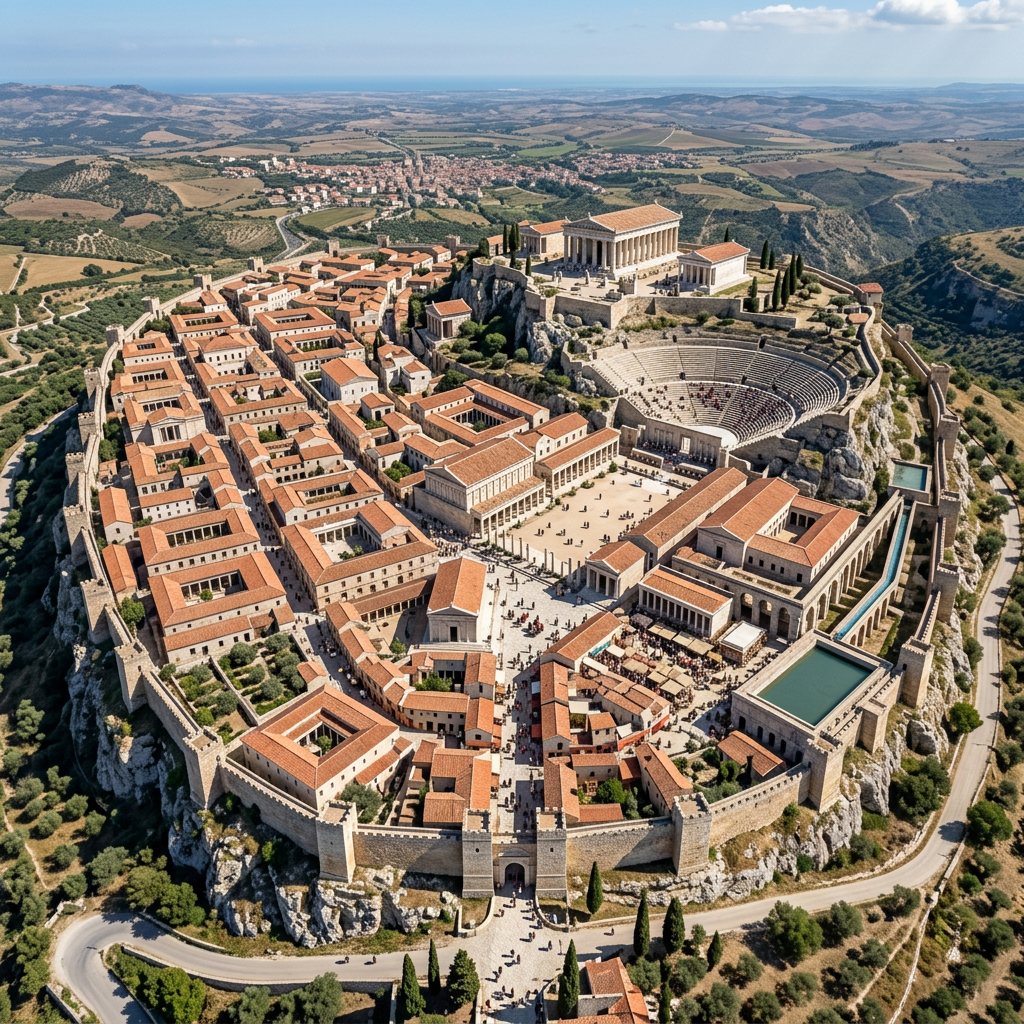
Introduction: A Forgotten City in the Heart of Sicily
Nestled among the limestone hills of southeastern Sicily, the ancient city of Acrae, also known by its Greek name Akrai, stands as one of the island’s most fascinating yet often overlooked archaeological treasures. While famous cities such as Syracuse, Agrigento, and Taormina attract millions of visitors, Acrae quietly preserves centuries of Greek and Roman history within its remarkably peaceful landscape.
Founded as a Greek colony before flourishing under Roman rule, Ancient Acrae became an important regional center that connected the fertile interior of Sicily with the prosperous coastal cities. Over the centuries, the settlement developed into a thriving community distinguished by impressive public buildings, religious sanctuaries, theaters, and sophisticated urban planning.
Today, the Acrae Archaeological Park offers visitors a unique opportunity to explore a city where Greek traditions and Roman administration blended to create a vibrant provincial community.
The story of Acrae reflects the broader history of Sicily itself—a land shaped by diverse cultures, strategic importance, and remarkable resilience.
The Greek Foundation of Acrae
The history of Ancient Acrae begins in 664 BCE, when the powerful Greek city of Syracuse established the settlement as one of its earliest inland colonies.
The objective was both practical and strategic.
By founding Acrae, Syracuse strengthened its control over central Sicily while protecting vital agricultural territories and trade routes.
Its elevated location provided excellent natural defenses while allowing easy communication with surrounding settlements.
From its earliest years, Acrae developed according to Greek urban principles, with organized streets, public spaces, and sanctuaries dedicated to the gods of the Hellenic world.
This strong Greek identity continued to influence the city even after Roman authority expanded across the island.
Acrae Under Roman Rule
Following the Roman conquest of Sicily during the Second Punic War, Acrae entered a new chapter in its history.
Rather than declining, the city benefited from the stability provided by the Roman Republic and later the Roman Empire.
As part of Roman Sicily, Acrae maintained its local traditions while adopting Roman administrative institutions, engineering techniques, and architectural styles.
The city prospered through agriculture, regional commerce, and its position along important inland transportation routes.
Roman governance encouraged economic development while preserving many aspects of the settlement’s earlier Greek character, creating a unique blend of cultures that remains visible in the archaeological record.

A Strategic Position in Ancient Sicily
Geography played a decisive role in Acrae’s success.
Situated on a plateau overlooking southeastern Sicily, the city controlled routes linking the interior with the coast and the great port of Syracuse.
Its strategic location offered several advantages:
- Natural defensive terrain
- Fertile agricultural land
- Reliable water sources
- Easy access to trade routes
- Strong communication with neighboring settlements
These advantages ensured Acrae’s importance for centuries under both Greek and Roman administration.
Life in Ancient Acrae
Daily life in Ancient Acrae reflected the multicultural nature of Sicily.
Its inhabitants included Greek descendants, Roman citizens, merchants, craftsmen, farmers, and officials who together created a prosperous provincial society.
The local economy relied primarily upon:
- Grain cultivation
- Olive production
- Vineyards
- Livestock
- Pottery workshops
- Regional trade
Markets provided opportunities for commerce, while religious festivals and theatrical performances strengthened civic identity.
Roman law and infrastructure brought stability, yet Greek language, customs, and artistic traditions continued to flourish.
Acrae became an excellent example of cultural continuity within the Roman world.
The Ancient Theatre of Acrae
One of the city’s greatest surviving monuments is the Ancient Theatre of Acrae.
Carved directly into the natural rock during the Greek period and later modified under Roman rule, the theater became the cultural heart of the community.
Here citizens gathered to enjoy:
- Greek tragedies
- Roman performances
- Musical competitions
- Public ceremonies
- Civic assemblies
Its location offers magnificent views across the Sicilian countryside, while its excellent preservation allows modern visitors to appreciate both Greek engineering and Roman adaptation.
The theater remains one of the finest examples of a provincial performance venue in Ancient Sicily.

Religious Sanctuaries and Sacred Traditions
Religion occupied a central place in the life of Acrae.
Archaeological discoveries have revealed temples, sacred areas, and ritual spaces dedicated to various Greek deities, many of which continued to be respected during the Roman period.
Among the most remarkable monuments are the mysterious Santoni, enormous rock-cut reliefs believed to be associated with the cult of Cybele, one of the most influential mother goddesses of the ancient Mediterranean.
These unique sculptures distinguish Acrae from many other archaeological sites in Sicily and highlight the city’s rich religious diversity.
Urban Planning and Public Spaces
Like many successful cities of the ancient Mediterranean, Acrae featured carefully organized public spaces.
Its urban landscape included:
- Administrative buildings
- Public squares
- Residential districts
- Streets
- Markets
- Religious sanctuaries
Roman improvements enhanced the existing Greek layout without erasing the city’s original identity.
This harmonious blend of Greek planning and Roman infrastructure became one of Acrae’s defining characteristics.
Roman Architecture and Civic Life
During the Roman period, Acrae continued to flourish as an important provincial community within Roman Sicily. Rather than replacing the city’s Greek identity, Roman authorities expanded and improved its existing infrastructure, creating a harmonious blend of Hellenic tradition and Roman efficiency.
Public buildings served as the center of civic life, while carefully planned streets connected residential districts, markets, and religious sanctuaries.
The city’s public spaces encouraged social interaction, commercial exchange, and political administration. Citizens gathered to discuss local affairs, celebrate festivals, conduct business, and participate in religious ceremonies that reflected both Greek heritage and Roman customs.
Acrae demonstrates how the Roman Empire often strengthened existing urban centers instead of rebuilding them from the ground up.

The Santoni: Sicily’s Unique Rock Reliefs
Among the most extraordinary discoveries at Ancient Acrae are the famous Santoni, monumental rock-cut reliefs carved directly into the limestone cliffs.
These impressive sculptures are believed to represent Cybele, the Great Mother Goddess, accompanied by other divine figures associated with her cult.
Dating primarily to the Hellenistic period but continuing to attract worshippers under Roman rule, the Santoni illustrate the remarkable religious diversity that characterized Sicily.
Unlike traditional temples, these monumental carvings provide rare evidence of an open-air sanctuary where eastern religious traditions blended with Greek and Roman beliefs.
Today, they remain one of the most distinctive archaeological features of the Acrae Archaeological Park.
Acrae During the Late Roman Empire
Like many provincial cities across the empire, Roman Acrae gradually experienced economic and political changes during Late Antiquity.
Several factors contributed to its decline:
- Administrative reforms
- Changing trade routes
- Economic contraction
- Political instability
- The gradual weakening of Roman authority
Although the city continued to be inhabited, its importance slowly diminished as regional power shifted toward larger urban centers.
Despite these challenges, Acrae retained its local character for centuries, demonstrating the resilience of Sicily’s inland communities.
Christianity and the Byzantine Era
As Christianity spread throughout the Roman Empire during the fourth century CE, Acrae underwent significant religious transformation.
Traditional pagan sanctuaries gradually lost prominence while Christian communities established places of worship throughout the region.
Under Byzantine administration, the city continued to serve as a local settlement, although on a much smaller scale than during its Roman peak.
The transition from paganism to Christianity reflected broader cultural changes occurring across the Mediterranean, making Acrae an important example of continuity and adaptation through changing historical eras.

Rediscovery Through Archaeology
Centuries of abandonment preserved many of Acrae’s ancient remains beneath layers of soil and vegetation.
Beginning in the nineteenth century, systematic archaeological investigations gradually revealed the city’s remarkable history.
Excavations uncovered:
- The Ancient Theatre
- Residential foundations
- Public streets
- Sanctuaries
- The Santoni reliefs
- Ancient inscriptions
- Pottery
- Coins
- Everyday household objects
These discoveries have significantly expanded our understanding of life in Ancient Sicily and the relationship between Greek colonies and Roman provincial administration.
Archaeological research continues today, offering new insights into the city’s development and cultural evolution.
Visiting the Acrae Archaeological Park
Today, the Acrae Archaeological Park, located near the modern town of Palazzolo Acreide, offers visitors an authentic experience far removed from crowded tourist destinations.
Walking through the ancient streets, visitors can explore:
- The Greek-Roman theatre
- The Santoni sanctuary
- Public buildings
- Ancient roads
- Residential districts
- Panoramic viewpoints overlooking southeastern Sicily
The peaceful landscape allows visitors to appreciate the strategic importance that first attracted Greek colonists and later Roman administrators.
Acrae remains one of Sicily’s finest archaeological treasures for those seeking to explore beyond the island’s most famous historical sites.
The Legacy of Ancient Acrae
Although Acrae never became one of the largest cities of the Mediterranean, its historical significance is undeniable.
The city represents the successful coexistence of two great civilizations.
Greek colonists established its foundations, while Roman administrators ensured its continued prosperity for centuries.
Its theatre, sacred monuments, and carefully planned urban landscape demonstrate how cultural continuity often proved stronger than political change.
Acrae reminds us that history is not shaped solely by imperial capitals but also by provincial communities where ordinary people preserved traditions, adapted to new rulers, and contributed to the development of Mediterranean civilization.

Conclusion
The story of Ancient Acrae is one of continuity, resilience, and cultural exchange.
Founded as a Greek colony, transformed under Roman Sicily, and preserved through centuries of history, Acrae offers a remarkable window into the evolution of one of the Mediterranean’s most important islands.
Its magnificent theatre, unique Santoni reliefs, sacred sanctuaries, and archaeological remains continue to reveal the rich interaction between Greek innovation and Roman administration.
Today, Ancient Acrae stands as one of Sicily’s hidden historical treasures—a place where the voices of Greek settlers and Roman citizens still echo among the limestone hills, inviting every visitor to rediscover a remarkable chapter of the ancient world.
Fortisetliber’s View
History often celebrates dramatic endings. Empires fall, cities are conquered, and new rulers reshape the world. Yet some of history’s most remarkable places tell a different story—not of destruction, but of continuity. Ancient Acrae is one of those rare cities.
Founded by Greek settlers from Syracuse and later flourishing under Roman rule, Acrae did not abandon its identity when power changed hands. Instead, it evolved. Greek theatres continued to welcome audiences, sacred traditions remained woven into daily life, and Roman administration brought new infrastructure and stability without erasing centuries of local heritage. In Acrae, civilizations did not simply replace one another—they built upon one another.
This quiet transformation reveals one of the Mediterranean’s greatest strengths. The ancient world was not only shaped by conquest but also by adaptation. Across Sicily, cultures met through trade, diplomacy, migration, and shared experience. Acrae became a living example of how different traditions could coexist, enriching a city rather than dividing it.
Perhaps nothing illustrates this better than the city’s remarkable theatre. Carved into the limestone hillside during the Greek period and preserved under Roman administration, it remained a place where generations gathered for performances, celebrations, and civic life. The monument itself became a bridge between cultures, reminding us that architecture can preserve memory long after political borders disappear.
The mysterious Santoni reliefs add another dimension to Acrae’s story. Their survival reflects the remarkable diversity of ancient Sicily, where local beliefs, Greek religion, and Roman influence intersected across centuries. Rather than existing in isolation, these traditions interacted, adapted, and left behind a cultural landscape unlike any other in the Mediterranean.
From the perspective of FortisLiber, Acrae teaches an important lesson. Great civilizations are measured not only by the territories they conquer, but by their ability to preserve knowledge, respect local traditions, and create societies where different cultures can contribute to a shared future. The endurance of Acrae reminds us that lasting civilizations are strengthened through continuity as much as through innovation.
Today, visitors walk among quiet ruins overlooking the Sicilian countryside, where the echoes of Greek settlers and Roman citizens still seem to linger in the stone. There are no imperial palaces or towering monuments proclaiming military triumph. Instead, Acrae offers something more enduring—a story of resilience, cultural dialogue, and the steady passage of civilization from one generation to the next.
Acrae reminds us that history’s greatest achievements are not always born from conquest. Sometimes they emerge when civilizations choose to preserve the best of the past while embracing the opportunities of the future. That quiet balance is the true legacy of this remarkable city—and one that continues to inspire the modern world.
Leave a Reply