
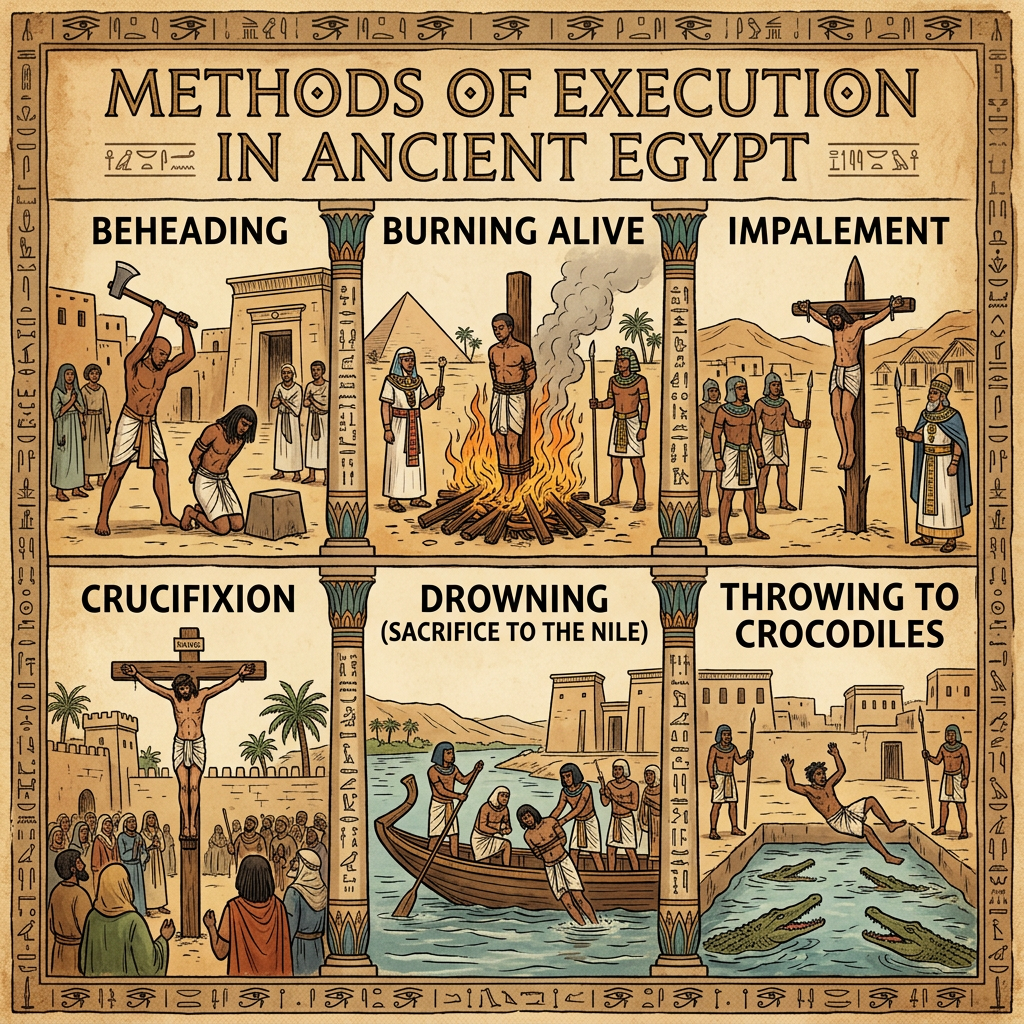
Introduction: Justice and Death in Ancient Egypt
Ancient Egypt is famous for its magnificent pyramids, powerful pharaohs, monumental temples, and extraordinary beliefs about the afterlife. However, behind this remarkable civilization existed a complex system of laws and punishments designed to maintain social order, protect royal authority, and preserve religious traditions. Among its most severe penalties was the death sentence.
The methods of execution in ancient Egypt varied according to the historical period, the nature of the crime, and the circumstances surrounding the accused. Treason, conspiracy against the pharaoh, attacks on sacred places, and certain forms of theft could result in severe punishment, including death. Historical documents reveal that Egyptian authorities sometimes used violent executions to demonstrate the consequences of challenging royal power or violating religious obligations.
Nevertheless, reconstructing ancient Egyptian execution practices requires careful examination of surviving evidence. Unlike some ancient civilizations, Egypt has left no single comprehensive criminal law code that explains every offense and its punishment. Instead, historians rely on inscriptions, administrative documents, legal papyri, archaeological discoveries, and later historical accounts.
This evidence reveals a society in which justice was closely connected to religion, political authority, and the Egyptian concept of ma’at, the principle of truth, balance, justice, and cosmic order.

1. Impalement: One of the Most Notorious Execution Methods
Impalement is among the most widely discussed methods of execution in ancient Egypt. Historical and scholarly studies suggest that Egyptian authorities used this punishment in certain circumstances, particularly when dealing with serious offenses or individuals considered threats to the state.
Impalement involved placing a condemned person on a pointed stake or similar structure. Its precise use, frequency, and application across different periods remain subjects of scholarly investigation. Research examining Egyptian texts from the Middle Kingdom and New Kingdom has argued that impalement formed part of the available repertoire of capital punishment.
One important context for understanding this punishment is the Egyptian state’s treatment of political conspirators. During the New Kingdom, royal authority was central to the stability of the kingdom, and challenges to the throne could provoke exceptionally harsh responses.
The Harem Conspiracy against Ramesses III, which occurred around the early twelfth century BCE, illustrates the severity with which authorities treated plots against the monarchy. The surviving Judicial Papyrus of Turin records investigations and punishments connected to the conspiracy. Some accused individuals received death sentences, although the precise punishment varied and is not securely established for every defendant.
Impalement is therefore an important subject in discussions of ancient Egyptian capital punishment, but it should not be presented as the universal or routine fate of every serious criminal.
2. Burning as a Form of Capital Punishment
Burning is another execution method discussed in historical studies of ancient Egyptian justice. It was associated in some accounts with severe crimes and exceptional punishments, although the evidence does not establish a single, consistent policy governing its use throughout Egyptian history.
To understand burning as a punishment, it is necessary to consider the relationship between the body, death, and the afterlife in ancient Egyptian religion.
Egyptians placed enormous importance on preserving the body after death because funerary traditions connected bodily integrity with the possibility of continued existence in the next world. Mummification, tomb construction, and funerary offerings all reflected this concern.
Consequently, punishments that destroyed or damaged the body could carry implications beyond physical death. However, it would be misleading to assume that every burning sentence was specifically intended to prevent resurrection or that Egyptian authorities always applied this religious reasoning.
Evidence for execution by burning must be evaluated case by case. Scholars continue to examine how written sources describe royal executions, religious offenses, and other forms of sanctioned killing.
Burning remains part of the broader historical discussion of ancient Egyptian execution methods, but its precise frequency and legal circumstances are less straightforward than popular accounts sometimes suggest.

3. Decapitation: Execution by Beheading
Decapitation, or beheading, is another method associated with capital punishment in ancient Egypt.
Egyptian art, military inscriptions, and archaeological evidence document the violent treatment of enemies and prisoners. However, distinguishing battlefield violence from judicial execution is essential. A representation of a defeated enemy does not automatically prove that the same method was regularly used to execute convicted criminals.
During military campaigns, Egyptian forces sometimes killed captured opponents and displayed the results of their victories in monumental reliefs. These images served political and ideological purposes, presenting the pharaoh as a powerful ruler who defeated Egypt’s enemies and restored order.
Judicial executions belonged to a different context. They involved punishment imposed by royal or administrative authority rather than simply the killing of an opponent during warfare.
The surviving evidence supports the broader conclusion that ancient Egyptian authorities could impose death sentences for serious offenses. Nevertheless, the frequency of beheading as a formal judicial execution method is difficult to establish, and claims that it was routinely reserved for a particular social class should be treated cautiously.
Decapitation is best understood within the wider history of state-sanctioned violence in ancient Egypt, where political authority, military power, and criminal justice sometimes overlapped.
4. Strangulation and Other Forms of Execution
Strangulation is also mentioned in historical discussions of execution in ancient Egypt. However, evidence for particular methods can be difficult to interpret because written accounts do not always describe the physical circumstances of a death in sufficient detail.
One of the most important examples of royal punishment comes from the Harem Conspiracy involving Ramesses III.
The conspiracy aimed to overthrow the king and place another claimant on the throne. The plot was investigated after the assassination attempt, and a special judicial process examined the involvement of numerous members of the royal household and administration.
The surviving judicial documents describe different outcomes for those accused. Some defendants were condemned to death, while others were subjected to different penalties. The documents are especially valuable because they demonstrate that ancient Egyptian authorities investigated serious political crimes and formally recorded judicial decisions.
The fate of Pentawere, a son of Ramesses III associated with the conspiracy, is particularly notable. The judicial record indicates that he was permitted to take his own life after being found guilty. His mummy, commonly identified as the so-called Screaming Mummy, has attracted considerable scientific and public interest, although its appearance alone cannot establish the exact circumstances of his death.
This case demonstrates that execution in ancient Egypt was not always carried out in a single, standardized manner. Royal status, the nature of the offense, and the decisions of the authorities could influence the punishment.

5. Ritual Sacrifice and Early Dynastic Egypt
Human sacrifice is another important subject in the history of death and violence in ancient Egypt, although it must be distinguished from ordinary criminal execution.
Archaeological evidence from the First Dynasty, approximately five thousand years ago, suggests that some individuals may have been killed in connection with royal burials. Subsidiary graves discovered near the tombs of early rulers at Abydos have long prompted debate about whether servants and other members of the royal court were sacrificed to accompany their rulers into the afterlife.
Recent research examining ancient skeletal remains has identified traumatic injuries consistent with deliberate violence in some individuals buried near royal tombs. These findings strengthen the argument that human sacrifice may have occurred during the early dynastic period, although the circumstances of every death cannot be established with certainty.
This practice appears to have declined after the earliest dynasties. Later Egyptian funerary traditions increasingly employed shabti figurines, which were intended to perform work on behalf of the deceased in the afterlife.
Human sacrifice should not be confused with the execution of criminals. The former, where it occurred, was associated with royal funerary practices, while capital punishment involved the authorities imposing death as a penalty or form of sanctioned killing.
The distinction is important because ancient Egyptian society changed significantly over thousands of years. Practices documented in the First Dynasty cannot automatically be applied to the Middle Kingdom, New Kingdom, or later periods.

6. Crimes That Could Lead to the Death Penalty
The methods of execution in ancient Egypt cannot be understood without examining the offenses that could provoke the harshest punishments.
Although no comprehensive criminal law code survives from pharaonic Egypt, documentary evidence indicates that serious offenses against the king, state, individuals, and religious institutions could result in severe penalties. These included the death sentence in certain cases.
Treason and Conspiracy Against the Pharaoh
Treason represented a direct challenge to the political order. Since the pharaoh occupied a central position in Egypt’s religious and political system, attempts to overthrow or assassinate the ruler were treated as exceptionally serious offenses.
The Harem Conspiracy against Ramesses III provides one of the clearest surviving examples of the investigation and punishment of a royal conspiracy.
Tomb Robbery and Temple Desecration
Tombs and temples held profound religious significance. Tomb robbery threatened the security of royal and private burials, while the violation of sacred places challenged religious traditions and institutional authority.
An important scholarly study by Harco Willems examines an inscription associated with Ankhtifi at Mo’alla. The inscription describes severe consequences for violations involving a tomb and provides evidence that human sacrifice could be associated with punishment for certain forms of desecration.
Other cases involving theft from temples or royal tombs demonstrate that the seriousness of an offense depended partly on what had been stolen and whom or what the crime had affected.
Murder and Other Serious Offenses
Violence against other people could also bring severe consequences. However, surviving evidence does not allow historians to reconstruct a complete and uniform sentencing system for murder, assault, and every other serious crime.
Punishments could include corporal punishment, financial penalties, forced labor, loss of property, mutilation, or death, depending on the circumstances and historical period.
It is therefore inaccurate to suggest that every major crime automatically resulted in execution.

7. Ancient Egyptian Justice and the Principle of Ma’at
The Egyptian justice system was closely connected to ma’at, the principle of truth, justice, balance, and universal order.
The pharaoh was traditionally understood to have a responsibility to maintain ma’at and protect Egypt against disorder. Courts, officials, scribes, and administrative authorities helped uphold this ideal through investigations, hearings, and the enforcement of decisions.
Legal documents show that Egyptians used written complaints, witness testimony, and documentary evidence in resolving disputes. The precise organization and authority of judicial institutions changed over time, but legal administration was an established feature of Egyptian society.
Punishment was not limited to execution. Lesser offenses could result in repayment, fines, beatings, forced labor, or other penalties. This range of punishments suggests that Egyptian authorities could distinguish between offenses according to their seriousness and consequences.
Capital punishment was therefore one component of a broader system of justice rather than the only means of maintaining order.
At the same time, justice was not separate from royal power. Political offenses could be treated differently from ordinary disputes, and the authority of the king played an important role in cases involving threats to the state.
Frequently Asked Questions (FAQ)
What were the main methods of execution in ancient Egypt?
Historical discussions of ancient Egyptian capital punishment include impalement, burning, decapitation, and other forms of sanctioned killing. The strength of the evidence differs by method and historical period.
What crimes were punishable by death in ancient Egypt?
Certain cases of treason, conspiracy against the pharaoh, and serious violations involving sacred places could result in death. The penalty depended on the circumstances and period.
Did ancient Egyptians execute people by impalement?
Scholarly studies argue that impalement was used in some circumstances. However, its frequency and precise application remain subjects of historical research.
Did the ancient Egyptians practice human sacrifice?
Archaeological evidence suggests that human sacrifice may have occurred in connection with royal burials during the First Dynasty. This practice appears to have declined after the earliest dynasties and was distinct from ordinary criminal punishment.
Why was punishment important in ancient Egypt?
Punishment helped maintain social order, protect property and sacred institutions, and reinforce royal authority. These responsibilities were closely connected to the Egyptian principle of ma’at.

Conclusion: Understanding Execution in Ancient Egypt
The methods of execution in ancient Egypt reveal a complex relationship between law, religion, politics, and social order. Historical evidence points to several forms of sanctioned killing, including impalement and other violent punishments, while particular cases demonstrate that convicted individuals could receive different sentences depending on the circumstances.
The evidence for burning, decapitation, and strangulation must be assessed carefully, since historical accounts vary in their detail and reliability. Archaeological research also suggests that human sacrifice may have accompanied some royal burials during Egypt’s earliest dynasties, a practice distinct from judicial execution.
Equally important is the fact that ancient Egyptian justice included penalties other than death. Financial compensation, corporal punishment, forced labor, and other sanctions formed part of the available responses to wrongdoing.
Ultimately, studying ancient Egyptian capital punishment helps historians understand how the civilization defended royal authority, protected sacred institutions, and sought to preserve ma’at. It also demonstrates why the history of Egyptian law must be examined across different periods rather than treated as one unchanging system.
By combining archaeological discoveries with inscriptions, legal documents, and scholarly research, we gain a more balanced understanding of crime and punishment in one of the world’s most influential ancient civilizations.
Fortisetliber’s View
Ancient Egypt was a civilization of magnificent pyramids, powerful pharaohs, and remarkable religious traditions. Yet behind its monuments lay a strict system of justice in which serious crimes could lead to severe punishments, including death.
From the perspective of Fortis et Liber, exploring the methods of execution in ancient Egypt offers a glimpse into a world where law, religion, and royal authority were closely connected. Historical evidence discusses punishments such as impalement and other forms of sanctioned killing, although the details and frequency of these practices varied across different periods.
Treason, conspiracies against the pharaoh, and certain serious offenses involving sacred places could provoke harsh penalties. The famous Harem Conspiracy against Ramesses III illustrates how fiercely Egyptian authorities defended royal power.
However, ancient Egyptian justice was not based exclusively on execution. Fines, corporal punishment, forced labor, and other penalties also played important roles. The principle of ma’at—truth, justice, balance, and cosmic order—formed a central part of Egyptian ideas about maintaining a stable society.
For Fortis et Liber, the history of ancient Egyptian punishment is more than a study of historical violence. It is an opportunity to examine the relationship between power and justice, fear and authority, and the enduring human search for order.
Discover the darker side of ancient Egyptian history with Fortis et Liber, where forgotten stories reveal the realities behind the legends.
Leave a Reply