
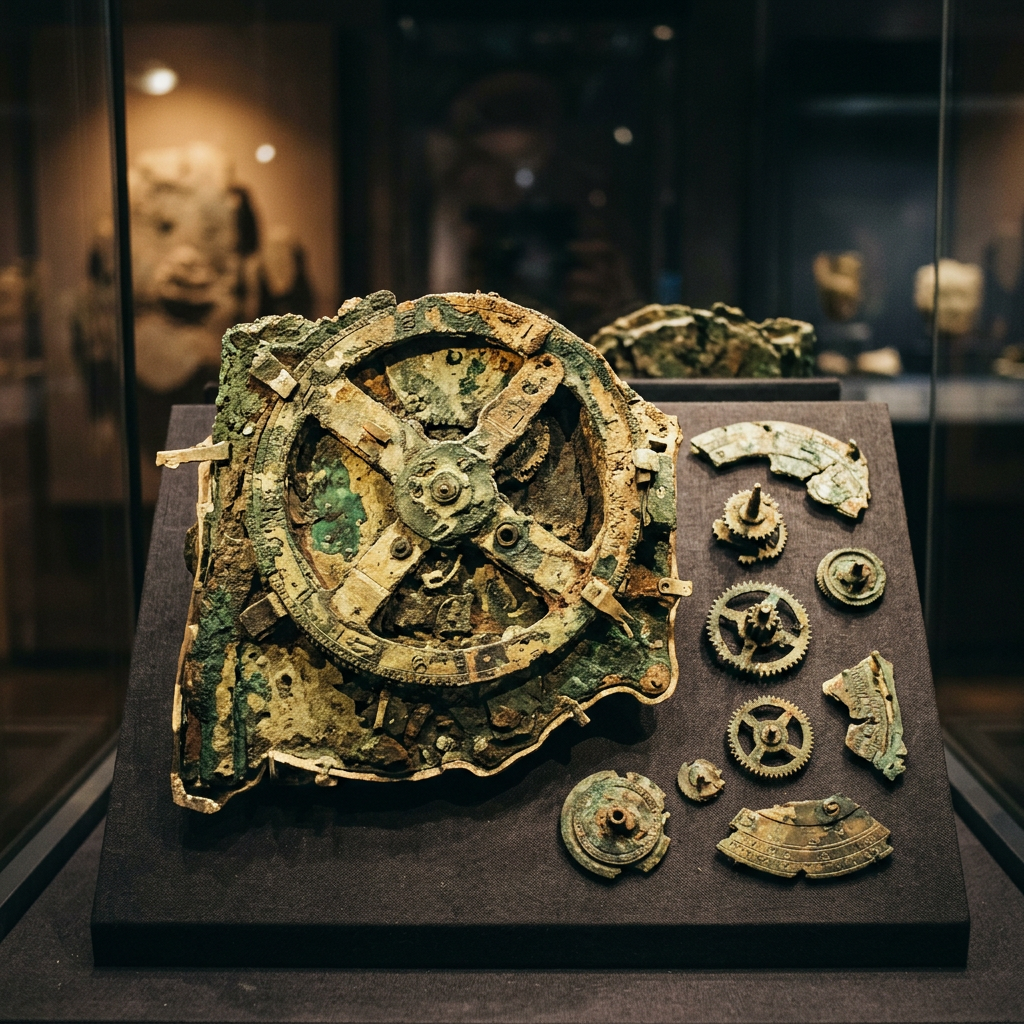
Imagine a machine built more than 2,000 years ago that could calculate astronomical cycles, track the movements of the Sun and Moon, and predict eclipses using an intricate system of bronze gears. Long before modern computers, electronic calculators, and digital technology existed, ancient Greek engineers created a device that demonstrated an extraordinary understanding of mathematics, astronomy, and mechanical engineering.
Known as the Antikythera Mechanism, this remarkable artifact is widely regarded as the world’s oldest known analog computer. Discovered in a shipwreck near the Greek island of Antikythera in 1901, it continues to fascinate scientists, historians, archaeologists, and technology enthusiasts.
But what exactly was the Antikythera Mechanism? How did it work, who created it, and why is it considered one of the greatest technological achievements of the ancient world?
What Is the Antikythera Mechanism?
The Antikythera Mechanism is an ancient Greek mechanical device designed to calculate and display astronomical information. Made primarily of bronze, it contained a sophisticated arrangement of interlocking gears, rotating pointers, numbered scales, and engraved inscriptions.
Researchers generally date its construction to the second century BC, although the precise date and place of manufacture remain uncertain. The device was probably housed in a wooden case with dials on its front and back.
Unlike modern computers, which process information electronically, the Antikythera Mechanism operated through physical movement. Turning a hand-operated control would move a series of connected gears, allowing a user to explore relationships between astronomical cycles and calendar dates.
The surviving remains consist of 82 fragments, and researchers have identified at least 30 gear wheels in the ancient artifact. Modern imaging techniques have helped scientists reconstruct many of its internal components and understand its principal functions.
The mechanism’s importance lies not simply in its age, but in its sophistication. It demonstrates that ancient Greek technology was capable of far more complex mechanical calculations than many people once believed.

The Discovery of the Antikythera Shipwreck
The story of the Antikythera Mechanism began in 1900, when Greek sponge divers discovered an ancient shipwreck near Antikythera, a small island located between Crete and the Peloponnese.
The divers were exploring the Mediterranean seabed when they encountered the remains of a large vessel surrounded by statues, pottery, coins, and other valuable archaeological objects. Their discovery led to an underwater recovery expedition supported by the Greek authorities.
During the recovery, divers brought numerous artifacts to the surface, including bronze and marble sculptures. Among the finds was a heavily corroded lump of bronze that initially attracted little attention.
In 1901, researchers began examining the recovered material more closely. The bronze object eventually separated into fragments, revealing traces of gears and mechanical components. By 1902, archaeologist Valerios Stais had recognized that the unusual object contained interlocking gear wheels.
This discovery transformed an apparently insignificant piece of corroded metal into one of the most extraordinary archaeological finds in history.
The shipwreck itself is generally associated with the first century BC, although its exact history and the circumstances surrounding the loss of its cargo remain subjects of scholarly investigation.
Today, the surviving Antikythera Mechanism fragments are preserved at the National Archaeological Museum in Athens, Greece.

How Does the Antikythera Mechanism Work?
The Antikythera Mechanism functioned as a mechanical astronomical calculator. Its interconnected gears translated the rotation of an input mechanism into coordinated movements of several pointers and displays.
Although the original device is incomplete, researchers have reconstructed important aspects of its operation using X-ray computed tomography, surface imaging, and detailed analysis of its inscriptions.
The basic principle was surprisingly straightforward: a carefully designed system of gears could represent complex astronomical relationships through predictable mechanical movement.
1. Tracking the Sun and Moon
One of the mechanism’s principal functions was to represent the movements of the Sun and Moon through the sky.
Its front display included a zodiac scale and a calendar scale, enabling users to relate dates to the apparent positions of celestial bodies.
The lunar display also represented the changing phases of the Moon, helping users understand where the Moon was in its monthly cycle.
This was important in ancient societies, where astronomical observations played a significant role in calendars, religious festivals, agriculture, and navigation.
2. Predicting Solar and Lunar Eclipses
Another extraordinary feature was its ability to represent eclipse cycles.
The rear of the mechanism included a spiral dial associated with the Saros cycle, a period of approximately 223 lunar months after which solar and lunar eclipses tend to repeat in a related pattern.
By tracking this cycle, the device could indicate periods when eclipses were likely to occur. Inscriptions and markings provided additional information associated with predicted eclipse events.
This achievement required an understanding of recurring astronomical patterns that had been studied across the ancient Mediterranean and Near East.
The mechanism therefore demonstrates how mathematical astronomy could be translated into a practical mechanical instrument.
3. Following the Metonic Calendar Cycle
The Antikythera Mechanism also incorporated a dial representing the Metonic cycle.
This cycle connects 235 lunar months with 19 solar years, providing a useful approximation for reconciling lunar months with the solar calendar.
Because 12 lunar months are shorter than a solar year, societies relying on lunar calendars needed methods for keeping months aligned with the seasons.
The Metonic cycle offered an elegant mathematical solution. Its inclusion shows that the mechanism was designed not merely to display celestial positions but also to organize time through sophisticated astronomical calculations.
4. Representing Planetary Movements
Researchers have also investigated evidence that the Antikythera Mechanism displayed the positions of planets known to ancient Greek astronomers.
Ancient astronomical traditions recognized Mercury, Venus, Mars, Jupiter, and Saturn as visible planets. Their apparent movements against the background stars were complex, sometimes appearing to slow down, reverse direction, and move forward again.
Surviving inscriptions and research into the mechanism’s possible gearing support the interpretation that it included planetary displays. However, the precise configuration and operation of all the original planetary mechanisms remain uncertain because significant parts of the device are missing.
This distinction is important: the Antikythera Mechanism was unquestionably an advanced astronomical calculator, but not every proposed feature can be reconstructed with equal confidence.

Who Built the Antikythera Mechanism?
The identity of the person or workshop responsible for building the Antikythera Mechanism remains unknown.
Its construction reflects the scientific traditions of the Hellenistic world, a period when Greek-speaking scholars developed sophisticated approaches to mathematics, astronomy, geography, and engineering.
Several historical figures have been discussed in connection with the intellectual background of the device. Archimedes, the famous mathematician and engineer from Syracuse, is often mentioned because ancient writers attributed remarkable mechanical and astronomical devices to him.
Hipparchus, an influential Greek astronomer associated with Rhodes, is also relevant to understanding the astronomical ideas reflected in the mechanism, particularly the mathematical description of lunar motion.
However, there is no conclusive evidence identifying either man as the mechanism’s inventor.
The device may have emerged from a specialized workshop that combined mathematical knowledge, metalworking skills, and practical experience with geared instruments.
Its creator probably relied on knowledge accumulated over generations, including astronomical observations and mathematical methods developed across different ancient civilizations.
Rather than being the work of an isolated genius, the Antikythera Mechanism may represent the culmination of a much wider scientific tradition.
Why Is the Antikythera Mechanism Called the World’s First Computer?
The Antikythera Mechanism is frequently described as the world’s first computer because it used a mechanical system to process mathematical relationships and generate meaningful information.
Modern electronic computers rely on electrical circuits and digital logic. The ancient Greek device instead used gear ratios, rotational motion, and calibrated scales to represent astronomical cycles.
This makes it an example of an analog computer: a machine that models relationships through continuously varying physical quantities, such as angles and positions.
When a user turned its control, the gear trains coordinated the movement of multiple indicators. Each pointer conveyed information about a particular astronomical or calendrical cycle.
The mechanism was not a general-purpose computer capable of running software or performing arbitrary calculations. Its functions were specialized and built directly into its mechanical design.
Nevertheless, its conceptual achievement was remarkable. It transformed abstract mathematical relationships into a portable machine that people could operate and interpret.
The sophistication of its surviving gearing has no known parallel among surviving mechanical devices from antiquity. It provides compelling evidence that ancient engineers possessed a level of technical expertise that was not fully represented by the surviving archaeological record.

How Modern Science Unlocked Its Secrets
For decades, researchers struggled to understand the mechanism because corrosion, broken components, and missing sections concealed much of its internal structure.
Early investigators could inspect the exposed gears, but the arrangement of the internal mechanisms remained difficult to determine.
A major breakthrough came through the work of British science historian Derek de Solla Price, who studied the artifact and published an influential reconstruction in 1974.
Later research made use of increasingly sophisticated technologies, including high-resolution X-ray imaging and computed tomography. These methods allowed scientists to examine the internal structure without dismantling the fragile fragments.
The Antikythera Mechanism Research Project brought together specialists in archaeology, astronomy, engineering, imaging, and the study of ancient Greek inscriptions.
In 2006, a landmark study published in Nature reported new findings about the mechanism’s gear trains, lunar calculations, eclipse predictions, and possible planetary displays.
Subsequent scholarship has continued to refine interpretations of its construction and purpose. Researchers can now read more of the engraved inscriptions and use the surviving evidence to develop increasingly detailed reconstructions.
Despite these advances, missing components mean that some questions remain unanswered.
The Legacy of the Antikythera Mechanism
The Antikythera Mechanism has changed how historians understand ancient Greek science and technology.
Before its discovery, the surviving evidence for ancient mechanical engineering provided only a limited picture of the complexity that Greek craftsmen could achieve. This artifact revealed that advanced geared instruments existed more than two millennia ago.
Its significance extends beyond astronomy. The mechanism demonstrates the relationship between mathematics, scientific observation, engineering, and practical problem-solving.
It also illustrates how scientific knowledge moves between cultures. Ancient Greek astronomy drew on traditions that included Babylonian observations and mathematical methods, while Hellenistic scholars developed their own theoretical models and mechanical applications.
Today, the Antikythera Mechanism inspires engineers, historians, educators, and computer scientists. Working replicas and digital reconstructions help researchers test theories and make the device’s complex operation easier to understand.
Most importantly, it reminds us that innovation did not begin with the Industrial Revolution or the digital age. Long before modern technology, people were developing ingenious tools to understand the natural world.

Frequently Asked Questions About the Antikythera Mechanism
What is the Antikythera Mechanism?
The Antikythera Mechanism is an ancient Greek mechanical astronomical calculator built around the second century BC. It used bronze gears and dials to represent astronomical movements and calendar cycles.
How old is the Antikythera Mechanism?
The device is generally dated to approximately 150–100 BC, although the precise date of construction remains uncertain.
What could the Antikythera Mechanism calculate?
It could represent the movements of the Sun and Moon, lunar phases, calendar cycles, and eclipse patterns. Evidence also supports the possibility that it displayed planetary positions.
Where was the Antikythera Mechanism discovered?
It was recovered from an ancient shipwreck near the Greek island of Antikythera in the Mediterranean Sea during an expedition that began in 1900.
Where can the Antikythera Mechanism be seen today?
The surviving fragments are held by the National Archaeological Museum in Athens, Greece.
Why is the Antikythera Mechanism important?
It is the oldest known surviving complex geared astronomical calculator and provides extraordinary evidence of ancient Greek mathematical knowledge, astronomy, and mechanical engineering.
Was the Antikythera Mechanism really the first computer?
It is widely described as the world’s oldest known analog computer because it used mechanical components to model and calculate astronomical relationships. It was not a digital or general-purpose computer like those used today.

Conclusion: An Ancient Machine Ahead of Its Time
The Antikythera Mechanism remains one of the most extraordinary discoveries in the history of science. Created in ancient Greece more than 2,000 years ago, it combined intricate bronze gears with mathematical astronomy to calculate celestial cycles and predict astronomical events.
Its discovery in a Mediterranean shipwreck revealed a level of mechanical sophistication that challenged established assumptions about ancient engineering.
Although much of the original device has been lost, modern scientific techniques continue to reveal details about its design and function. Important questions remain concerning its maker, place of manufacture, and complete range of capabilities.
What is already clear, however, is that the Antikythera Mechanism represents an exceptional achievement in human ingenuity. Often called the world’s first computer, it stands as a powerful reminder that the desire to calculate, predict, and understand the universe has shaped human civilization for thousands of years.
The Antikythera Mechanism is more than an archaeological curiosity. It is a lasting symbol of the remarkable scientific and technological achievements of the ancient world.
Fortisetliber’s View
Beneath the waters of the Mediterranean, a corroded fragment of bronze concealed one of the greatest technological mysteries of antiquity. Discovered in a shipwreck near the Greek island of Antikythera in 1901, the Antikythera Mechanism revealed that the ancient Greeks possessed an extraordinary understanding of astronomy and mechanical engineering.
Dating to approximately the second century BC, this intricate device used a system of bronze gears to calculate celestial cycles, track the movements of the Sun and Moon, and predict eclipses. Often described as the world’s oldest known analog computer, it stands as a remarkable testament to the scientific achievements of the Hellenistic world.
Its creator remains unknown, yet the mechanism reflects a civilization determined to understand the heavens through mathematics, observation, and reason. More than two thousand years later, its surviving fragments continue to challenge our understanding of ancient technology.
The Antikythera Mechanism is not merely an archaeological curiosity. It is a lasting reminder that the intellectual brilliance of the ancient world often surpassed what history has preserved.
Leave a Reply