
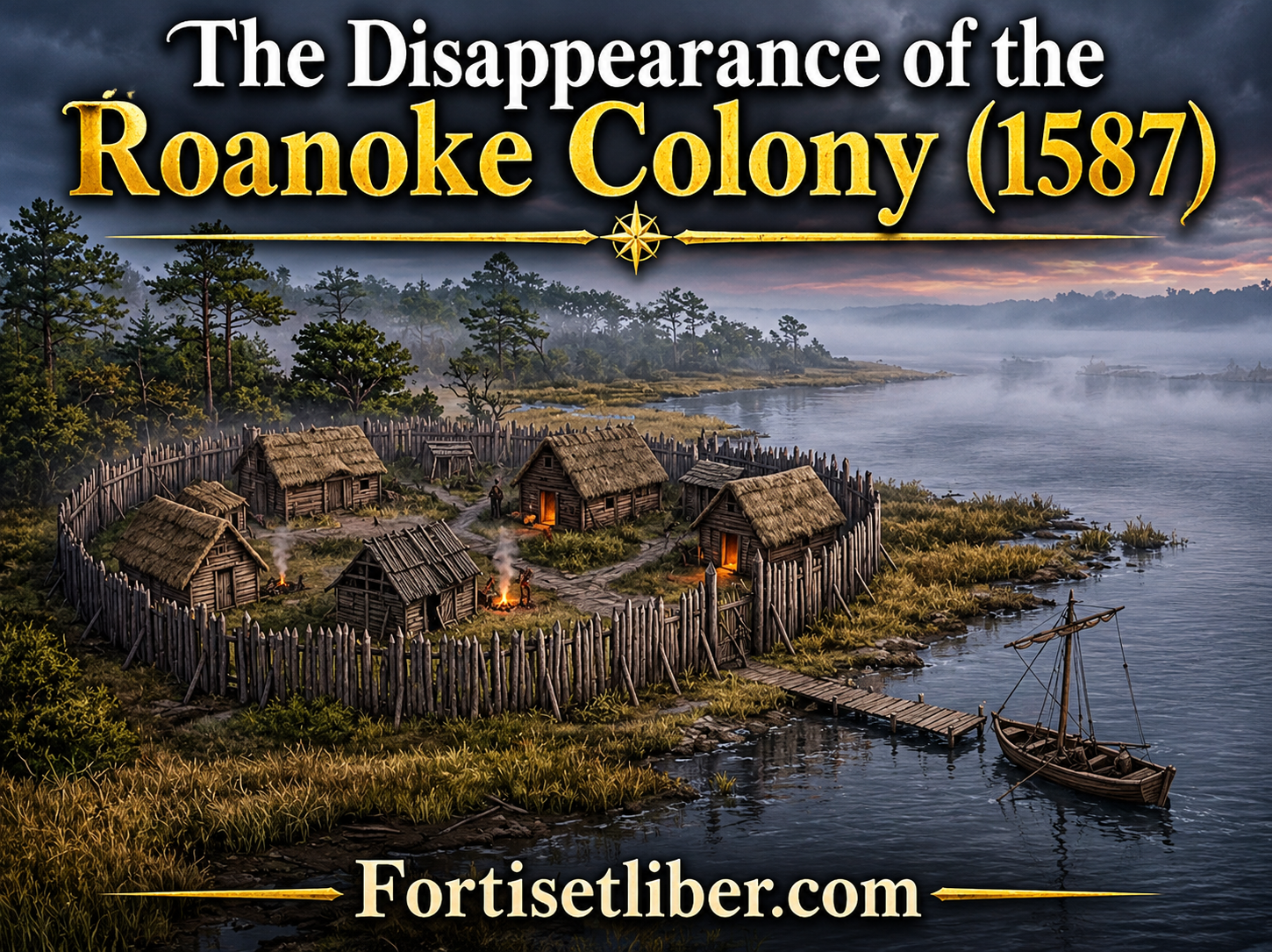
If you are fascinated by unexplained historical events, forgotten civilizations, and mysterious disappearances, few stories are as intriguing as the disappearance of the Roanoke Colony in 1587. Often called the Lost Colony of Roanoke, this mysterious event remains one of the greatest unsolved mysteries in American history.
In the late 16th century, a group of English settlers arrived on Roanoke Island, hoping to establish England’s first permanent colony in the New World. However, when an English expedition returned several years later, the entire settlement had vanished. There were no obvious signs of a violent attack, no bodies, and almost no clues about what had happened to the colonists.
The only remarkable evidence left behind was a mysterious word carved into a wooden post: CROATOAN.
More than four centuries later, historians, archaeologists, and researchers continue to investigate what happened to the missing settlers. Did they join a neighboring Native American community? Were they victims of disease, starvation, or conflict? Or did they abandon the settlement and disappear into the wilderness?
Let’s explore the fascinating history of the Roanoke Colony, the events leading to its disappearance, and the most convincing theories surrounding America’s Lost Colony.
1. The Beginning of the Roanoke Colony: England’s Ambition in the New World
To understand the mystery of the Lost Colony of Roanoke, it is important to look at England’s ambitions during the 16th century.
During the reign of Queen Elizabeth I, England wanted to expand its influence beyond Europe. Spain and Portugal had already established powerful overseas empires, and English explorers hoped to discover new trade routes, valuable resources, and territories.
One of the leading figures behind England’s colonial ambitions was Sir Walter Raleigh. With royal support, Raleigh organized expeditions to explore the eastern coast of North America and establish an English settlement.
Roanoke Island, located in present-day North Carolina, appeared to be a promising location. Its coastal waters offered access to fishing, transportation, and potential trade with Indigenous communities.
The first English expedition arrived in 1584, followed by another colonization attempt in 1585. Unfortunately, the earlier settlement experienced serious difficulties, including food shortages, tensions with local Indigenous communities, and poor relations between settlers and their leaders.
Despite these setbacks, England refused to abandon its plans.
In 1587, a new group of approximately 115–118 English settlers, including men, women, and children, sailed across the Atlantic under the leadership of Governor John White.
Their mission was to establish a permanent English settlement in North America.
However, nobody could have imagined that this expedition would become one of history’s most famous mysteries.

2. The Arrival of the 1587 Settlers and the Birth of Virginia Dare
The new settlers arrived at Roanoke Island in July 1587. Their original intention was to establish a settlement farther north, near the Chesapeake Bay. However, circumstances forced them to remain on Roanoke Island, where an earlier English settlement had been established.
Life was extremely challenging.
The colonists needed food, shelter, and protection in an unfamiliar environment. They also had to maintain peaceful relationships with Indigenous communities whose lands and resources were already part of established societies.
Relations were complicated by earlier conflicts involving English explorers and local Algonquian-speaking peoples.
One particularly important figure was Manteo, a Croatoan man who had developed connections with the English and helped facilitate communication between the two communities.
Despite the difficult circumstances, the colony experienced an important moment of hope.
On August 18, 1587, Virginia Dare was born. She was the granddaughter of Governor John White and is widely recognized as the first English child born in the Americas.
Her birth became an important historical milestone and later made her one of the most famous figures associated with the Lost Colony of Roanoke.
Unfortunately, the celebration did not last long.
The settlement faced growing problems, and supplies were running low. The colonists desperately needed additional provisions and support from England.
They eventually persuaded John White to return to England to organize a relief expedition.
Before leaving, White and the colonists agreed on a system of messages. If they relocated, they would carve the name of their destination into a tree or another suitable structure. If they were forced to leave because of danger, they would add a Maltese cross.
On August 27, 1587, John White departed for England.
He believed he would return relatively quickly.
Instead, his absence would last approximately three years.

3. Why Did John White Take So Long to Return?
One of the most important factors behind the disappearance of the Roanoke Colony was the political situation in Europe.
When John White arrived in England, the country was preparing for a major conflict with Spain.
In 1588, the Spanish Armada attempted to invade England. The English government needed ships and sailors to defend the country, making it extremely difficult to organize another voyage across the Atlantic.
White’s plans were repeatedly delayed.
He could not simply gather supplies and return to North America whenever he wanted. International conflict, maritime dangers, and a shortage of available ships all complicated his mission.
An earlier attempt to return in 1588 also failed after problems involving privateers and the loss of supplies.
Eventually, White managed to secure passage aboard a vessel heading toward the Caribbean.
In August 1590, he finally reached the coast of North Carolina.
He was desperate to find his family, particularly his granddaughter Virginia Dare, along with the other settlers he had left behind.
But what he discovered would shock him.

4. The Mysterious Disappearance of the Roanoke Colony in 1590
On August 18, 1590, John White returned to Roanoke Island.
He expected to find familiar faces, homes, and a functioning settlement.
Instead, he discovered that the colony had been abandoned.
There were no settlers waiting for him. The houses had been dismantled, and the settlement appeared to have been left behind.
However, White did not find clear evidence of a massacre or a violent attack.
There were no obvious signs of a desperate struggle, and the settlers had apparently taken many of their belongings with them.
Then White noticed something unusual.
Two messages had been carved into wooden structures.
The first was the word:
CRO
The second, found on a palisade, read:
CROATOAN
White immediately understood that these words might be connected to the agreement he had made with the settlers before departing.
Croatoan referred to both a place and an Indigenous people associated with present-day Hatteras Island, south of Roanoke.
Because the settlers had not carved the agreed-upon distress signal, White believed they might have relocated voluntarily.
He hoped they had moved to Croatoan Island, where they might have found food, protection, and assistance from the local population.
Unfortunately, bad weather and dangerous sea conditions prevented him from completing his search.
He was forced to abandon his immediate plans and return to England.
John White never discovered what happened to the missing settlers.
And so began the enduring mystery of the Roanoke Colony disappearance of 1587.

5. What Does CROATOAN Mean? The Most Important Clue
The word CROATOAN remains the most famous piece of evidence connected to the Lost Colony mystery.
It is particularly important because it appears to have been part of a communication arrangement between John White and the settlers.
Unlike a mysterious symbol or unexplained drawing, the word identified a real geographical location and an Indigenous community.
This has led many historians to believe that at least some of the colonists relocated to Hatteras Island.
The Croatoan people had established communities in the region and maintained relationships with certain English settlers.
It is possible that the missing colonists sought their assistance and gradually became part of the local population.
However, the word alone cannot establish exactly where every settler went or what happened to them.
Some may have moved elsewhere, while others could have died from disease, hunger, or conflict.
The absence of definitive evidence means that the meaning of CROATOAN remains an important historical clue rather than a complete solution.

6. Theories About the Lost Colony of Roanoke
Over the centuries, historians and researchers have developed several explanations for the disappearance of the Roanoke settlers. Although none has been universally accepted, some theories are supported by historical documents and archaeological discoveries.
Let’s examine the most popular explanations.
Theory 1: The Colonists Joined the Croatoan People
One of the most convincing explanations is that the settlers relocated to Croatoan, present-day Hatteras Island.
The carved message strongly supports this possibility. The Croatoan people had established communities in the area, and some English settlers had previously developed friendly relationships with them.
Archaeological investigations on Hatteras Island have uncovered European objects alongside Indigenous artifacts. These discoveries suggest that Europeans and Native Americans interacted in the region.
Some researchers believe that surviving English colonists may have joined Indigenous communities, married into local families, and gradually adopted their customs and way of life.
If this happened, the colonists might not have disappeared in the traditional sense. Instead, they may have become integrated into another society.
Nevertheless, archaeologists have not conclusively identified a settlement or human remains belonging to the missing Roanoke colonists.

Theory 2: The Colonists Moved Inland
Another explanation suggests that the settlers traveled inland in search of better resources and safer living conditions.
Before leaving for England, John White had instructed the colonists that they could move approximately 50 miles inland if necessary.
This instruction creates another possibility: the settlers may have abandoned Roanoke Island and established a new community somewhere along the rivers or waterways of present-day North Carolina.
Archaeological discoveries at inland locations have attracted considerable attention.
Researchers have investigated sites containing European pottery, metal objects, and other materials dating to the late 16th century.
Some findings could be connected to English explorers or settlers, but there is no definitive proof that they belonged to the missing colonists.
Theory 3: Disease, Starvation, and Extreme Weather
The third theory focuses on environmental conditions and the struggle to survive.
The settlers arrived in an unfamiliar environment without reliable access to food supplies from England.
Agriculture, hunting, fishing, and trade were essential to their survival. Any disruption could have placed the entire settlement in danger.
Research using tree-ring evidence has identified an exceptionally severe drought in the region between 1587 and 1589.
This drought may have reduced agricultural production, affected freshwater supplies, and increased pressure on already vulnerable communities.
Disease and malnutrition could also have contributed to the settlers’ difficulties.
It is possible that some colonists died while others moved elsewhere in search of survival.
This theory offers a realistic explanation for the settlement’s collapse, although it does not explain the exact destination of the survivors.
Theory 4: Conflict with Indigenous Communities
Some historical interpretations suggest that tensions between English settlers and Indigenous populations may have contributed to the colony’s disappearance.
Relations between the English and local Algonquian-speaking communities were not always peaceful.
Misunderstandings, competition for resources, territorial pressures, and earlier violent encounters created an unstable environment.
However, there is no conclusive archaeological evidence proving that the entire Roanoke Colony was destroyed in a coordinated attack.
It is also important to recognize that Indigenous communities were diverse, with different leaders, interests, and relationships with the English.
The possibility of conflict cannot be excluded, but it should not be treated as an established explanation.

7. Archaeological Discoveries: Are We Close to Solving the Mystery?
Modern archaeology has provided new opportunities to investigate the disappearance of the Roanoke Colony.
Researchers have examined Roanoke Island, Hatteras Island, and locations farther inland in search of physical evidence.
Some discoveries have included European pottery, metal fragments, and objects associated with 16th-century trade and settlement.
One particularly interesting area of research involves the First Colony Foundation, which has investigated possible locations connected to the original English settlement.
Archaeological work at inland sites has uncovered European materials that could indicate the presence of English visitors or settlers.
However, identifying an object as European does not automatically prove that it belonged to the Lost Colony. European goods could have reached Indigenous communities through trade or other forms of contact.
Similarly, discoveries on Hatteras Island have strengthened interest in the possibility that some colonists joined the Croatoan population.
These findings are important because they provide physical evidence that can be compared with historical documents.
Nevertheless, the central question remains unanswered: where did the settlers go, and what happened to their descendants?
For now, archaeology continues to offer clues rather than a definitive conclusion.
8. Virginia Dare: The Child at the Center of the Mystery
Among all the people associated with Roanoke, few have captured the public imagination as much as Virginia Dare.
Born on August 18, 1587, she was the granddaughter of John White and became the first English child born in the Roanoke settlement.
Her birth represented hope for the future of English colonization in North America.
However, when John White returned in 1590, Virginia Dare was nowhere to be found.
Her disappearance transformed her into a legendary historical figure.
Over time, writers, artists, and storytellers created numerous imaginative accounts of her possible fate.
Some stories suggest that she survived among Indigenous communities, while others portray her as a symbol of the tragedy of the Lost Colony.
Unfortunately, there is no reliable historical evidence establishing what happened to Virginia Dare.
Her story remains inseparable from the mystery of the missing Roanoke settlers.

9. Why Has the Roanoke Colony Mystery Never Been Solved?
More than 430 years have passed since the disappearance of the Roanoke settlers, yet the mystery remains unresolved.
One major challenge is the limited historical evidence. The English colonists left behind very few written records describing their final days.
John White’s accounts provide valuable information, but his absence between 1587 and 1590 created a significant gap in the historical record.
Another difficulty is the changing landscape of the Outer Banks. Coastal erosion, storms, rising sea levels, and shifting shorelines may have destroyed archaeological evidence that could have helped researchers understand what happened.
Furthermore, the settlers may have moved to several different locations rather than remaining together as one community.
Some could have joined Indigenous populations, while others may have died or established separate settlements.
This means that the disappearance might not have been a single dramatic event. It could have been a gradual process involving migration, environmental hardship, and cultural integration.
The mystery continues to attract researchers because even a small archaeological discovery could change our understanding of early English colonization in North America.

10. Conclusion: The Enduring Mystery of America’s Lost Colony
The disappearance of the Roanoke Colony in 1587 remains one of the most fascinating unsolved mysteries in American history.
What began as an ambitious English attempt to establish a permanent settlement in the New World ended with the disappearance of more than a hundred men, women, and children.
The mysterious word CROATOAN, the absence of the settlers, and the unanswered questions surrounding Virginia Dare have kept this historical mystery alive for generations.
Although theories involving migration, Indigenous communities, starvation, drought, and conflict offer possible explanations, none has completely solved the mystery.
Perhaps the colonists found a new home and became part of the surrounding communities. Perhaps some never survived the difficult conditions of the New World.
Whatever the truth may be, the Lost Colony of Roanoke reminds us that history is not always a complete record of what happened. Sometimes, the most important stories are those for which the evidence has disappeared.
And until researchers uncover more definitive clues, one question will continue to fascinate the world:
What really happened to the Lost Colony of Roanoke?
Fortisetliber View
Fortis et Liber — meaning Strong and Free — is a fitting expression for the spirit of the early settlers who crossed the Atlantic in search of a new beginning.
The story of the Roanoke Colony is not only about disappearance and mystery; it is also about courage, ambition, and the human desire for freedom. In 1587, more than a hundred English settlers faced an unknown world, hoping to build a new life despite dangerous seas, limited resources, and uncertain circumstances.
Their fate remains unknown, but their story continues to inspire curiosity and admiration. Perhaps they found a new home among the Indigenous communities, or perhaps they succumbed to the harsh realities of colonial life.
Whatever happened, the Lost Colony reminds us that history is shaped not only by those whose names survive, but also by those whose stories remain unfinished.
Strong and Free — Fortis et Liber — is more than a motto. It is a tribute to the courage of those who dared to explore the unknown.
References and Further Reading
- National Park Service – The Lost Colony.
- National Park Service – Major Theories of the Lost Colony.
- National Park Service – The 1590 Rescue Voyage.
- Smithsonian Magazine – Archaeological Evidence.
- North Carolina Department of Natural and Cultural Resources – Origins of the Lost Colony Mystery.
Leave a Reply