
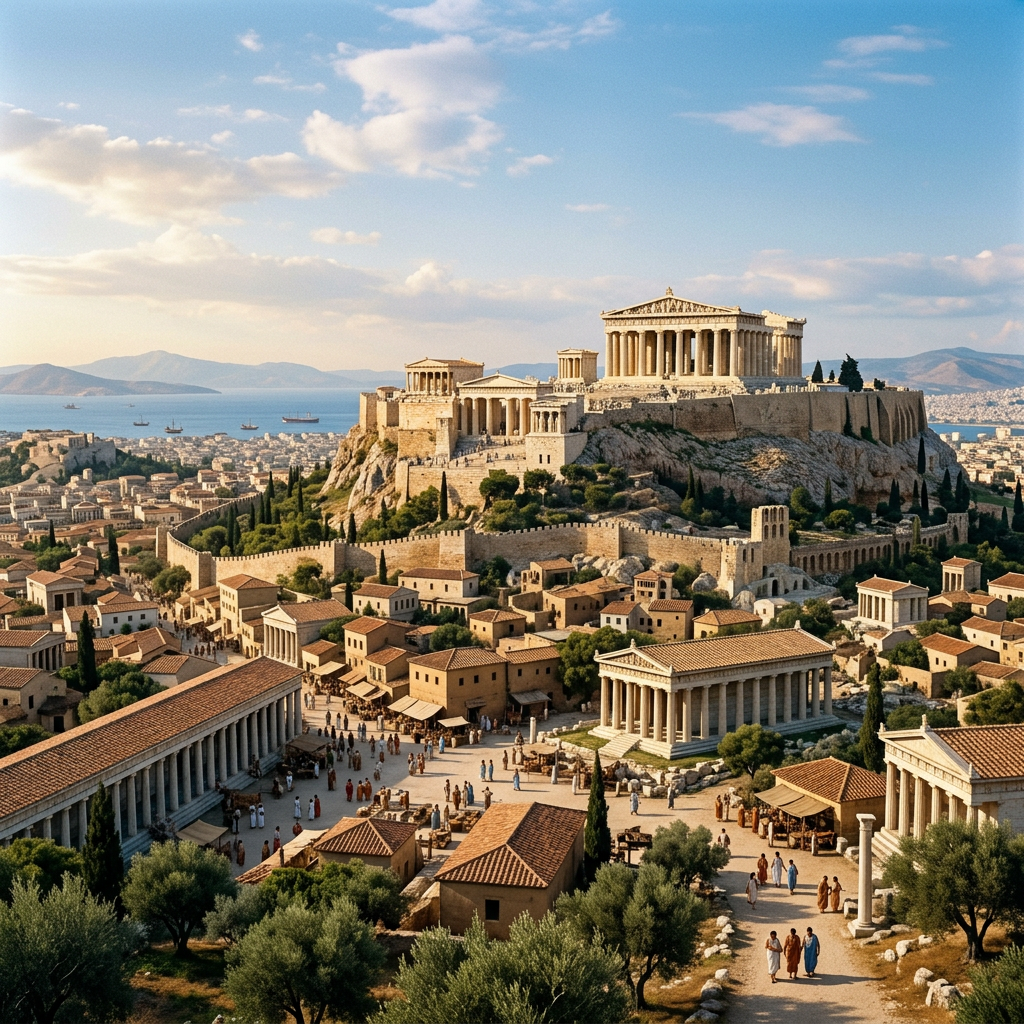
Ancient Athens, a city-state on the Attic peninsula of Greece, holds a unique place in world history. Between the 6th and 4th centuries BCE, it became a center of political innovation, artistic creativity, and philosophical inquiry. Much of what we today call “Western civilization” can trace roots back to this small but influential polis.
Geography and Origins
Athens developed in the region of Attica, a rocky peninsula with limited fertile land but access to the sea via the port of Piraeus. This location shaped the city’s character:
- Limited farmland encouraged trade and craftsmanship rather than large-scale agriculture.
- Access to the Aegean Sea allowed Athenians to build a powerful navy and establish wide trade networks.
- Natural defenses, such as hills and surrounding mountains, helped protect the city.
Early Athens was ruled by kings and then by aristocratic families, but social tensions and economic inequalities gradually pushed the city toward political reform.
The Birth of Athenian Democracy
Athens is best known as the birthplace of democracy, though its system would look quite different from modern representative democracies.
Early Reforms: Solon and Cleisthenes
In the early 6th century BCE, Solon introduced reforms to ease social conflict:
- He cancelled certain debts and ended debt slavery.
- He reorganized citizens into classes based on wealth, not birth.
- He opened public office to a broader portion of the population.
Later, around 508/507 BCE, Cleisthenes carried out deeper democratic reforms:
- He broke up old clan-based power structures.
- He organized citizens into new tribes based on residence, mixing people from different regions.
- He created the Council of 500, which prepared legislation and governed daily affairs.
These reforms laid the groundwork for a more inclusive political system.
How Athenian Democracy Worked
Athenian democracy was a direct democracy—citizens participated in decisions themselves:
- The Assembly (Ekklesia): Open to all male citizens over 18. They met regularly to vote on laws, war, foreign policy, and public expenditures.
- The Council of 500 (Boule): Selected by lot from the citizen body, it set the agenda for the Assembly and handled administrative tasks.
- Public Offices: Many positions were filled by random selection rather than election, to prevent concentration of power among the wealthy and well-connected.
However, this democracy was limited:
- Women, enslaved people, and resident foreigners (metics) could not participate.
- Only free-born Athenian men were considered full citizens.
Even with its restrictions, the Athenian experiment with direct rule by citizens was revolutionary for its time.

Society and Everyday Life
Athenian society was complex and stratified.
Citizens, Metics, and Slaves
- Citizens: Free-born Athenian males who had political rights and military obligations. Their identity was tied to participation in public life.
- Metics: Free non-citizens who lived and worked in Athens. They paid special taxes and often played important roles in trade and crafts but lacked political rights.
- Slaves: Enslaved people were a significant part of the population and worked in households, workshops, mines, and sometimes in administrative roles.
Family and Gender Roles
- Men were expected to participate in politics, military service, and public debate.
- Women in citizen families were largely confined to the domestic sphere—managing the home, weaving, and raising children. They rarely appeared in public life.
- Education focused on boys, who learned reading, writing, music, physical training, and, for wealthier families, rhetoric and philosophy.
Culture, Philosophy, and Education
Ancient Athens became a magnet for thinkers, artists, and teachers.
Philosophy and Intellectual Life
Athens was home to some of history’s most influential philosophers:
- Socrates questioned conventional beliefs and encouraged critical thinking through dialogue.
- Plato, his student, founded the Academy and explored justice, politics, and metaphysics in his dialogues.
- Aristotle, Plato’s student, systematized knowledge across fields such as logic, biology, ethics, and politics.
Public spaces like the Agora (marketplace) served not only as centers of trade but also as places for debate and discussion. Intellectual life was deeply woven into civic identity.
Drama and Literature
Athens also pioneered theater as a public art form.
- Tragedians such as Aeschylus, Sophocles, and Euripides wrote plays that examined fate, justice, and human suffering.
- Comedic playwrights like Aristophanes used satire to criticize politicians, cultural trends, and even the gods.
Plays were performed at religious festivals, especially those dedicated to Dionysus, and were considered both entertainment and moral education.
Art and Architecture
Athenian art and architecture helped define classical ideals of harmony and proportion.
The Acropolis and the Parthenon
The Acropolis, a rocky hill rising above the city, became a monumental religious and symbolic center:
- The Parthenon, dedicated to the goddess Athena, embodied refined classical architecture with its Doric columns, subtle curves, and intricate sculptures.
- Other structures, like the Erechtheion with its famous Caryatid columns, showcased Athenian creativity and craftsmanship.
These buildings were not only religious spaces but also powerful statements of Athenian wealth and prestige.

Sculpture and Visual Art
Athenian sculpture moved from rigid, archaic styles toward more naturalistic representations of the human body:
- Attention to anatomy, movement, and emotion expressed a belief in human potential and beauty.
- Public statues often depicted gods, heroes, and important citizens, reinforcing shared values and civic pride.
Economy, Trade, and Naval Power
Athens’ rise depended heavily on its economy and navy.
- Silver mines in nearby Laurium provided revenue for public projects and the fleet.
- Maritime trade brought in grain, timber, metals, and luxury goods from across the Mediterranean.
- Craft production, including pottery and metalwork, became widely exported and recognized for quality.
The Athenian navy, built with contributions from citizens and financed by the city’s wealth, turned Athens into a dominant sea power.
Empire and Conflict
Athens’ power came with tensions and contradictions.
The Delian League
After the Persian Wars, Athens led a defensive alliance known as the Delian League:
- Initially created to protect Greek cities from Persia, it gradually became an Athenian empire.
- Member states paid tribute, which Athens often used for its own building projects and military needs.
- Over time, allies who tried to leave the league faced intimidation or force.
This expansion of power inspired both admiration and resentment.
The Peloponnesian War and Decline
Rivalry with Sparta, a powerful land-based military state, led to the Peloponnesian War (431–404 BCE):
- The war strained Athenian resources and morale.
- A devastating plague and internal political conflicts weakened the city.
- Ultimately, Athens was defeated, its walls were torn down, and its empire collapsed.
Although Athens later recovered some of its cultural influence, it never regained the same level of political dominance.
Legacy of Ancient Athens
Despite its limitations and eventual decline, Ancient Athens left an enduring legacy:
- Democracy: Ideas about citizens participating in government, the rule of law, and public debate influenced later political thought in Europe and beyond.
- Philosophy: Athenian thinkers shaped how we approach ethics, science, politics, and logic.
- Art and Architecture: Classical styles inspired later eras, from the Roman Empire to the Renaissance and modern public buildings.
- Literature and Drama: Greek tragedies and comedies remain central to theater and literary studies today.
Ancient Athens was not a perfect society—it was built on inequality and exclusion. Yet its experiments in politics, art, and ideas opened paths that cultures around the world continue to explore. In its streets, assembly spaces, and theaters, we see the early formation of questions that still matter: Who should rule? What is a good life? How should a community organize itself?

Fortisetliber’s View
At Fortisetliber, we look at Ancient Athens not as a golden age to be uncritically admired, but as a laboratory of human possibility and failure. Athens shows how far a community can go when it trusts debate, education, and shared public life—yet it also reminds us how fragile those achievements are when they rest on exclusion and inequality.
The Athenian experiment in democracy was radical: ordinary citizens were expected to speak, argue, and decide. This insistence that public life belongs to the many, not the few, remains one of Athens’ most powerful legacies. But the same city that celebrated freedom for citizens accepted slavery, silenced most women, and treated many neighbors as subjects rather than partners. Its greatness was built on limits it rarely questioned.
For us, the value of studying Athens lies in this tension. It invites us to ask what it would mean to keep the courage of its questions—about justice, the good life, and the responsibilities of citizens—while refusing the boundaries it placed around who counts as fully human. To read Athens well is not to imitate it, but to let it unsettle us, to see where we are still repeating its exclusions in new forms.
If we learn anything enduring from Ancient Athens, it is that a free society is never finished. Democracy must be renewed in every generation, philosophy must be lived as well as argued, and culture must remain open to criticism from those it has pushed to the margins. In that ongoing work, Athens is both a warning and an invitation.
Leave a Reply