
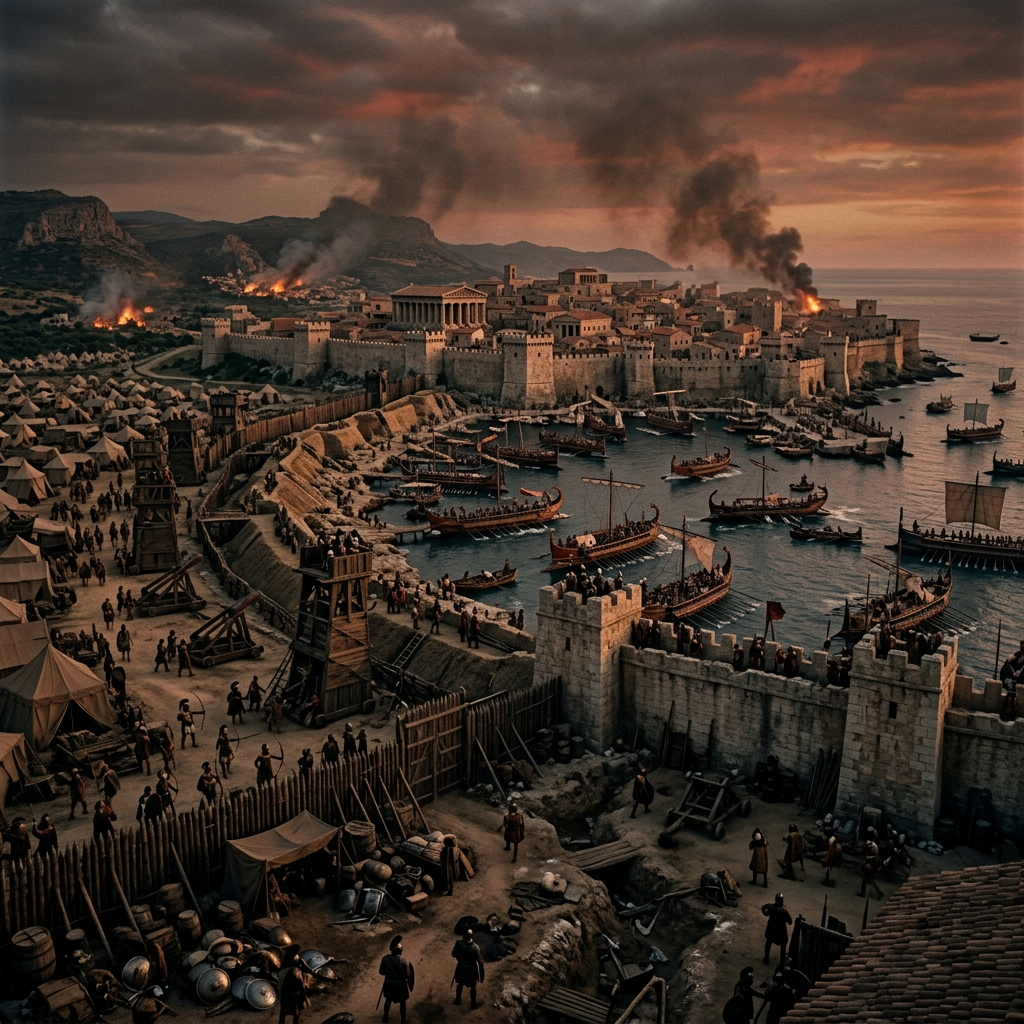
Introduction: What Was the Sicilian Expedition?
The Sicilian Expedition was one of the most ambitious military campaigns in ancient Greek history. Launched by Athens in 415 BC during the Peloponnesian War, it aimed to extend Athenian influence across Sicily, weaken rival powers, and potentially strengthen Athens’s position against Sparta. However, what began as a bold attempt to expand an empire ended in a catastrophic military defeat in 413 BC.
The campaign involved thousands of soldiers, a powerful naval fleet, and some of the most influential political and military figures of classical Greece. Among them were Alcibiades, Nicias, and Demosthenes, whose decisions helped shape the course of the expedition. Their struggle against Syracuse, one of the strongest Greek cities in Sicily, became a defining episode in the history of ancient warfare.
The failure of the Sicilian Expedition had consequences far beyond the island itself. Athens lost ships, soldiers, resources, and much of its military prestige. The disaster also encouraged Athens’s enemies and contributed to the eventual defeat of the Athenian Empire in the Peloponnesian War.
Understanding the Sicilian Expedition provides valuable insight into Athenian imperial ambitions, the dangers of military overconfidence, and the complex political rivalries that shaped the ancient Greek world.
1. The Historical Background of the Sicilian Expedition
To understand why Athens invaded Sicily, it is necessary to examine the political situation in Greece during the fifth century BC.
Athens and Sparta were the two dominant powers in the Greek world. Athens controlled a maritime empire supported by its powerful navy and the Delian League, while Sparta led the Peloponnesian League and relied heavily on its formidable land army.
Their rivalry resulted in the Peloponnesian War, which began in 431 BC. Although the Peace of Nicias was established in 421 BC, the agreement failed to resolve the underlying tensions between the two powers. Both sides continued to compete for influence, allies, and strategic advantages.
Sicily offered an attractive opportunity for Athens. The island possessed fertile agricultural land, valuable resources, prosperous cities, and important maritime connections throughout the western Mediterranean.
Syracuse, in particular, represented both an opportunity and a threat. Its military strength and political connections made it a potential obstacle to Athenian expansion. Athens also feared that Syracuse might provide assistance to Sparta and its allies.
By intervening in Sicilian affairs, Athens hoped to support friendly cities, weaken Syracuse, and establish a stronger strategic position in the western Mediterranean.
However, the distance between Athens and Sicily created serious logistical challenges. Any successful campaign would require reliable supplies, coordinated leadership, and sufficient resources to sustain a prolonged military operation.

2. Why Did Athens Invade Sicily?
The immediate trigger for the Sicilian Expedition came from Segesta, a city in western Sicily that requested Athenian assistance against its rival Selinus. Segesta appealed to Athens for military support and promised financial contributions to help cover the costs.
Athenian leaders saw the request as an opportunity to pursue broader strategic objectives. Supporting Segesta could strengthen Athens’s relationships with Sicilian allies while weakening the influence of Syracuse.
Nevertheless, the motivations behind the invasion extended beyond defending a single city.
Athenian imperial ambition
Athens had built its power through naval superiority, alliances, and control over strategic territories. Expanding into Sicily promised additional influence and potentially new sources of wealth.
Strategic competition with Sparta
Syracuse possessed considerable military and economic resources. If Athens could neutralize Syracuse or bring it into its sphere of influence, Sparta might lose a valuable potential ally.
Economic opportunity
Sicily’s agricultural production and prosperous cities made the island an appealing target for an ambitious imperial power. Control over Sicilian territory could potentially provide access to resources and trade routes.
Political rivalry in Athens
The decision to invade Sicily also reflected divisions within Athenian democracy. Alcibiades supported the expedition and advocated an aggressive foreign policy, while Nicias warned that the operation was dangerous and expensive.
Despite these concerns, the Athenians approved the campaign. Their decision demonstrated how strategic ambition and political enthusiasm could outweigh warnings about military risk.

3. Alcibiades, Nicias, and the Leadership of the Expedition
Three Athenian generals were appointed to lead the Sicilian Expedition: Alcibiades, Nicias, and Lamachus.
Each brought a different perspective to the campaign.
Alcibiades was an influential and ambitious politician who believed that Athens could achieve significant gains in Sicily. He supported an expansive strategy and helped persuade the assembly to authorize the expedition.
Nicias was a respected general who opposed the invasion. He believed that the operation demanded far greater resources than Athens was prepared to commit. Although he argued against the campaign, he was appointed commander and ultimately became one of its principal leaders.
Lamachus was an experienced military commander who favored decisive action. His approach emphasized attacking Syracuse before the defenders could fully organize their resistance.
The expedition suffered an early political crisis when Alcibiades was recalled to Athens to face accusations connected with religious scandals, including the mutilation of sacred statues known as Hermae. Instead of returning to stand trial, he fled and eventually sought protection in Sparta.
His departure deprived Athens of one of its most energetic advocates of expansion. More importantly, Alcibiades subsequently advised the Spartans on how to assist Syracuse and weaken Athens.
The leadership crisis complicated an already difficult campaign and exposed the dangers of allowing domestic political conflict to interfere with military operations.

4. The Athenian Invasion of Sicily Begins
In 415 BC, a large Athenian fleet sailed from the port of Piraeus toward Sicily. The expedition included warships, transport vessels, infantry, and other personnel necessary to sustain a major overseas campaign.
Ancient accounts describe the departure as an extraordinary display of Athenian wealth and power. The scale of the undertaking reflected the confidence that many Athenians placed in their navy and their city’s imperial strength.
Once the fleet reached Sicily, however, the campaign immediately encountered difficulties. The promised financial assistance from Segesta proved far less substantial than expected, undermining assumptions about the expedition’s funding.
The Athenians also struggled to secure consistent support from local communities. Not every Sicilian city welcomed Athenian intervention, and Syracuse possessed the resources and determination to resist.
The original mission of assisting Segesta gradually became a much larger operation directed against Syracuse.
This change in objectives proved significant. Capturing a fortified city far from home required more than a powerful fleet. It demanded a sustained siege, dependable supply lines, effective coordination, and the ability to respond to unexpected enemy tactics.
The Athenian invasion of Sicily had begun with enormous expectations, but the realities of distance, diplomacy, and resistance quickly complicated the campaign.

5. The Siege of Syracuse: A Turning Point in Ancient Greek Warfare
The Siege of Syracuse became the central military confrontation of the Sicilian Expedition. Syracuse was a wealthy and powerful city, protected by strong fortifications and supported by a population determined to resist Athenian domination.
Initially, the Athenians achieved important successes. They established positions near Syracuse and attempted to construct defensive and circumvallation walls that would isolate the city from outside assistance. If completed, these fortifications could have restricted the movement of defenders and made the capture of Syracuse much easier.
However, the Syracusans responded by building counterwalls and organizing their defenses. Their resistance disrupted Athenian plans and transformed what had been expected to be a relatively short campaign into a prolonged siege.
The arrival of the Spartan commander Gylippus proved decisive. Sent to assist Syracuse, Gylippus helped strengthen the city’s defenses, improve military coordination, and restore confidence among its defenders.
His intervention changed the balance of the campaign. The Athenians were increasingly forced to react to enemy initiatives rather than dictate the course of the fighting.
The death of Lamachus further weakened Athenian leadership, leaving Nicias in command during an increasingly difficult military situation.
The Siege of Syracuse demonstrated that naval superiority alone could not guarantee victory. A determined defender, effective leadership, and the ability to disrupt an enemy’s supply lines could defeat even a much larger invading force.

6. Athenian Reinforcements and the Changing Balance of Power
Despite growing difficulties, Athens refused to abandon the expedition. In 414 and 413 BC, it committed additional resources to the campaign, hoping to reverse the situation before the army was destroyed.
The arrival of reinforcements under Demosthenes temporarily revived Athenian hopes. The new force brought soldiers, ships, and fresh energy to the besieging army.
Demosthenes recognized that the campaign was deteriorating and attempted to achieve a decisive result through a night assault against the Syracusan defenses on the high ground of Epipolae.
The operation failed. Confusion during the night fighting, difficult terrain, and resistance from the defenders contributed to heavy Athenian losses.
After this setback, Demosthenes argued that the army should withdraw while it was still possible. Nicias hesitated, partly because of concerns about returning to Athens after such a costly failure and partly because he remained uncertain about the situation.
Meanwhile, the Syracusans continued to strengthen their position. Their growing confidence, combined with Spartan assistance and the arrival of additional allies, made the Athenian position increasingly precarious.
The failure to withdraw at this stage became one of the campaign’s most consequential decisions. Instead of preserving a substantial portion of its forces, Athens continued investing in an operation whose prospects of success were rapidly diminishing.

7. The Final Naval Battles and the Athenian Defeat
By 413 BC, the Athenian army and navy faced a desperate situation. Their supply lines were threatened, their siege operations had stalled, and their ability to maintain control of the harbor was deteriorating.
The Syracusans understood that defeating the Athenian fleet was essential to preventing an escape. They intensified their naval operations and forced the Athenians into increasingly confined waters within Syracuse’s Great Harbor.
In these restricted conditions, the Athenians could not maneuver as effectively as they had in open water. Their traditional naval strengths became less useful, while the Syracusans gained opportunities to attack the trapped fleet.
The final naval engagements ended in disaster for Athens. A substantial portion of its fleet was destroyed or captured, and the harbor could no longer provide a reliable route home.
The Athenian commanders then faced an agonizing decision: remain near Syracuse and risk further destruction or abandon their ships and attempt an overland retreat.
They chose to retreat by land.
The withdrawal quickly became a humanitarian and military catastrophe. Exhausted soldiers struggled to find food and water while Syracusan forces harassed their columns, blocked routes, and attacked them along the way.
The retreating army eventually separated into two main groups. Demosthenes’s force was surrounded and surrendered, while Nicias’s group continued moving before suffering a similar fate.
Both commanders were captured and subsequently executed. Thousands of surviving soldiers were taken prisoner, and many suffered terrible conditions in Syracuse’s stone quarries.
Thucydides, the principal ancient historian of the Peloponnesian War, describes the expedition’s conclusion as an overwhelming destruction of Athens’s military power.
The Athenian defeat at Syracuse remains one of the most devastating military disasters in ancient Greek history.

8. Why Did the Sicilian Expedition Fail?
The failure of the Sicilian Expedition cannot be attributed to a single mistake. Several interconnected factors undermined the Athenian campaign.
1. Excessive ambition: Athens expanded its objectives beyond the original request for assistance. Attempting to conquer or neutralize a major Sicilian power while fighting Sparta placed enormous pressure on its resources.
2. Inadequate strategic planning: The Athenians underestimated the time, money, and logistical support required for a prolonged siege far from home.
3. Leadership divisions: The recall of Alcibiades, the death of Lamachus, and disagreements between Nicias and Demosthenes weakened the coherence of the campaign.
4. Effective Syracusan resistance: Syracuse demonstrated strong defensive organization and benefited from the military expertise of Gylippus and support from Sparta and other allies.
5. Failure to withdraw in time: Even after the campaign had deteriorated, Athenian leaders hesitated to abandon the operation. This decision exposed their forces to further losses.
6. Naval disadvantages: Fighting in the confined Great Harbor reduced the Athenians’ ability to exploit their traditional strengths in naval maneuvering.
Together, these factors transformed an ambitious invasion into a strategic disaster. The campaign illustrates how military strength can be undermined by poor planning, political interference, underestimated opponents, and an unwillingness to reconsider a failing strategy.
9. The Consequences of the Sicilian Expedition
The consequences of the Sicilian Expedition extended far beyond Syracuse. Athens lost a substantial fleet, thousands of experienced soldiers and sailors, and enormous financial resources.
The defeat also damaged the prestige of the Athenian Empire. Communities that had previously feared Athenian power could now see that Athens was vulnerable, while its enemies gained renewed confidence.
Sparta exploited the situation by intensifying the war. Encouraged by Alcibiades, the Spartans established a fortified position at Decelea in Attica in 413 BC, placing additional pressure on Athens and disrupting its economic activities.
At the same time, the Persian Empire became increasingly involved in the conflict by supporting Sparta’s efforts to challenge Athenian naval power. Revolts among Athenian allies further threatened the stability of the empire.
Nevertheless, the Sicilian Expedition did not immediately end the Peloponnesian War. Athens continued fighting for another decade, rebuilding its fleet and achieving several important naval successes.
Ultimately, however, the city surrendered to Sparta in 404 BC after its defeat at the Battle of Aegospotami in 405 BC.
The Sicilian disaster was therefore not the sole cause of Athens’s eventual defeat, but it significantly weakened the city and made the struggle for survival much more difficult.

10. The Historical Legacy of the Sicilian Expedition
The Sicilian Expedition remains an essential subject for anyone studying ancient Greek history, military strategy, and the rise and fall of empires.
Its most important historical account comes from Thucydides, whose History of the Peloponnesian War provides a detailed examination of the political debates, military decisions, and human consequences of the campaign.
His narrative reveals how democratic decision-making, public ambition, and rivalry among political leaders influenced military strategy. It also highlights the uncertainty of warfare, where intelligence failures, unexpected resistance, and logistical problems can overturn even the most impressive plans.
The expedition’s legacy is not simply a story of Athenian defeat. It is also a story of Syracusan resilience, Spartan intervention, and the importance of understanding local conditions before launching a distant military campaign.
For modern readers, the Sicilian Expedition offers enduring lessons about strategic overreach, leadership, and the dangers of confusing military resources with guaranteed success.
Conclusion: Why the Sicilian Expedition Still Matters
The Sicilian Expedition of 415–413 BC began as an ambitious attempt to expand Athenian influence and strengthen Athens’s position in the Peloponnesian War. Instead, it became a disastrous invasion that destroyed much of Athens’s military power and reshaped the balance of power in the Greek world.
The failure of the Athenian invasion of Sicily resulted from a combination of overambition, strategic miscalculations, leadership problems, and determined resistance by Syracuse. The final defeat in the Great Harbor and the subsequent collapse of the Athenian retreat marked the tragic conclusion of one of antiquity’s most significant military campaigns.
Although Athens continued fighting until 404 BC, the losses suffered in Sicily weakened its empire and encouraged its enemies to intensify their efforts.
Today, the Sicilian Expedition remains a powerful example of how political ambition and military confidence can lead to catastrophic consequences when they are not supported by realistic planning. Its history continues to illuminate the complexities of ancient Greek warfare and the enduring challenges faced by states seeking to expand their power.
Frequently Asked Questions
What was the Sicilian Expedition?
The Sicilian Expedition was Athens’s military campaign to Sicily between 415 and 413 BC during the Peloponnesian War. It ended in a disastrous defeat against Syracuse and its allies.
Who led the Sicilian Expedition?
The original Athenian commanders were Alcibiades, Nicias, and Lamachus. After Alcibiades was recalled and Lamachus died, Nicias became the principal commander, with Demosthenes later arriving with reinforcements.
Why did the Athenians lose the Sicilian Expedition?
Athens lost because of strategic overreach, leadership difficulties, inadequate planning, strong Syracusan resistance, Spartan intervention, and the failure to withdraw before the army became trapped.
How did the Sicilian Expedition affect the Peloponnesian War?
The defeat severely weakened Athens, encouraged revolts among its allies, and strengthened Sparta’s position. Athens continued fighting but eventually surrendered in 404 BC.
Who was the main ancient source for the Sicilian Expedition?
The principal ancient source is Thucydides. His History of the Peloponnesian War, especially Books VI and VII, provides a detailed account of the campaign.
Fortisetliber’s View
The Sicilian Expedition (415–413 BC) was one of the most dramatic turning points in ancient Greek history. During the Peloponnesian War, Athens launched an ambitious military campaign to conquer Syracuse in Sicily and expand its influence across the Mediterranean. What began as a bold imperial project ended in one of the most devastating defeats of the ancient world.
Led by commanders including Nicias, Alcibiades, and Lamachus, the Athenian forces initially appeared formidable. However, political divisions, strategic mistakes, and fierce resistance from Syracuse gradually undermined the campaign. With Spartan assistance strengthening the defenders, the Athenians found themselves trapped in a prolonged siege far from home.
In 413 BC, the expedition collapsed. The Athenian fleet was defeated, thousands of soldiers were captured or killed, and the commanders Nicias and Demosthenes were executed. The disaster severely weakened Athens and shifted the balance of power in the Peloponnesian War.
For Fortis et Liber, the Sicilian Expedition offers a timeless lesson in leadership, ambition, and the consequences of strategic overreach. The story reminds us that courage alone cannot guarantee victory: wisdom, discipline, sound judgment, and an understanding of one’s limitations are equally essential.
History does not merely recount the rise and fall of powers; it teaches us to recognize the choices that shape their destiny.
References and Further Reading
- Thucydides, History of the Peloponnesian War, Books VI–VII. Read the text through Perseus Catalog.
- Lee L. Brice, “The Athenian Expedition to Sicily,” in The Oxford Handbook of Warfare in the Classical World.
- PBS: The Sicilian Campaign of 415.
- Livius: Sicilian Expedition.
Leave a Reply