
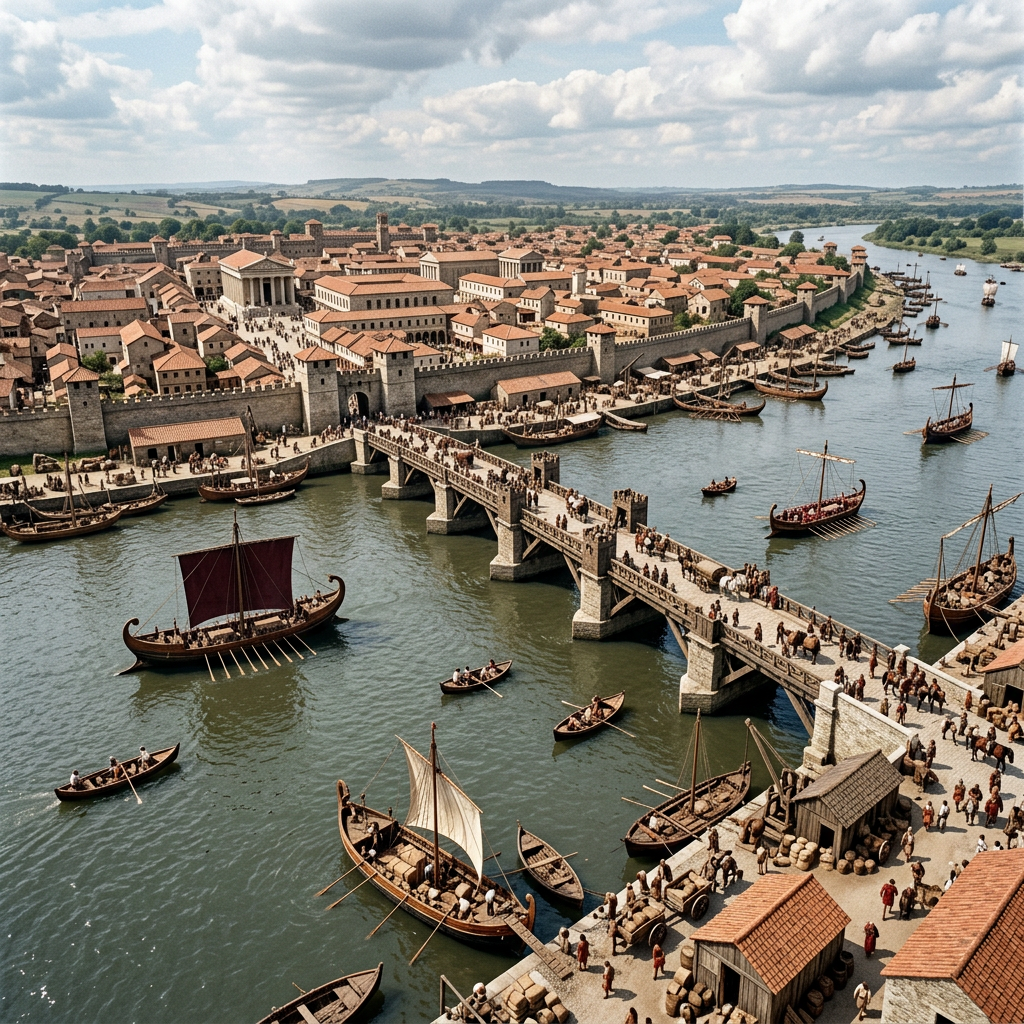
Introduction: Where an Empire Built the Foundations of a Global City
Modern London is one of the world’s greatest cities, a global center of finance, culture, and politics. Yet beneath its busy streets, towering skyscrapers, and historic landmarks lie the remains of a much older settlement—Londinium, the Roman city that laid the foundations for more than two thousand years of urban history.
Founded shortly after the Roman conquest of Britain in the first century CE, Londinium rapidly grew from a modest military settlement into one of the most prosperous cities of the Roman Empire in northwestern Europe. Positioned along the River Thames, it became a thriving center of commerce, administration, and military strategy, linking Britain with the wider Roman world.
Its streets echoed with the voices of merchants, soldiers, craftsmen, and travelers from across the empire. Stone forums, temples, bathhouses, warehouses, and defensive walls transformed the settlement into a symbol of Roman engineering and organization.
Although much of Roman Londinium disappeared beneath the medieval and modern city, archaeology continues to reveal remarkable evidence of its grandeur.
The story of Londinium is not simply the story of ancient London—it is the story of how Rome transformed a frontier settlement into one of Britain’s most important urban centers.
The Roman Conquest of Britain
The origins of Londinium cannot be understood without the Roman invasion of Britain.
Although Julius Caesar launched expeditions to Britain in 55 and 54 BCE, permanent conquest began nearly a century later.
In 43 CE, Emperor Claudius ordered a full-scale invasion led by Aulus Plautius, bringing southern Britain under Roman control.
As Roman forces advanced, they required secure military bases, supply centers, and commercial hubs.
One location proved ideal.
Near the narrowest practical crossing of the River Thames, Roman engineers established a settlement that would become Londinium.
Its strategic position allowed efficient movement of troops while providing access to maritime trade routes connecting Britain with Gaul and the rest of the empire.
Why Londinium Was Built
Unlike many British settlements that evolved gradually from earlier communities, Londinium appears to have been a planned Roman foundation.
Several factors made the site exceptionally attractive.
The Thames offered:
- Reliable river transport
- Access to the North Sea
- Commercial connections with continental Europe
- Natural protection
- Opportunities for bridge construction
The Romans quickly recognized that controlling this crossing meant controlling trade throughout southeastern Britain.
Within only a few years, Londinium had become one of the most important commercial centers in Roman Britain.

A City Destroyed by Boudica
The early success of Londinium faced its greatest challenge in 60–61 CE during the revolt led by Queen Boudica of the Iceni.
Following disputes with Roman authorities, Boudica united several British tribes in a massive uprising.
Roman governor Gaius Suetonius Paulinus judged Londinium impossible to defend with the forces available and ordered its evacuation.
The rebels entered the city and destroyed it almost completely.
Ancient historian Tacitus describes widespread destruction and heavy casualties.
Modern archaeology confirms extensive layers of burning dating to this period.
Despite the devastation, Londinium’s strategic importance ensured that Rome would rebuild it almost immediately.
The Rebirth of Londinium
The destruction caused by Boudica became an opportunity for ambitious reconstruction.
Roman planners redesigned the city with wider streets, improved drainage, stronger public buildings, and better commercial facilities.
During the late first and second centuries CE, Londinium experienced remarkable growth.
Its population expanded rapidly, making it one of the largest urban centers in Roman Britain.
The rebuilt city reflected Roman ideals of order, administration, and civic life.
Stone gradually replaced timber, while monumental public buildings emphasized imperial authority.
The Commercial Heart of Roman Britain
Trade became the foundation of Londinium’s prosperity.
Merchants imported luxury goods from across the empire, including:
- Wine
- Olive oil
- Fine pottery
- Glassware
- Jewelry
- Marble
- Spices
Meanwhile Britain exported:
- Wool
- Metals
- Grain
- Leather
- Agricultural products
Its bustling port connected Britain directly to continental Europe, making Londinium one of the empire’s busiest commercial centers in the northwest.

Public Buildings and Roman Life
As Londinium expanded, impressive public buildings transformed the settlement into a true Roman city.
Among its most important structures were:
- The Forum and Basilica
- Public bathhouses
- Temples dedicated to Roman deities
- Amphitheatre
- Markets
- Administrative headquarters
These buildings reflected the Roman commitment to urban planning and civic identity.
Life in Londinium increasingly resembled that of cities across the empire, demonstrating Rome’s ability to integrate distant provinces into a shared cultural and political system.
The Roman Bridge Across the Thames
One of Rome’s greatest engineering achievements in Britain was the construction of the first permanent bridge across the River Thames.
The bridge transformed Londinium into the region’s principal transportation hub.
Roads connected the city with major Roman settlements including:
- Verulamium
- Camulodunum
- Eboracum
- Aquae Sulis
These roads strengthened trade, military movement, and communication throughout Roman Britain.
The London Wall: Defending the City
By the late second century CE, Londinium had become one of the wealthiest and most strategically important cities in Roman Britain. As prosperity increased, so did the need for protection.
Around 190–225 CE, Roman engineers constructed the impressive London Wall, a massive stone fortification stretching nearly 3 kilometers (2 miles) around the city.
Built with limestone, ragstone, and brick, the wall featured defensive towers and fortified gates controlling access to Londinium.
Remarkably, large sections of the London Wall survived for centuries and influenced the layout of medieval and even modern London. Today, visitors can still see preserved portions integrated into the city’s streets and buildings, offering a tangible connection to Britain’s Roman past.
Military Importance
Although Londinium developed into a thriving commercial center, it also played a vital military role.
The city served as a logistical headquarters where troops, supplies, and information moved efficiently throughout the province.
Roman roads radiating from Londinium connected major military centers including:
- Eboracum (York)
- Verulamium (St Albans)
- Camulodunum (Colchester)
- Aquae Sulis (Bath)
These roads allowed governors to deploy soldiers rapidly while maintaining control over one of the empire’s most distant provinces.
The presence of military officials also reinforced Roman authority throughout southeastern Britain.

Daily Life in Roman Londinium
Life in Ancient Roman London reflected the extraordinary diversity of the Roman Empire.
The population included:
- Roman administrators
- Soldiers
- Celtic Britons
- Merchants
- Craftsmen
- Slaves
- Immigrants from across Europe, North Africa, and the eastern Mediterranean
Bustling markets filled the streets with imported goods, while workshops produced pottery, leather goods, jewelry, metalwork, and textiles.
Public bathhouses became centers of social life where citizens relaxed, discussed politics, and conducted business.
Food available in Londinium reflected the city’s international character, including bread, fish, oysters, pork, vegetables, wine, olive oil, and spices imported from across the empire.
Religion and Spiritual Life
Religion in Roman Londinium was remarkably diverse.
Roman settlers introduced temples dedicated to gods such as:
- Jupiter
- Mars
- Minerva
- Mercury
At the same time, many native Britons continued honoring local Celtic deities.
Religious beliefs gradually blended, creating unique forms of worship that combined Roman and British traditions.
One of the most remarkable archaeological discoveries was the Temple of Mithras, dedicated to the mysterious eastern cult of Mithras, which attracted many Roman soldiers and merchants.
The discovery of this temple in modern London remains one of the city’s most significant archaeological finds.
Londinium at Its Peak
During the second century CE, Londinium reached its greatest prosperity.
Historians estimate that the city’s population may have exceeded 45,000–60,000 inhabitants, making it one of the largest settlements in Roman Britain.
Its impressive urban landscape included:
- A vast Forum and Basilica
- Government offices
- Warehouses
- Temples
- Public baths
- An amphitheatre
- Residential districts
- A thriving river port
The city’s economy flourished through trade with Gaul, Germania, Hispania, and other provinces, establishing Londinium as the commercial heart of Roman Britain.

The Decline of Roman Londinium
Beginning in the late third century CE, the Roman Empire entered a prolonged period of political instability and economic decline.
Britain faced increasing pressure from:
- Saxon raiders
- Internal rebellions
- Economic disruption
- Reduced imperial support
When Roman administration gradually withdrew from Britain around 410 CE, Londinium lost its political importance.
Many public buildings fell into disrepair, commercial activity declined, and large sections of the city were eventually abandoned.
Yet the infrastructure built by the Romans—roads, bridges, and defensive walls—continued to influence later settlements.
Archaeological Discoveries
Modern archaeology has transformed our understanding of Ancient Roman Londinium.
Excavations beneath London’s streets have uncovered extraordinary remains, including:
- The Roman amphitheatre
- Sections of the London Wall
- The Temple of Mithras
- Mosaic floors
- Coins
- Pottery
- Wooden writing tablets
- Merchant warehouses
- Human burials
Among the most fascinating discoveries are the Bloomberg Tablets, wooden documents preserving everyday correspondence from the first century CE.
These writings provide rare insights into business transactions, legal matters, and daily life in Roman Britain.
Together, these discoveries allow historians to reconstruct one of the empire’s most important provincial capitals.

The Legacy of Londinium
The legacy of Londinium extends far beyond archaeology.
The Romans established the city’s strategic location, road network, commercial importance, and administrative foundations—elements that helped shape London’s future development.
Over the centuries, Saxons, Normans, medieval merchants, and modern engineers all built upon the framework first established during Roman rule.
Today, millions walk the streets of London without realizing that beneath their feet lie the remains of one of the Roman Empire’s greatest cities.
Londinium serves as a powerful reminder that the foundations of modern civilization often rest upon the achievements of ancient societies.
Conclusion
The story of Londinium is the story of transformation.
What began as a modest Roman settlement beside the River Thames became the economic, political, and military heart of Roman Britain.
Despite invasion, destruction, and eventual decline, the city endured through the centuries, evolving into one of the world’s greatest capitals.
Its walls, temples, marketplaces, and roads disappeared beneath new generations of construction, but their influence never truly vanished.
Ancient Londinium stands as one of Rome’s greatest successes beyond continental Europe—a city whose foundations continue to support the heartbeat of modern London more than two thousand years after the first Roman soldiers crossed the Thames.

Fortisetliber’s View
Every great city has a beginning.
Some emerge from ancient kingdoms, others from medieval castles or bustling ports. London, however, owes its earliest urban foundations to a bold Roman vision. Beneath the modern metropolis lies Londinium, a city built not by chance, but by the remarkable ability of Rome to recognize opportunity and transform it into prosperity.
When Roman engineers crossed the River Thames in the first century CE, they did more than establish another provincial settlement. They identified a location where geography, trade, and military strategy converged. From that insight grew a city that would become the heart of Roman Britain and, centuries later, one of the world’s most influential capitals.
The story of Londinium also reminds us that history is rarely a straight path. The city was devastated during Boudica’s revolt, yet it rose again stronger than before. Its destruction became the foundation for an even greater reconstruction, proving that resilience has always been one of London’s defining characteristics.
From the perspective of FortisLiber, Londinium represents one of Rome’s greatest strengths: the ability to create lasting institutions rather than temporary victories. Roads, bridges, marketplaces, walls, and public buildings were not merely symbols of imperial authority—they were investments in stability, commerce, and the future. Long after the legions departed Britain, the framework they created continued to shape the city’s development.
Perhaps this is why Londinium remains so fascinating today. Modern London is often viewed as a symbol of innovation and global influence, yet its earliest heartbeat still echoes beneath its streets. Archaeologists continue to uncover temples, mosaics, writing tablets, and sections of the Roman wall, reminding us that every generation builds upon the achievements of those who came before.
History teaches us that civilizations rarely disappear completely. They leave behind ideas, infrastructure, and lessons that quietly shape the future. Londinium is a perfect example. Though the Roman Empire faded, the city it founded endured, adapted, and ultimately became one of humanity’s greatest urban success stories.
The greatest legacy of Londinium is not simply that it became London. It is that it demonstrates how vision, planning, and resilience can outlive empires themselves. Beneath every modern skyline lies an older story waiting to be remembered—and beneath London, that story still speaks with a Roman voice.
Leave a Reply