
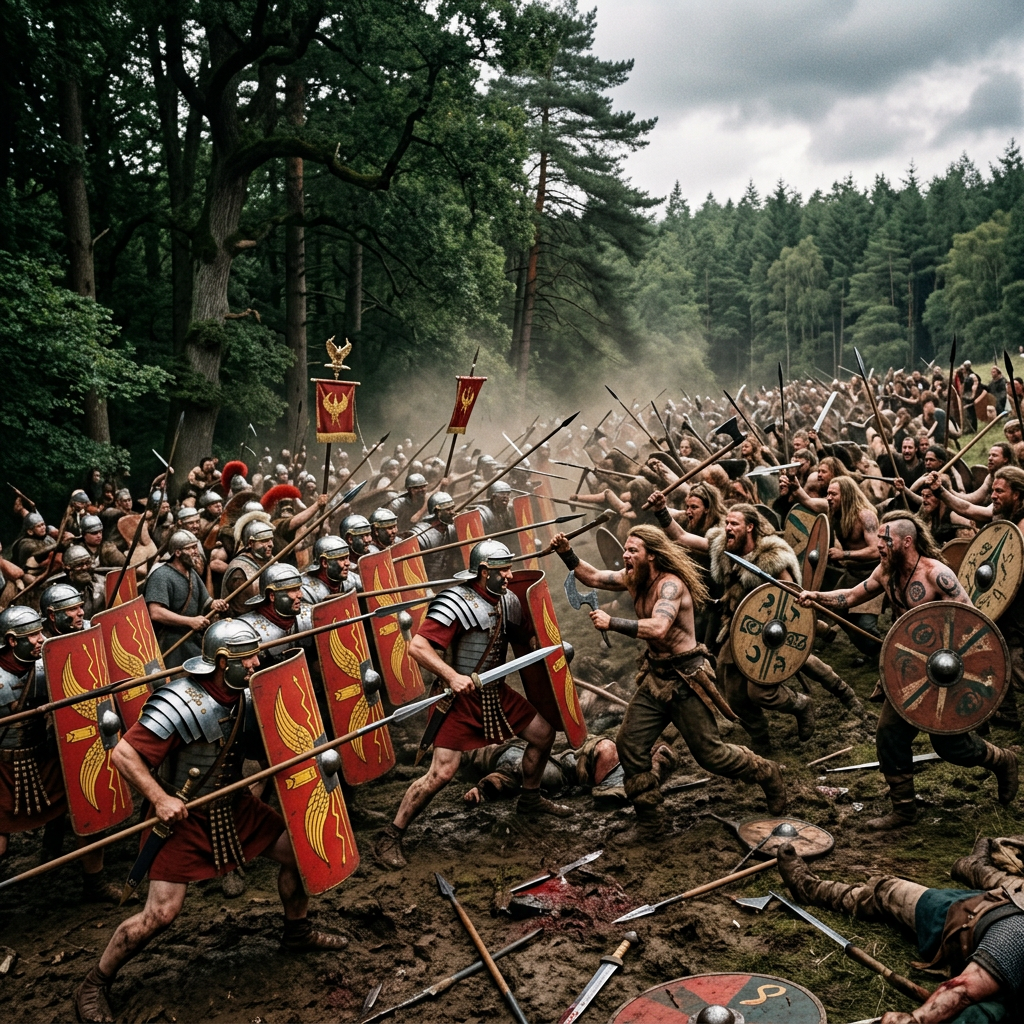
Introduction
The Battle of Watling Street (60/61 AD) stands as one of the most decisive military engagements in the history of Roman Britain.
Fought during the dramatic rebellion led by the Iceni queen Boudica, the battle marked the final confrontation between the forces of the Roman Empire and a coalition of British tribes seeking to overthrow Roman rule.
Although heavily outnumbered, the Roman army, commanded by Gaius Suetonius Paulinus, achieved a remarkable victory through superior discipline, tactical planning, and battlefield positioning. The defeat shattered the rebellion, secured Roman control over Britain for centuries, and transformed the future of the province.
Despite its immense historical importance, the exact location of the Battle of Watling Street remains unknown, adding an enduring element of mystery to one of antiquity’s most famous military encounters.
Historical Background
The Roman Conquest of Britain
The Roman conquest of Britain began in 43 AD under Emperor Claudius. Roman legions quickly established control over southeastern Britain, building roads, forts, and new administrative centers.
However, Roman rule brought:
- Heavy taxation
- Land confiscations
- Political interference
- Cultural disruption
Many native tribes accepted Roman authority, while others harbored deep resentment.
Who Was Boudica?
Boudica was queen of the Iceni, a Celtic tribe in eastern Britain.
Following the death of her husband, King Prasutagus, Roman officials ignored his will, annexed Iceni territory, confiscated property, publicly flogged Boudica, and reportedly assaulted her daughters.
These actions sparked one of the greatest revolts against Roman authority.
Boudica’s Revolt
Beginning around 60 AD, Boudica united numerous British tribes against Rome.
Her army destroyed several Roman settlements, including:
- Camulodunum
- Londinium
- Verulamium
Ancient Roman historians report widespread destruction and thousands of deaths among Roman settlers and their allies.
The rebellion represented the greatest threat to Roman rule in Britain since the invasion.

Suetonius Paulinus Returns
At the outbreak of the revolt, Governor Gaius Suetonius Paulinus was campaigning against tribes in western Britain.
Upon learning of the uprising, he rapidly marched east with the forces he could gather.
His army consisted primarily of:
- Legio XIV Gemina
- Detachments of Legio XX Valeria Victrix
- Auxiliary infantry
- Auxiliary cavalry
In total, historians estimate between 10,000 and 12,000 Roman soldiers.
The Battlefield
Although traditionally called the Battle of Watling Street, the exact location remains unknown.
Possible sites include areas along the Roman road known as Watling Street, stretching across central England.
Leading theories place the battlefield somewhere in:
- West Midlands
- Warwickshire
- Leicestershire
- Staffordshire
No archaeological discovery has definitively identified the battlefield.
Opposing Forces
Roman Army
Estimated strength:
- 10,000–12,000 men
Advantages:
- Professional soldiers
- Superior discipline
- Heavy armor
- Standardized weapons
- Advanced battlefield tactics
Main weapons:
- Pilum (throwing spear)
- Gladius (short sword)
- Scutum (large shield)
British Coalition
Boudica’s force likely included warriors from:
- Iceni
- Trinovantes
- Cornovii
- Other allied tribes
Ancient sources claim over 200,000 warriors, although modern historians consider this a significant exaggeration.
Most estimates suggest a force several times larger than the Roman army.

Roman Battle Plan
Suetonius carefully selected the battlefield.
Its advantages included:
- Narrow entrance
- Forest protecting the rear
- Open ground before the Romans
- Limited opportunity for enemy flanking
This forced the numerically superior Britons to attack head-on.
The Roman formation consisted of:
- Infantry in the center
- Auxiliary troops on the flanks
- Cavalry positioned on the wings
The narrow battlefield prevented the Britons from surrounding the Roman line.
The Battle Begins
As Boudica’s warriors advanced in massive numbers, the Romans held their position.
Only when the enemy approached effective range did Suetonius order the first attack.
Roman soldiers launched volleys of pila.
The heavy spears:
- Penetrated shields
- Wounded front ranks
- Created confusion
Immediately afterward, Roman infantry advanced.
The Wedge Formation
Roman legionaries attacked using a wedge-like advance.
Their discipline proved decisive.
While British warriors relied on individual bravery and momentum, Roman soldiers fought as organized units.
Advantages included:
- Shield coordination
- Rotating front ranks
- Close combat training
- Cohesive command structure
The Roman line steadily pushed forward.
British Collapse
As casualties mounted, panic spread among Boudica’s coalition.
Compounding the disaster, many British families had gathered behind the army with wagons to witness what they expected to be a victory.
When the warriors attempted to retreat, the wagons created a deadly bottleneck.
Thousands became trapped.
Roman infantry and cavalry exploited the chaos.
The British army disintegrated.

Casualties
Ancient historian Tacitus reports:
- Approximately 80,000 Britons killed
- Around 400 Roman casualties
Most modern historians believe these figures were exaggerated but agree the Roman victory was overwhelming.
The Fate of Boudica
Following the defeat, Boudica disappeared from history.
Ancient sources offer two possibilities:
- She took poison to avoid capture.
- She died from illness shortly after the battle.
Her burial place remains unknown.
Although defeated militarily, she became one of Britain’s greatest national heroes.
Why the Romans Won
Several factors explain the Roman victory.
Superior Leadership
Suetonius demonstrated exceptional battlefield judgment by choosing ideal terrain.
Discipline
Roman soldiers maintained formation under immense pressure.
Equipment
Heavy armor and shields offered major protection.
Tactical Flexibility
Roman command allowed coordinated attacks rather than individual combat.
British Overconfidence
The enormous size of Boudica’s force became a disadvantage within restricted terrain.
Consequences of the Battle
The Battle of Watling Street ended the largest rebellion in Roman Britain.
Its consequences included:
- Collapse of organized British resistance
- Continued Roman occupation
- Expansion of Roman towns
- Growth of infrastructure
- Increased military presence
Roman Britain would remain under imperial rule for more than three centuries.

Archaeological Evidence
Unlike many famous battles, Watling Street has not been conclusively located.
Researchers continue studying:
- Roman roads
- Ancient landscapes
- Coin finds
- Military artifacts
Modern archaeology may eventually identify the battlefield.
Legacy of the Battle
The Battle of Watling Street became a symbol of:
- Roman military professionalism
- Indigenous resistance
- Leadership under adversity
Boudica herself evolved into a national icon of courage and independence.
Her story inspired literature, paintings, sculptures, and political symbolism throughout British history.
Battle of Watling Street in Popular Culture
The battle has appeared in:
- Historical novels
- Television documentaries
- Academic research
- Strategy games
- Military studies
Modern historians continue debating:
- The battle’s exact location
- Army sizes
- Casualty numbers
- Tactical details
Visiting Sites Associated with Boudica’s Revolt
Although the battlefield remains unidentified, visitors can explore important locations connected to the campaign:
- Colchester Castle
- Museum of London
- Verulamium Museum
- Boudica Statue
These sites preserve the memory of one of Britain’s defining historical episodes.
Frequently Asked Questions (FAQ)
Where was the Battle of Watling Street fought?
The exact location remains unknown, although it likely occurred somewhere along the Roman road known as Watling Street in central England.
Who fought in the Battle of Watling Street?
The battle was fought between the Roman army under Gaius Suetonius Paulinus and a coalition of British tribes led by Queen Boudica.

Why was the battle important?
It ended Boudica’s revolt and secured Roman control of Britain for more than 300 years.
How did the Romans defeat a much larger army?
Superior discipline, tactical positioning, heavy equipment, and effective leadership allowed the Romans to overcome overwhelming numerical odds.
What happened to Boudica?
Ancient sources suggest she either took poison or died from illness shortly after the battle. Her final resting place remains unknown.
Conclusion
The Battle of Watling Street (60/61 AD) was a defining moment in the history of Roman Britain. Against overwhelming odds, the disciplined forces of Gaius Suetonius Paulinus halted the rebellion led by Boudica, preserving Roman authority and reshaping the future of Britain.
Although the exact battlefield has yet to be discovered, the battle’s significance is unquestionable. It demonstrated the effectiveness of Roman military organization while cementing Boudica’s legacy as a symbol of resistance, courage, and the enduring desire for freedom.
Nearly two millennia later, the Battle of Watling Street continues to captivate historians, archaeologists, and military enthusiasts, standing as one of antiquity’s most remarkable clashes between empire and rebellion.
Fortisetliber’s View
From a FortisLiber perspective, the Battle of Watling Street (60/61 AD) is more than the final chapter of Boudica’s rebellion—it is a timeless lesson in how leadership, preparation, and discipline can determine the outcome of history. It reminds us that numerical superiority alone is rarely enough to secure victory when confronted by a well-trained and strategically commanded force.
Queen Boudica has become one of Britain’s greatest symbols of resistance against oppression. Her revolt was born from injustice, fueled by the mistreatment of her family and the harsh policies imposed by Roman authorities. In many ways, she embodied the determination of a people unwilling to surrender their freedom without a fight. Yet courage, while inspiring, was not enough to overcome the military machine of Rome.
The Roman commander Gaius Suetonius Paulinus demonstrated the qualities that defined the empire’s greatest generals: patience, tactical awareness, and an understanding of terrain. By choosing a battlefield that neutralized the Britons’ numerical advantage, he transformed a seemingly impossible situation into one of history’s most remarkable military victories. The battle illustrates that strategy often outweighs sheer strength.
For FortisLiber, the Battle of Watling Street also highlights the complexity of history. It was not a simple struggle between good and evil, but a collision between two worlds—an expanding empire seeking stability and control, and native tribes fighting to preserve their independence, traditions, and identity. Both sides believed they were defending their future, making the conflict one of antiquity’s most compelling confrontations.
Today, although the exact battlefield remains unknown, the legacy of Watling Street endures. It stands as a reminder that civilizations are shaped not only by victories and defeats, but by the decisions, sacrifices, and resilience of those who lived through them.
Nearly two thousand years later, the courage of Boudica and the discipline of the Roman legions continue to fascinate historians, proving that some battles never fade from collective memory—they become part of humanity’s shared heritage.
Leave a Reply