
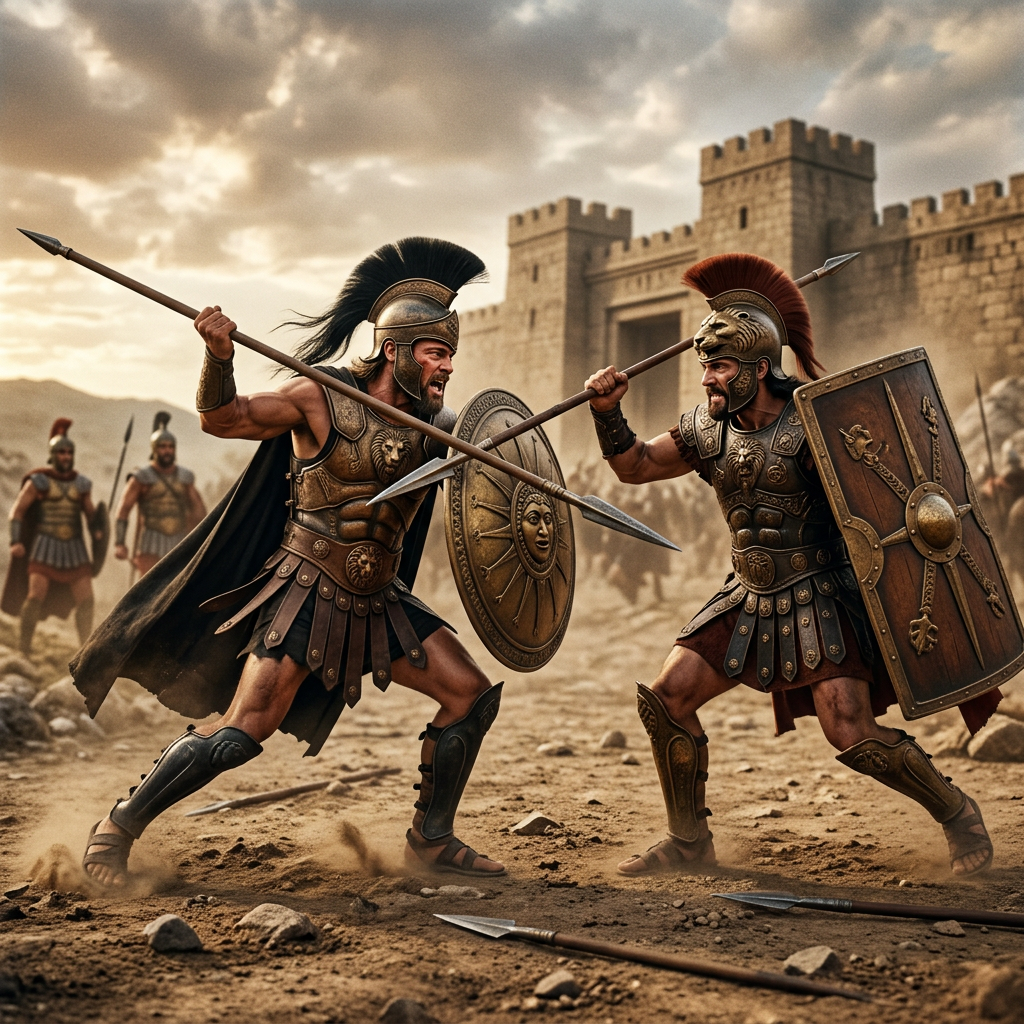
Introduction: The Greatest Duel of the Ancient World
Few moments in ancient literature have captured the imagination of readers for more than two thousand years like the legendary duel between Achilles and Hector. Described in Homer’s Iliad, this dramatic confrontation represents far more than a battle between two exceptional warriors. It symbolizes the clash of honor and destiny, rage and duty, glory and mortality.
Set during the final years of the Trojan War, the duel brought together the greatest champion of the Greek armies, Achilles, and Troy’s noblest defender, Hector. Their encounter would determine not only the fate of individuals but also the future of one of history’s most famous cities.
Whether viewed as mythology, heroic tradition, or a reflection of Bronze Age warfare, the story of Achilles versus Hector continues to inspire historians, writers, military scholars, and lovers of classical literature around the world.
The Trojan War: A Conflict Between Legends
According to Greek tradition, the Trojan War began after Paris, prince of Troy, abducted or eloped with Helen, wife of the Spartan king Menelaus.
In response, a coalition of Greek kings launched an expedition against Troy under the command of Agamemnon.
The conflict brought together many legendary heroes, including:
- Achilles
- Odysseus
- Ajax
- Diomedes
- Nestor
On the Trojan side stood equally remarkable defenders:
- Hector
- Paris
- Aeneas
- Sarpedon
- Glaucus
For nearly ten years, neither side achieved complete victory.
Achilles: Greece’s Greatest Warrior
Among all the Greek champions, none equaled Achilles in combat.
The son of the mortal king Peleus and the sea goddess Thetis, Achilles possessed extraordinary strength, speed, and martial skill.
Ancient tradition portrayed him as nearly invincible, with later myths giving rise to the famous story of his vulnerable heel.
Beyond his physical abilities, Achilles embodied the heroic ideal of seeking eternal glory (kleos) through great deeds.
However, his greatest weakness was not physical—it was his overwhelming pride and uncontrollable anger.
This flaw would shape the entire narrative of the Iliad.

Hector: The Guardian of Troy
If Achilles fought primarily for personal honor, Hector fought for something greater.
As the eldest son of King Priam and heir to the Trojan throne, Hector carried the responsibility of protecting his family, his people, and his city.
Unlike many heroes driven by ambition or revenge, Hector consistently placed duty above personal desire.
He was:
- A brilliant military commander.
- A devoted husband to Andromache.
- A loving father.
- A respected prince.
- Troy’s greatest defender.
These qualities have made Hector one of antiquity’s most admired tragic heroes.
The Death of Patroclus
The events leading to the famous duel began with a devastating loss.
Following a bitter dispute with Agamemnon, Achilles withdrew from the fighting, refusing to aid the Greek army.
As Trojan forces gained the upper hand, Achilles’ closest companion, Patroclus, entered battle wearing Achilles’ armor in an attempt to inspire the Greeks.
Initially successful, Patroclus pushed the Trojans back toward their city.
However, he eventually encountered Hector.
In one of the Iliad’s most emotional episodes, Hector killed Patroclus and claimed Achilles’ magnificent armor as a trophy.
This single event transformed the course of the war.
Achilles Returns to Battle
News of Patroclus’ death shattered Achilles.
His grief quickly became overwhelming rage.
Determined to avenge his fallen companion, Achilles reconciled with Agamemnon and returned to the battlefield wearing magnificent new armor forged by the divine smith Hephaestus.
His return terrified the Trojans.
Homer describes Achilles advancing almost like an unstoppable force of nature.
Every encounter ended in Greek victory.
Every Trojan warrior feared meeting him in combat.
Only one man remained willing to stand before him.

Hector’s Decision
As Achilles approached the walls of Troy, most Trojan soldiers retreated behind the city’s massive gates.
Hector remained outside.
Despite pleas from his parents to seek safety, he chose to face Achilles alone.
His decision reflected the highest ideals of heroic duty.
Hector understood the enormous risk before him.
Yet abandoning the battlefield would have meant abandoning Troy itself.
Knowing that death was likely, he accepted his responsibility as protector of his people.
His courage transformed the coming duel into one of the greatest acts of heroism in world literature.
The Duel Before the Walls of Troy
When Achilles finally confronted Hector, the Trojan prince briefly fled around the walls of Troy.
Three times the two warriors circled the city before Hector resolved to make his stand.
The gods themselves watched the confrontation.
Athena, favoring the Greeks, intervened by deceiving Hector into believing he would receive assistance.
Confident that he no longer stood alone, Hector turned to fight.
The decisive duel had begun.
The Duel That Changed the War
Standing before the walls of Troy, Achilles and Hector prepared for the inevitable confrontation.
Hector was the first to speak, proposing that whichever warrior fell should have his body returned to his family for proper burial.
Achilles, consumed by grief and fury over the death of Patroclus, rejected the proposal outright. His anger had grown beyond the customs that traditionally governed heroic warfare.
The duel began with both warriors demonstrating exceptional skill. Hector launched his spear first, but it failed to strike a fatal blow. Believing he still had support, he called for another weapon—only to discover that the ally beside him was an illusion created by the goddess Athena, who had deceived him.
Realizing that the gods had abandoned him, Hector accepted his fate.
Achilles seized the moment. Guided by Athena, he hurled his spear with deadly precision, striking Hector in the neck—the only vulnerable point not protected by his armor.
Mortally wounded, Hector collapsed before the greatest warrior of the Greek army.

The Death of Hector
With his final breaths, Hector pleaded for his body to be returned to his family.
Achilles refused.
Instead, he declared that no birds or beasts would be prevented from feeding upon his fallen enemy.
After Hector died, Achilles pierced the prince’s ankles, tied the body to his chariot, and dragged it around the walls of Troy before the horrified eyes of the Trojans.
This shocking act stands as one of the most controversial moments in the Iliad. It demonstrated that Achilles’ overwhelming grief had driven him beyond the heroic ideals he once embodied.
For Homer, victory without compassion came at a profound moral cost.
King Priam’s Courage
One of the most moving episodes in ancient literature occurs after Hector’s death.
Guided by the god Hermes, the elderly King Priam secretly entered the Greek camp and approached Achilles.
Rather than appealing to the conqueror’s pride, Priam appealed to his humanity.
He reminded Achilles of his own father, Peleus, and begged for Hector’s body so that Troy could honor its greatest defender with a proper funeral.
The encounter transformed Achilles.
For the first time since Patroclus’ death, his rage gave way to compassion.
Deeply moved, Achilles returned Hector’s body, granted a temporary truce, and allowed the Trojans to perform the funeral rites.
This moment marks the emotional climax of the Iliad, demonstrating that mercy can achieve what violence cannot.
Historical and Mythological Perspectives
Whether the duel between Achilles and Hector reflects an actual historical event remains a subject of scholarly debate.
Most historians agree that the Trojan War, if it occurred, likely differed considerably from Homer’s poetic account.
Archaeological excavations at the ancient site of Troy indicate that the city experienced multiple destructions during the Late Bronze Age, suggesting that memories of real conflicts may have inspired later traditions.
However, the individual heroes, divine interventions, and dramatic details preserved in the Iliad belong primarily to the realm of epic poetry rather than verifiable history.
Regardless of historical certainty, the duel has become one of humanity’s most enduring literary symbols.

Themes That Transcend Time
The confrontation between Achilles and Hector continues to resonate because it explores universal human experiences.
Among its central themes are:
- Honor versus revenge.
- Duty versus personal glory.
- The burden of leadership.
- Mortality and the search for lasting fame.
- The destructive power of anger.
- Compassion after conflict.
These themes explain why the Iliad remains essential reading more than twenty-seven centuries after it was composed.
The Legacy of Achilles and Hector
The duel has influenced countless generations of writers, philosophers, artists, and military thinkers.
Its legacy appears in:
- Classical literature.
- Renaissance art.
- Modern novels.
- Films and television.
- Military ethics.
- Leadership studies.
- Philosophy.
- Popular culture.
Achilles has become the archetype of the nearly invincible warrior whose greatest battle is against his own emotions.
Hector represents the noble defender who knowingly accepts sacrifice for the greater good.
Together, they embody two contrasting yet equally compelling visions of heroism.
Conclusion
The legendary confrontation between Achilles and Hector remains one of the defining moments of world literature.
More than a duel between two extraordinary warriors, it is a timeless exploration of courage, loss, vengeance, honor, and forgiveness.
Achilles achieved victory, yet his triumph was incomplete until compassion restored his humanity. Hector fell in battle, yet his unwavering devotion to family and city ensured that his honor would outlive his death.
For over two millennia, the duel before the walls of Troy has reminded humanity that true greatness is measured not only by victories won in combat but also by the character displayed in moments of suffering, choice, and reconciliation. That enduring lesson continues to give the story of Achilles and Hector its extraordinary power.
Fortisetliber’s View
History often asks a simple question: Who won? Yet the greatest stories of humanity invite a different one: What made each person worthy of remembrance? The duel between Achilles and Hector endures not because one warrior defeated the other, but because each embodied a different vision of what it means to be truly great.
Achilles was the warrior every army desired. Gifted with unmatched strength, speed, and courage, he sought kleos—the eternal glory that outlives mortal life. He believed that a short life filled with extraordinary deeds was preferable to a long life forgotten by history. For Achilles, greatness was earned on the battlefield, where excellence demanded absolute commitment and fear had no place.
Hector stood for another ideal. He fought not for personal fame but for responsibility. Every time he walked through the gates of Troy, he knew his decisions affected far more than his own reputation. He was a prince, a husband, a father, and the defender of an entire city. His courage was not born from the certainty of victory but from the willingness to stand firm despite knowing that defeat was possible.
From the perspective of FortisLiber, neither path diminishes the other. Civilizations need extraordinary individuals capable of remarkable achievements, but they also depend upon those who quietly accept responsibility for the people and values entrusted to them. History advances through both ambition and duty, through those who challenge the impossible and those who protect what already exists.
The tragedy of the duel is that neither hero leaves the battlefield truly victorious. Achilles wins the fight but discovers that vengeance cannot erase grief. Hector loses his life, yet gains something even death cannot take away: enduring respect. His final stand transforms him from a prince defending a city into one of the greatest symbols of courage in world literature.
Perhaps this explains why Homer’s epic has survived for nearly three thousand years. The Iliad is not merely a story about war. It is a meditation on human nature. It reminds us that even the strongest warrior cannot escape loss, and even the defeated can achieve a form of immortality through character.
Modern society often celebrates success while overlooking sacrifice. Achilles and Hector challenge that way of thinking. One teaches us that excellence demands relentless dedication. The other reminds us that true leadership sometimes means accepting unbearable burdens without expecting recognition. Together, they reveal that greatness has more than one face.
In the end, Troy’s walls witnessed more than the death of a hero—they witnessed the meeting of two timeless ideals. One pursued glory that would echo through the ages. The other chose duty, even when it led toward certain death. Both achieved what every hero seeks: to be remembered.
The duel between Achilles and Hector teaches us that history’s greatest legacy is not measured solely by victory. It is measured by the principles we refuse to abandon when everything else is at stake. Glory may win battles, and duty may lose them, but character is what grants immortality. That is why, after thousands of years, the world still speaks the names of both warriors—not as enemies alone, but as two enduring symbols of the human spirit.
Leave a Reply