
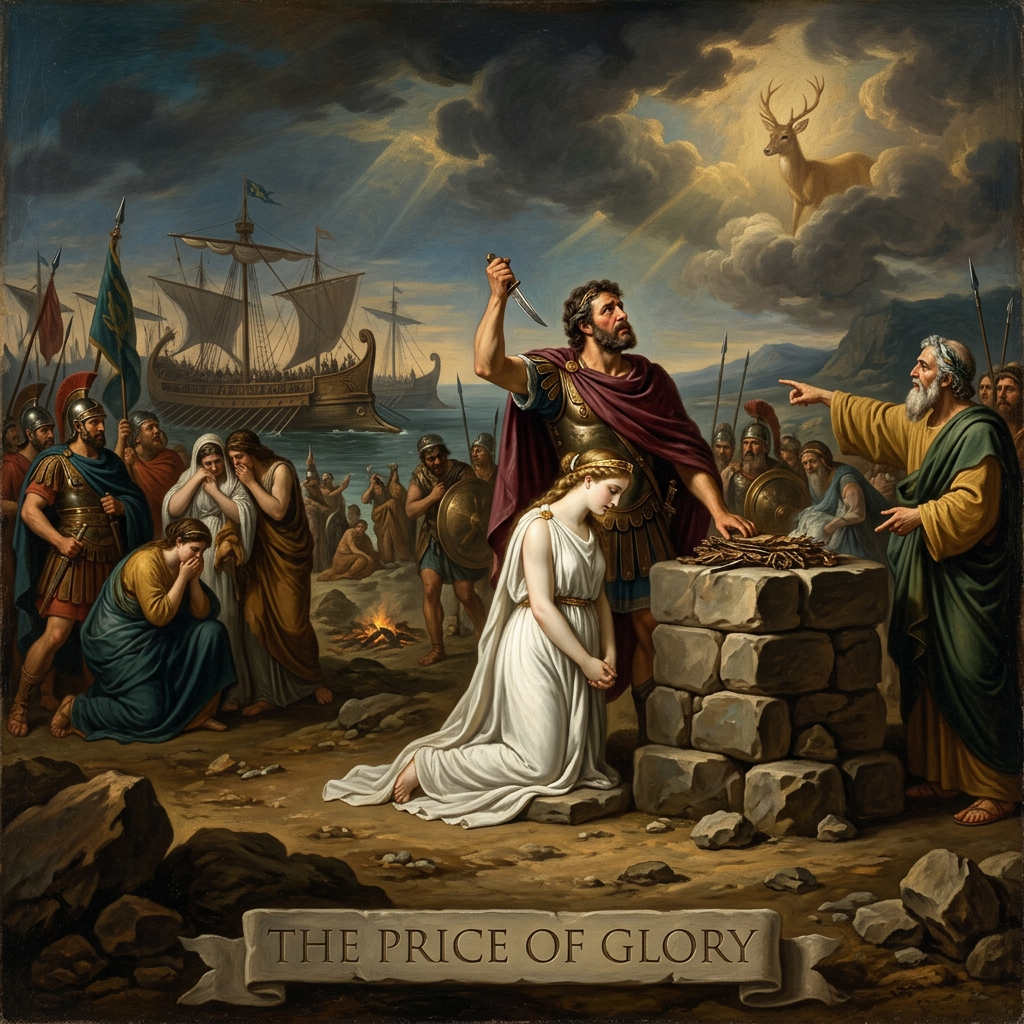
When a king was forced to choose between his daughter, the gods, and an army bound for Troy
Before the ships of the Greeks could sail toward Troy, they faced an unexpected enemy: silence.
The great fleet had gathered at Aulis, on the coast of Boeotia, carrying warriors, kings, and heroes who were preparing for the expedition against Troy. Yet the ships could not leave. The winds had fallen still.
For the Greeks, this was not simply an inconvenience. It was a sign.
The gods had been offended, and the price demanded for the journey was horrifying.
The prophet Calchas revealed that Artemis, goddess of the hunt and protector of wild animals, had been angered by Agamemnon, commander of the Greek forces. To restore the goddess’s favor and bring back the winds, Agamemnon would have to sacrifice his own daughter:
Iphigenia.
The story of the Sacrifice of Iphigenia is one of the darkest and most powerful myths of ancient Greece. It stands at the intersection of religion, warfare, family, honor, and fate—and raises a question that has troubled audiences for more than two thousand years:
How far can a person go in the name of duty?
Iphigenia, Daughter of a King
Iphigenia was the daughter of Agamemnon, king of Mycenae and commander of the Greek expedition against Troy, and Clytemnestra, his wife.
Her family stood at the center of one of the great mythological dynasties of Greece. Her father would become the supreme commander of the Greek army during the Trojan War, while her mother would later play a central role in one of the most famous cycles of Greek tragedy.
But at Aulis, Iphigenia was not a warrior or a political leader.
She was a young woman whose fate was suddenly determined by the ambitions and obligations of men.
According to the tradition dramatized by Euripides in Iphigenia in Aulis, Agamemnon summoned his daughter to Aulis under a terrible deception. Iphigenia was led to believe that she had been brought there to marry Achilles, the greatest warrior among the Greeks.
Instead, she had been brought to die.
The contrast could hardly be more brutal.
A wedding was expected.
A sacrifice awaited her.
Euripides turns this deception into one of the central emotional tensions of the tragedy. Iphigenia arrives with the expectations of a bride, while her father struggles with the knowledge that she has been brought to the army’s camp so that her life can be offered to Artemis.

Why Did Artemis Demand Iphigenia’s Death?
The mythology surrounding the anger of Artemis varies between ancient sources and traditions.
In the version associated with Iphigenia in Aulis, Agamemnon had offended Artemis, and the goddess prevented the Greek fleet from sailing. The prophet Calchas declared that only the sacrifice of Iphigenia could restore favorable winds.
The goddess Artemis was not simply a deity of hunting. She was associated with wilderness, animals, virginity, and the protection of the young. Her relationship with Iphigenia therefore creates an especially striking element in the myth: a goddess associated with protecting young life becomes the figure to whom a young woman must supposedly be sacrificed.
The sacrifice also reflects a broader feature of ancient Greek mythology.
The gods were powerful, but they were not necessarily compassionate by human standards.
Divine justice could be mysterious, unpredictable, and terrifying. A king could command armies, but he could not simply ignore the will of the gods.
Agamemnon therefore finds himself trapped between two forms of authority: his responsibility as a father and his responsibility as commander of the Greek expedition.
Agamemnon’s Impossible Choice
The tragedy of Agamemnon and Iphigenia lies in the fact that neither choice is presented as simple.
If Agamemnon refuses the sacrifice, the Greek fleet may never reach Troy. The expedition could collapse before it begins. His authority as commander would be threatened, and the warriors who had gathered for the campaign could turn against him.
If he agrees, he becomes the father who has allowed his own daughter to die.
This conflict is central to Euripides’ tragedy.
Agamemnon is not portrayed as a man who calmly welcomes the sacrifice. He struggles, hesitates, attempts to reverse his decision, and recognizes the horror of what he is being asked to do.
But events have already begun moving beyond his control.
The Greek army is waiting.
The prophecy has been delivered.
The fleet is ready.
And the gods, according to the story, demand payment.
The result is one of the most disturbing ideas in Greek mythology: sometimes tragedy emerges not because a character wants evil, but because every available choice carries destruction.

Clytemnestra Learns the Truth
If Agamemnon represents the conflict between military duty and fatherhood, Clytemnestra represents the fury of a mother confronted with the destruction of her child.
She had originally been told that Iphigenia would marry Achilles.
But Achilles himself knows nothing about the supposed marriage.
When the deception is exposed, Clytemnestra realizes that her daughter has been brought to Aulis for another purpose.
The revelation transforms the atmosphere of the story.
What had appeared to be a royal wedding becomes a death sentence.
Clytemnestra confronts Agamemnon, while Achilles, enraged that his name has been used to deceive Iphigenia, offers to defend her. In Euripides’ play, Achilles is prepared to oppose the forces demanding the sacrifice. Yet the situation is larger than any one man. The Greek army itself has become part of the pressure surrounding the royal family.
The individual is now caught beneath the weight of the collective.
That tension would become one of the defining themes of Greek tragedy.
The Sacrifice of Iphigenia
Perhaps the most remarkable transformation in the story occurs when Iphigenia learns the truth.
At first, she is horrified.
But in the Euripidean version, she eventually decides to accept her fate.
Her reasoning is extraordinary.
If her death will allow the Greek fleet to sail, if it will enable the Greeks to recover Helen and begin the campaign against Troy, then perhaps her death can serve a greater purpose.
Iphigenia transforms from victim into willing participant.
This does not make the story less tragic.
In some ways, it makes it more disturbing.
The idea of a noble sacrifice in ancient Greece could give death a meaning beyond the individual. A person’s death could be understood as benefiting the wider community, preserving honor, or allowing a military cause to succeed. The tradition surrounding Iphigenia reflects this ancient concept of sacrificing oneself for something regarded as larger than one’s own life.
But modern readers may see another possibility.
Perhaps Iphigenia’s acceptance is not simply heroic.
Perhaps it is the final consequence of living in a world where individuals are expected to surrender themselves to kings, armies, gods, and destiny.
That ambiguity is one reason the myth has survived.

Did Iphigenia Really Die?
Here the story becomes even more complicated.
There are different versions of the Iphigenia myth, and they do not all agree about her final fate.
In the version associated with Euripides’ Iphigenia in Aulis, a remarkable divine intervention occurs. At the moment of the sacrifice, Artemis saves Iphigenia and substitutes a deer in her place.
The Greeks hear the sacrifice take place, but Iphigenia disappears, leaving the animal at the altar.
Artemis then carries Iphigenia away, and in later tradition she becomes associated with the goddess’s sanctuary at Tauris, where she serves as a priestess.
This creates a fascinating contradiction.
The story begins with Iphigenia being offered to Artemis.
It ends, in this version, with Artemis saving her.
The goddess who demanded—or appeared to demand—her death becomes the source of her survival.
The Connection to the Trojan War
The Sacrifice of Iphigenia and the Trojan War are inseparably connected.
The Greek fleet’s journey to Troy could not begin until the crisis at Aulis was resolved. Iphigenia’s story therefore becomes the dark threshold through which the entire Trojan expedition must pass.
Before Achilles can fight Hector, before Odysseus can devise his famous strategy, before Troy becomes synonymous with war and destruction, there is Aulis.
There is a motionless fleet.
There is an anxious army.
And there is a young woman standing before an altar.
The sacrifice becomes a symbolic price for the war that follows.
This is important because Greek mythology rarely presents war as something glorious without consequences. Behind the famous heroes and legendary battles are families destroyed, cities burned, and individuals sacrificed to causes that they did not choose.
Iphigenia is one of the earliest and most powerful reminders of that human cost.

From Iphigenia to Clytemnestra’s Revenge
The story does not end with Iphigenia.
It also shapes the fate of Agamemnon and Clytemnestra.
In later Greek tragedy, particularly in Aeschylus’ Oresteia, Clytemnestra’s hatred of Agamemnon is closely connected with the death of their daughter.
When Agamemnon eventually returns from Troy, victorious but unaware of the vengeance waiting for him, the memory of Iphigenia remains.
The war that began with her sacrifice ultimately contributes to the destruction of the royal family itself.
The chain of violence continues:
Iphigenia is sacrificed.
Agamemnon goes to Troy.
Troy falls.
Agamemnon returns.
Clytemnestra takes revenge.
Orestes must eventually confront his mother’s crime.
The personal and the political become inseparable.
A single decision at Aulis echoes through generations.
Why the Story Still Matters
More than two thousand years after the great Greek tragedies were written, the Sacrifice of Iphigenia remains remarkably relevant.
It asks questions that have never disappeared.
What does a leader owe to his people?
What does a parent owe to a child?
Can a political cause justify the destruction of an innocent person?
What happens when religious belief, military necessity, and personal morality collide?
And perhaps most importantly:
Can an act be called heroic if the person making the sacrifice was never truly free to choose?
These questions make Iphigenia more than a character from Greek mythology.
She becomes a symbol.
Her story represents the human cost hidden behind grand political ambitions and heroic narratives. The Greeks would sail to Troy, and generations would remember the heroes who fought there. But before the first great battle, another story had already taken place—one involving a daughter, a father, a goddess, and an altar.

The Eternal Tragedy of Iphigenia
The wind eventually returns.
The Greek ships can sail.
Troy awaits.
But the silence of Aulis never completely disappears.
The story of Iphigenia in Aulis reminds us that the ancient world was fascinated not only by heroes who conquered enemies, but by ordinary human emotions trapped inside extraordinary circumstances: fear, grief, loyalty, ambition, love, and sacrifice.
Iphigenia’s name survives because her story refuses to offer an easy answer.
Was she a victim?
A hero?
A sacrifice?
A survivor?
Depending on the ancient version, she may be all of these at once.
And perhaps that is the enduring power of the myth.
Before the Greeks reached Troy, they had already paid a terrible price.
The first casualty of the Trojan War may not have fallen on the battlefield.
She may have stood at an altar in Aulis, beneath the gaze of Artemis, while an entire army waited for the wind.
Conclusion: The Price of Glory
The story of Iphigenia endures because it exposes the human cost hidden behind the legends of heroes and victorious kings. The Trojan War is often remembered through the names of Achilles, Hector, Odysseus, and Agamemnon—but before those names became immortal, a young woman stood at the center of a terrible choice.
Whether Iphigenia ultimately died at Aulis or was rescued by Artemis, depending on the ancient tradition, her fate became inseparable from the destiny of the Greek expedition. Her story reminds us that the great events celebrated by history and mythology are rarely built without sacrifice.
Agamemnon gained the winds he needed, but he lost something that could never truly be recovered. Clytemnestra carried the memory of her daughter into an act of vengeance, and the consequences continued through generations of the House of Atreus.
Perhaps this is the deepest lesson of Iphigenia’s story: glory always has a price, and those who pay it are not always the ones who receive the glory.
The ships sailed for Troy. The city eventually fell. The heroes became legends.
But at Aulis, before the first arrow was fired, the ancient Greeks were already confronted with the darkest question of war:
How much is a victory worth when the price is the life of the innocent?
More than two millennia later, Iphigenia still stands at that question—and the wind is still waiting.

Fortisetliber’s View
Before the Greek fleet could sail to Troy, it became trapped at Aulis, with no wind to carry the ships. According to Greek mythology, the goddess Artemis had been angered by Agamemnon, commander of the Greek forces.
The solution was horrifying: Agamemnon had to sacrifice his daughter, Iphigenia.
Brought to Aulis under the false promise of marriage to Achilles, Iphigenia discovered that she had been chosen as the price for the Greek expedition. In Euripides’ Iphigenia in Aulis, she eventually accepts her fate, believing her death will allow the Greek army to sail.
Yet another tradition tells a different story. At the moment of sacrifice, Artemis rescues Iphigenia and replaces her with a deer.
Whether victim or willing sacrifice, Iphigenia became a powerful symbol of the human cost of war.
Before Troy fell, a daughter was already sacrificed for the glory of kings.
At Fortis et Liber, we look beyond the familiar stories of ancient history to the people, choices, and sacrifices hidden behind them. Iphigenia’s story reminds us that history is not only written by kings and heroes—it is also shaped by those whose voices were almost lost.
Fortis et Liber — where the forgotten stories of the past find their voice again.
Leave a Reply