
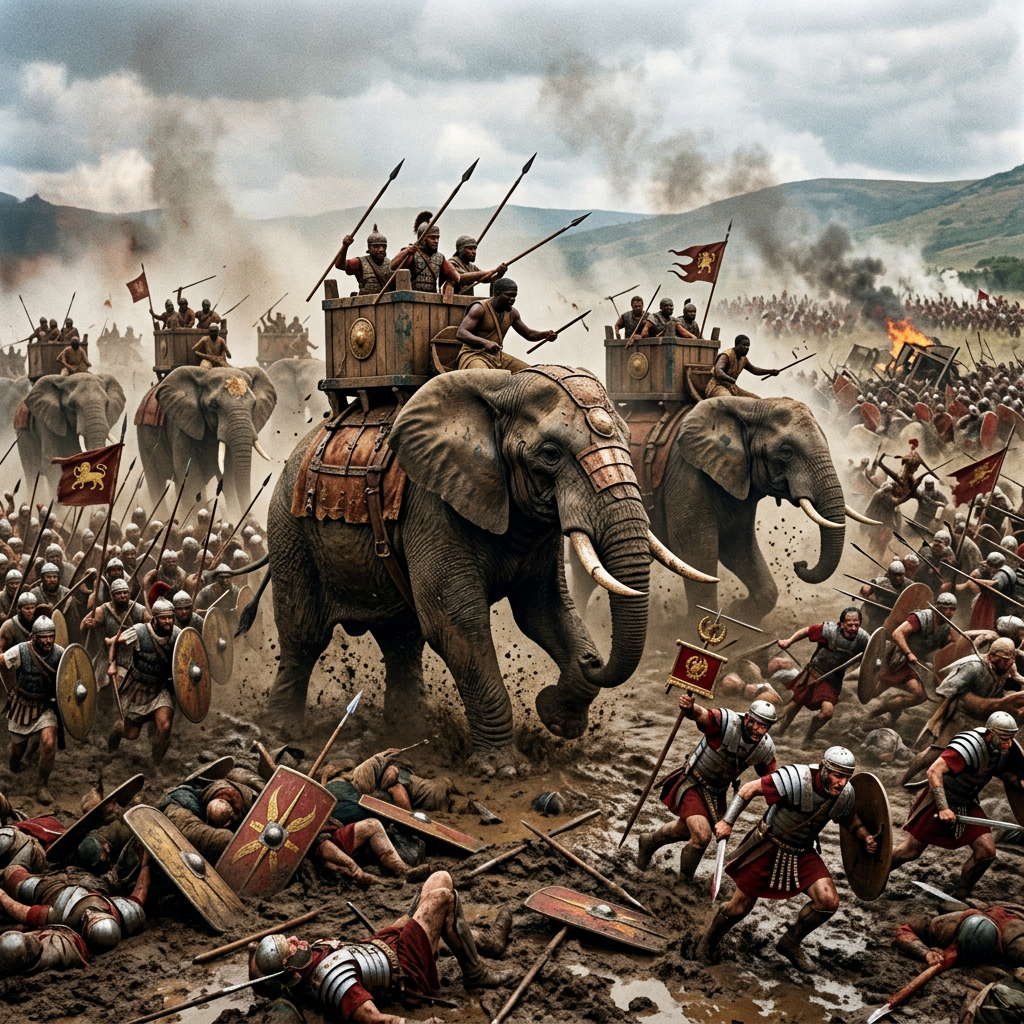
The Battle of Zama in 202 BC was one of the most important battles of the ancient Mediterranean world. Fought in North Africa during the Second Punic War, the battle brought together two of antiquity’s greatest military commanders: Hannibal Barca of Carthage and Scipio Africanus of Rome.
For more than sixteen years, Rome and Carthage had fought a brutal struggle for control of the western Mediterranean. Hannibal had crossed the Alps, defeated Roman armies in some of history’s most famous battles, and threatened Rome itself. Yet at Zama, the balance finally shifted decisively in Rome’s favor.
Scipio’s Roman army defeated Hannibal’s forces, effectively ending Carthage’s ability to challenge Roman supremacy. The resulting peace treaty transformed the political landscape of the Mediterranean and established Rome as the dominant power in the western Mediterranean.
The Battle of Zama 202 BC is particularly fascinating because it was not simply a confrontation between two armies. It was the culmination of a strategic contest between Hannibal’s battlefield brilliance and Scipio’s ability to adapt Roman military methods to the challenges posed by Carthage.
The battle also demonstrated the importance of cavalry, battlefield communication, tactical flexibility, and military intelligence.
For historians, Zama represents the moment when the long struggle between Rome and Carthage was effectively decided.
The Second Punic War
To understand the importance of the Battle of Zama, we must first look at the conflict that produced it.
The Second Punic War began in 218 BC.
Rome and Carthage were already major Mediterranean powers. Their rivalry had previously produced the First Punic War, which ended with Rome gaining control of Sicily.
But tensions remained.
The Carthaginian general Hannibal Barca believed that Rome could be defeated if its Italian allies could be separated from the Roman Republic.
Hannibal therefore launched one of the most extraordinary military campaigns in ancient history.
Instead of attacking Rome through Sicily or directly from North Africa, he invaded Italy from the north.
His route would take him through Spain, southern Gaul, across the Alps, and into Italy.

Hannibal’s Italian Campaign
Hannibal’s invasion initially shocked Rome.
In 218 BC, he defeated Roman forces at the Battle of the Ticinus and the Battle of the Trebia.
The following year, he achieved another devastating victory at Lake Trasimene.
Then came his greatest triumph.
At the Battle of Cannae in 216 BC, Hannibal’s army surrounded and destroyed a much larger Roman force.
The Roman casualties were enormous.
Cannae became a textbook example of the double-envelopment tactic.
Yet despite these victories, Hannibal did not capture Rome.
The Roman Republic refused to surrender.
Instead, Rome adopted a strategy of endurance.
Roman armies avoided unnecessary decisive battles when possible, while Rome’s enormous manpower reserves allowed it to replace losses.
This strategy gradually changed the war.
Scipio Africanus Enters the War
One of the Roman commanders who eventually transformed the conflict was Publius Cornelius Scipio, later known as Scipio Africanus.
Scipio belonged to an important Roman aristocratic family.
He was young by Roman political standards but demonstrated remarkable military ability.
Rather than attempting to defeat Hannibal directly in Italy, Scipio recognized that Carthage itself could be threatened.
He launched a Roman campaign in Spain.
There he defeated Carthaginian armies and gradually destroyed Carthage’s position in the Iberian Peninsula.
The loss of Spain was a major strategic setback for Carthage.
Spain had provided Carthage with soldiers, money, and resources.
Scipio then turned his attention toward Africa.

Rome Invades North Africa
In 204 BC, Scipio landed in North Africa.
This transformed the strategic situation.
Carthage was suddenly under direct threat.
Hannibal was recalled from Italy.
After years of campaigning in the Italian peninsula, he finally returned to Africa.
This was a crucial moment.
Hannibal had not been defeated in Italy.
Instead, Rome had forced him to abandon the theater where he had achieved his greatest victories.
The war would now be decided in North Africa.
Hannibal and Scipio Meet
The two commanders eventually met before the decisive battle.
Ancient sources describe a meeting between Hannibal and Scipio before Zama.
The precise historical details are uncertain, but the tradition emphasizes the extraordinary nature of the confrontation.
Hannibal was one of the most famous commanders of antiquity.
Scipio had studied Carthaginian tactics and had developed methods specifically designed to counter Hannibal’s army.
Their meeting symbolized the larger struggle between Rome and Carthage.

The Armies at Zama
The exact numbers involved in the Battle of Zama 202 BC remain debated.
Ancient sources provide different figures.
Hannibal’s army probably consisted of several different groups of troops.
These included:
- African infantry;
- veteran Carthaginian soldiers;
- troops from Italy who had fought alongside Hannibal;
- cavalry;
- and war elephants.
Scipio’s army consisted of Roman and allied forces.
Most importantly, he had significant Numidian cavalry support.
The Numidians were among the finest cavalrymen in the ancient Mediterranean.
Scipio’s alliance with Masinissa, a Numidian prince, proved extremely important.
Hannibal’s War Elephants
One of the most recognizable features of the Carthaginian army was its use of war elephants.
Hannibal deployed elephants at the beginning of the battle.
Their purpose was to disrupt the Roman infantry formation.
Elephants could terrify horses, break formations, and create chaos among inexperienced troops.
But Scipio had prepared for them.
Rather than forming a solid wall of infantry, Roman units created lanes through which the elephants could pass.
Trumpets and other noise may also have contributed to confusing the animals.
When the elephants charged, the Romans attempted to channel them away from the main body of infantry.
This prevented the elephants from producing the devastating breakthrough Hannibal needed.

Scipio’s Tactical Innovation
The Roman response to the elephants demonstrated Scipio’s flexibility.
Traditional Roman formations could be extremely dense.
But Scipio modified the deployment of his infantry.
He arranged the maniples so that gaps existed between units.
The elephants could therefore move through the spaces instead of smashing directly into tightly packed infantry.
Roman soldiers could then attack from the sides.
The tactic reduced one of Hannibal’s most important battlefield advantages.
This was a critical moment in the battle.
The Infantry Clash
After the elephant attack failed to break the Roman formation, the infantry armies engaged.
Hannibal’s forces were arranged in several lines.
His first line consisted largely of less experienced troops.
Behind them were more experienced African and Carthaginian soldiers.
His veteran Italian troops formed another important part of the army.
The fighting became intense.
Roman infantry eventually pushed back Hannibal’s first lines.
But Hannibal’s veterans offered much stronger resistance.
The battle was therefore far from decided.

The Cavalry Decides the Battle
The decisive factor at Zama was cavalry.
At the beginning of the battle, Roman and Numidian cavalry attacked their Carthaginian opponents.
The Carthaginian cavalry was forced from the field.
This allowed Roman and Numidian horsemen to pursue them.
But Scipio had a larger plan.
After defeating the enemy cavalry, the Roman horsemen eventually returned to the battlefield.
They attacked Hannibal’s army from the rear.
The timing was devastating.
Hannibal’s infantry was already engaged with Roman troops from the front.
The arrival of Roman and Numidian cavalry behind the Carthaginian army created a classic encirclement.
The Carthaginian formation collapsed.
Hannibal Is Defeated
The Carthaginian army suffered catastrophic losses.
Many soldiers were killed.
Others were captured.
Hannibal survived the battle but could not continue the war.
The Battle of Zama was a decisive Roman victory.
The man who had spent more than fifteen years challenging Rome had finally been defeated.
Scipio had achieved what many Roman commanders had failed to do.
He had defeated Hannibal on the battlefield.

Why Did Hannibal Lose at Zama?
The defeat resulted from several factors.
1. Roman Cavalry Superiority
Scipio’s alliance with Masinissa gave Rome a major cavalry advantage.
2. Elephant Neutralization
Scipio’s formation prevented Hannibal’s elephants from causing maximum damage.
3. Roman Manpower
Rome possessed enormous military resources.
4. Tactical Adaptation
Scipio had studied Hannibal’s methods and designed his tactics accordingly.
5. Hannibal’s Army Was Mixed
Hannibal commanded troops with different levels of experience and loyalty.
His veteran soldiers remained formidable, but coordination was difficult.
6. Strategic Isolation
Hannibal had been recalled from Italy.
He no longer had the strategic environment that had enabled his earlier victories.
The Peace Treaty After Zama
The defeat forced Carthage to accept harsh peace terms.
Carthage surrendered its overseas territories.
It was required to give up most of its warships.
It had to pay a large indemnity to Rome.
Most importantly, Carthage was forbidden from conducting warfare without Roman permission.
The political balance of the Mediterranean had changed permanently.
Rome was now the dominant power in the western Mediterranean.

Scipio Africanus
After his victory, Scipio received the title Africanus.
He became one of the most celebrated generals in Roman history.
His victory at Zama was considered the culmination of his career.
Yet Scipio’s success was not simply based on battlefield courage.
His greatest achievement was strategic.
He recognized that Hannibal could not easily be defeated by copying traditional Roman methods.
Instead, he changed the nature of the war.
He attacked Carthage’s resources.
He built alliances.
He brought the war into Africa.
And at Zama, he combined infantry tactics with cavalry mobility.
The Fate of Hannibal
Hannibal remained politically influential after the war.
He served as a leader in Carthage and attempted to reform its government and finances.
But Rome remained suspicious of him.
Eventually, Hannibal went into exile.
He served several foreign rulers and continued to oppose Roman expansion diplomatically.
According to ancient tradition, Hannibal eventually died after taking poison to avoid capture by Rome.
His life became legendary.
Even in defeat, he remained one of the most respected military commanders of antiquity.

The Long-Term Importance of Zama
The Battle of Zama 202 BC transformed Mediterranean history.
Carthage was no longer Rome’s equal.
The defeat destroyed the Carthaginian military threat.
Rome emerged as the dominant power in the western Mediterranean.
This victory also gave Rome greater freedom to intervene in the affairs of the Hellenistic kingdoms of the eastern Mediterranean.
Within decades, Roman influence would expand dramatically.
Zama therefore helped establish the foundations of Roman Mediterranean supremacy.
Zama and the Rise of Rome
Rome’s victory did not immediately create the Roman Empire.
The Roman Republic still existed.
But Zama strengthened Rome’s position enormously.
The republic now possessed:
- a powerful military tradition;
- extensive territories;
- enormous economic resources;
- experienced commanders;
- and increasing influence across the Mediterranean.
The defeat of Carthage removed Rome’s greatest western rival.
The path toward Roman dominance was now open.

Conclusion: The Battle That Changed the Mediterranean
The Battle of Zama in 202 BC was the final great confrontation of the Second Punic War.
Hannibal Barca had spent years defeating Roman armies and threatening Rome’s survival.
But Scipio Africanus changed the war.
He took the fight to Africa.
He secured the support of the Numidian cavalry.
He neutralized Hannibal’s war elephants.
And at Zama, he defeated one of history’s greatest commanders.
The consequences were enormous.
Carthage lost its status as a major military power.
Rome became the dominant power in the western Mediterranean.
The victory marked the beginning of a new era in which Roman influence would continue expanding across the ancient world.
The Battle of Zama is therefore remembered not simply because Hannibal lost.
It is remembered because Rome won the struggle for the Mediterranean.
And from that victory emerged the political power that would eventually become one of the greatest empires in human history.
At Zama, the fate of Carthage was decided—and the road to Roman supremacy opened.
Fortisetliber’s View
In 202 BC, on the plains of North Africa, two of antiquity’s greatest commanders finally faced each other.
Hannibal Barca had spent more than fifteen years fighting Rome. He had crossed the Alps, destroyed enormous Roman armies, and turned his name into a legend.
But at Zama, he met Scipio Africanus.
Scipio understood that defeating Hannibal required more than courage. He studied the Carthaginian commander’s methods, neutralized his war elephants, and relied on the powerful Numidian cavalry of Masinissa.
The battle became a struggle between two different visions of warfare.
Hannibal had battlefield experience and legendary tactical skill.
Scipio had adaptability.
When Roman and Numidian cavalry eventually attacked the Carthaginian army from behind, Hannibal’s forces were overwhelmed.
Carthage had lost.
For FortisLiber, however, Zama is not simply a story about one commander defeating another.
It is a story about adaptation.
Hannibal had defeated Rome repeatedly because Roman commanders often fought him according to his rules.
Scipio refused to do that.
He changed the rules.
He took the war to Africa, built alliances, studied his opponent, and transformed Rome’s weaknesses into strengths.
That is perhaps the greatest lesson of Zama:
Experience is powerful—but the ability to adapt is even more powerful.
Hannibal left the battlefield defeated, but his military genius survived for centuries.
Scipio left Zama victorious, and Rome emerged as the dominant power of the western Mediterranean.
The battle therefore marked more than the end of the Second Punic War.
It marked the moment when the Mediterranean began to belong to Rome.
At Zama, one legend ended—and another empire began its rise.
Leave a Reply