
The extraordinary Roman city in Algeria where an empire’s vision still survives
There are ancient cities that disappeared beneath modern streets.
Others were transformed, rebuilt, and forgotten beneath centuries of new civilization.
And then there is Timgad.
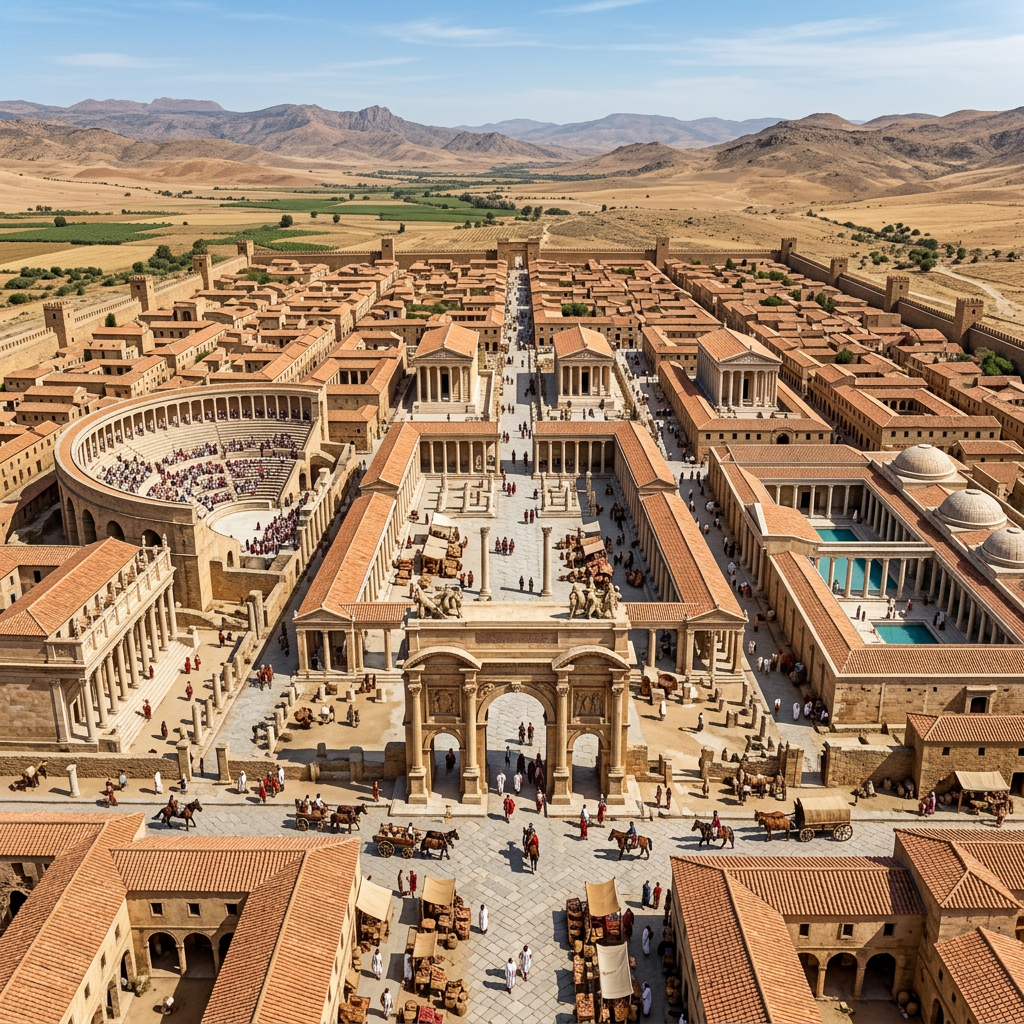
Set against the northern slopes of the Aurès Mountains in Algeria, the ruins of this ancient city seem almost too perfectly organized to be real. Straight roads cross one another at precise angles. Columns line the ancient streets. A monumental arch rises above the ruins. The remains of temples, baths, houses, a theatre, and public buildings reveal a city that was once alive with merchants, soldiers, officials, families, and worshippers.
Known in antiquity as Thamugadi, Timgad was founded by the Roman emperor Trajan around AD 100. Created as a Roman colony in North Africa, it became one of the clearest surviving examples of Roman urban planning. UNESCO describes the site as an exceptional example of a Roman military colony created ex nihilo—essentially, built from the beginning according to a deliberate plan.
Today, Timgad offers something rare.
It allows us to see the Roman city almost as an architect once saw it: a carefully ordered landscape of streets, buildings, public spaces, and monuments.
A City Born from Roman Ambition
When Trajan established Timgad, Rome controlled enormous territories across Europe, Asia, and North Africa.
The Roman Empire did not simply conquer territory. It also built roads, towns, forts, administrative centers, markets, and monuments that extended Roman institutions and culture across the provinces.
Timgad was part of this wider transformation.
The city was established on the northern side of the Aurès Mountains, in a strategically important region of ancient North Africa. Its original design reflected the principles of Roman military and civic planning. Two principal roads—the cardo running north to south and the decumanus running east to west—formed the central framework of the settlement.
From these streets, the city expanded according to a remarkably regular grid.
The geometry was not accidental.
Roman planners valued order, accessibility, and organization. Streets could be laid out with remarkable precision, while public buildings were positioned within a coherent urban framework.
At Timgad, that system remains visible nearly two thousand years later.

The Roman Grid of Timgad
Perhaps the most fascinating feature of the Timgad ancient city is its street plan.
Standing among the ruins today, visitors can still follow the straight lines established by Roman engineers. The original city was organized within a nearly square enclosure, with streets crossing at right angles and blocks arranged between them.
It is one of the finest surviving examples of Roman urban planning.
But the grid also tells us something about Roman society.
The city was not designed as a random collection of buildings. It was an organized environment in which public life, commerce, religion, administration, and private life occupied their own spaces.
The Romans were masters of transforming geography into architecture.
At Timgad, they imposed an urban order upon the landscape—and that order survived long after the political power that created it disappeared.
From Military Colony to Thriving City
Timgad’s original foundation was connected with the Roman military presence in North Africa, but it soon developed beyond the character of a simple military settlement.
As the population increased, the city expanded beyond its original boundaries. New neighborhoods and public buildings appeared, including markets, temples, baths, and other monumental structures. UNESCO notes that by the middle of the 2nd century, Timgad had outgrown its original limits.
This expansion reveals an important truth about the ancient city.
Timgad was not simply a military outpost at the edge of the Roman world.
It became a genuine urban center.
People lived there.
They worked there.
They worshipped, traded, argued, celebrated, bathed, attended performances, and conducted the ordinary business of life.
The ruins therefore represent much more than architecture.
They represent a Roman community.

The Arch of Trajan
Among Timgad’s most recognizable monuments is the magnificent Arch of Trajan, which stands near the western end of the city’s principal east-west road.
Although commonly associated with Trajan and the foundation of the city, the surviving monument was constructed or developed later than the original foundation. UNESCO notes that the arch was restored during the Roman period, reflecting the continued investment in the city’s monumental landscape.
Its arches once formed a dramatic entrance into the heart of Timgad.
Imagine approaching the city nearly two thousand years ago.
Beyond the surrounding landscape, the roads lead toward monumental architecture. Stone buildings rise ahead. Merchants and citizens move through the streets. Roman officials pass through the public spaces.
And above it all stands an enormous stone arch proclaiming the power and permanence of Rome.
Today, the scene is silent.
But the architecture still communicates the message its builders intended:
Rome is here.
A City of Baths, Theatre, and Public Life
The Romans were famous for their public architecture, and Timgad was no exception.
The remains of numerous bath complexes demonstrate the importance of communal bathing in Roman society. UNESCO records 14 baths still visible at the site, an extraordinary number for an ancient city of this scale.
Roman baths were not simply places to wash.
They were social spaces.
People could meet friends, conduct business, relax, exercise, and participate in an important part of civic life.
Timgad also possessed a theatre, religious buildings, markets, and a forum. These structures reveal a city where public life was central to the Roman experience.
The theatre is particularly evocative.
Today, rows of weathered stone remain beneath the North African sky. Once, however, the space would have been filled with spectators watching performances in a carefully designed architectural setting.
The voices are gone.
The stone remains.

The Mosaics of Timgad
Not everything in Timgad was built for military strength or political display.
The remains of private houses contain some of the site’s most beautiful surviving details: Roman mosaics.
These floors reveal the wealth and taste of Timgad’s inhabitants. UNESCO notes that the city’s houses contained sumptuous mosaics, which helped compensate for the relative absence of precious marbles in their decoration.
Mosaics were more than decoration.
They could display mythology, animals, geometric patterns, scenes of everyday life, and symbols of status.
Walking through the ruins today, it is easy to imagine how different the city must have looked when its floors were brightly decorated, its buildings intact, and its streets crowded with people.
The ruins may appear monochrome now.
The ancient city was not.
Timgad and the Roman World
Timgad also tells the story of Roman North Africa, a region that was economically and culturally important to the empire.
Rome’s African provinces were not isolated territories existing on the margins of civilization. They were deeply connected to the wider Mediterranean world through trade, administration, military networks, religion, and culture.
Timgad reflects this integration.
Its architecture follows Roman models, yet its location in North Africa gives the city a distinctive historical character. The result is a fascinating meeting of Roman imperial planning and the local environment of the Aurès region.
UNESCO considers Timgad an important example of the exchange of ideas, technologies, and traditions associated with Roman colonization in the high plains of ancient Algeria.

From Pagan Rome to Christian Timgad
The history of Timgad did not end with the height of the Roman Empire.
Like many cities across the Mediterranean, it experienced major religious and political changes during Late Antiquity.
Christianity eventually became an important part of life in the city, and Timgad developed into a notable bishopric. The archaeological remains therefore preserve evidence of a society changing from the traditional religious world of the Roman Empire toward a Christian one.
This makes Timgad particularly valuable to historians.
It is not simply a snapshot of the reign of Trajan.
It is a record of centuries of transformation.
The city changed because the empire changed.
The Decline of Timgad
No city remains powerful forever.
Following the Vandal invasion of North Africa in AD 430, Timgad entered a period of decline and destruction. Later, the Byzantine reconquest brought renewed activity to the region. Around AD 539, a Byzantine fortress was constructed south of the ancient city, using blocks taken from earlier Roman monuments.
Eventually, however, Timgad ceased to function as a major urban center.
By the 8th century, the ancient city had been abandoned.
Its streets became silent.
Its buildings deteriorated.
And over the centuries, nature gradually reclaimed the remains.
Yet the disappearance of the city also helped preserve it.
Unlike many ancient settlements that were continuously rebuilt, Timgad was not covered by a modern city. Its archaeological remains survived with remarkable clarity, allowing later generations to reconstruct its original Roman plan.

Rediscovering the Ancient City
Archaeological excavations at Timgad took place extensively from the late 19th century into the 20th century. UNESCO notes that excavations were conducted almost continuously from 1881 to 1960, helping reveal the remarkable extent of the ancient settlement.
What emerged was extraordinary.
A Roman city appeared beneath the accumulated centuries.
Its streets could be traced.
Its monuments could be identified.
Its houses, mosaics, baths, theatre, and religious buildings revealed the complexity of urban life.
The archaeological site became one of the most important surviving examples of Roman city planning.
In 1982, Timgad was inscribed on the UNESCO World Heritage List, recognized for its exceptional archaeological and architectural significance.
Why Timgad Still Matters
There are many Roman ruins across the Mediterranean.
So why does Timgad feel different?
Perhaps because the city’s plan is so legible.
At many ancient sites, centuries of rebuilding have transformed the original urban landscape. At Timgad, however, the Roman blueprint remains remarkably clear.
The streets still point toward the horizon.
The blocks remain visible.
The monuments still occupy their ancient positions.
It is almost as if the Roman surveyors have only just left.
Timgad therefore gives modern visitors something extraordinary: the opportunity to walk through a city designed nearly two thousand years ago and still understand the logic behind its creation.
It is architecture as archaeology.
It is history written into the ground.
Timgad: A City That Refused to Disappear
The ancient city of Timgad is more than a collection of Roman ruins in Algeria.
It is a reminder of the extraordinary ambition of Roman civilization.
Trajan’s engineers arrived in North Africa and created a city according to a precise geometric vision. Generations later, that city expanded, prospered, changed its religious identity, endured political upheaval, and eventually disappeared.
Yet the stones remained.
The roads remained.
The mosaics remained.
And almost two thousand years later, the original Roman plan can still be read across the landscape.
Perhaps that is the most remarkable thing about Timgad.
Empires disappear.
Languages change.
Kings are forgotten.
But sometimes, if the conditions are right, a city can survive in silence long enough for another civilization to discover it again.

Conclusion: When Rome Fell Silent
Timgad reminds us that the greatness of an ancient city is not measured only by the empire that built it, but by what remains after that empire is gone.
The Romans came to North Africa with a vision of order. They laid out streets with mathematical precision, raised monumental arches and temples, built baths and theatres, and created a city that reflected the extraordinary organization of Roman civilization. For centuries, Timgad was alive with people, commerce, religion, and ambition.
Then the world changed.
Rome’s power in North Africa faded. Timgad was eventually abandoned, and the voices that once filled its streets disappeared. Yet the city itself refused to vanish completely. Its roads, mosaics, columns, and monuments remained beneath the landscape, waiting for another age to rediscover them.
Today, walking through Timgad is almost like walking through the pages of a Roman architectural plan. The streets still follow their ancient lines, and the ruins reveal a civilization that believed stone could make its achievements permanent.
But history tells us otherwise.
Empires fall. Cities fade. Civilizations change.
What survives is the evidence they leave behind—and at Timgad, that evidence is extraordinary.
Fortisetliber’s View
At Fortis et Liber, we believe forgotten places can sometimes tell the greatest stories. Timgad is one of them: a city that once stood at the edge of the Roman world, and now stands as a monument to everything that time could not erase.
The people are gone. The empire is gone. But Timgad still speaks—in stone.
Leave a Reply