
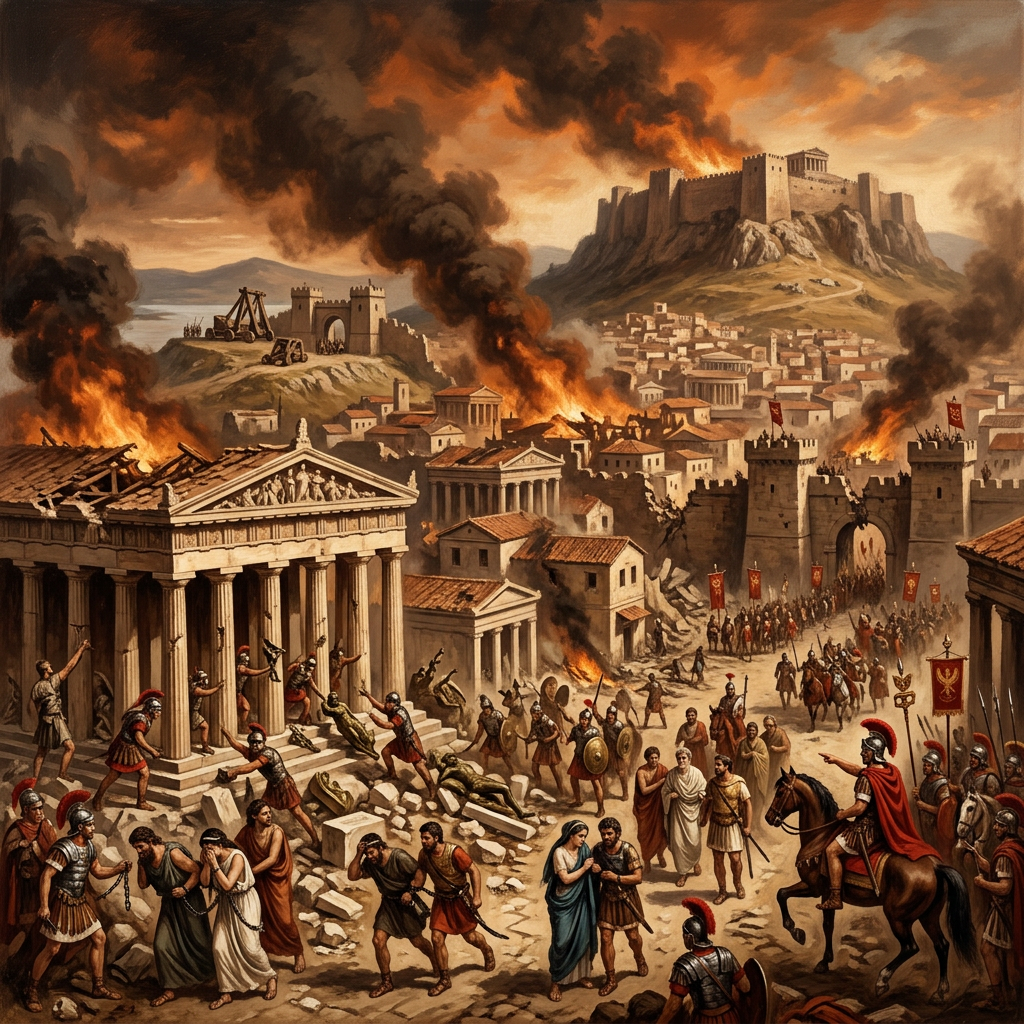
The Battle of Corinth in 146 BC was one of the decisive military events in the history of ancient Greece. Fought during the Achaean War, the conflict ended with a Roman victory, the destruction and plundering of Corinth, and the collapse of the Achaean League. The Roman commander Lucius Mummius, later known as Mummius Achaicus, led the Roman forces against the Achaean army and captured one of the richest and most strategically important cities in Greece.
The fall of Corinth was more than a single military defeat. It marked a major stage in the expansion of Roman power in Greece and became a symbol of the changing political order of the Mediterranean world. After centuries in which Greek city-states and kingdoms had competed for influence, Rome was now the dominant military power in the region.
What Was the Battle of Corinth?
The Battle of Corinth 146 BC was the final major confrontation of the Achaean War between the Roman Republic and the Achaean League. The Achaean League was a federation of Greek city-states in the Peloponnese that had become an important political and military organization during the Hellenistic period.
Corinth had joined the Achaean League in the third century BC and occupied an exceptionally important geographical position. Located on the Isthmus of Corinth, the city controlled the land route connecting northern and southern Greece while also benefiting from access to important maritime routes.
Its strategic importance made Corinth valuable to both Greek powers and Rome. By 146 BC, however, tensions between Rome and the Achaean League had reached the point of open war. Rome defeated the Achaeans, and Corinth became the principal target of the victorious Roman army.

Why Did Rome Go to War with the Achaean League?
The origins of the Achaean War lay in the increasingly complicated relationship between Rome and the Greek states.
During the second century BC, Rome became deeply involved in Greek affairs. The Romans initially presented themselves as allies and protectors of Greek communities, particularly during their wars against Macedon. The Achaean League itself had at times cooperated with Rome.
After Rome’s victories in the Macedonian Wars, however, Roman influence over Greece increased substantially. The Achaean League continued to pursue its own political interests, while Roman authorities increasingly demanded compliance with Roman decisions.
Tensions became particularly serious over the position of Sparta and other communities within the Achaean League. According to surviving historical accounts, Rome’s dissatisfaction with the League eventually contributed to open conflict in 146 BC. The Achaean League mobilized its forces, but the resulting war was extremely short compared with many earlier Greek-Roman conflicts.
The Roman victory demonstrated how dramatically the balance of power had shifted.

Lucius Mummius and the Roman Army
The Roman commander responsible for the campaign against Corinth was Lucius Mummius.
Mummius was a Roman consul in 146 BC and was given command of the Roman forces fighting in Greece. His army represented the military power of the Roman Republic at a time when Rome was simultaneously fighting another major war in North Africa against Carthage.
The Roman military system had already demonstrated its effectiveness against Macedonian armies and other Hellenistic powers. By the middle of the second century BC, Rome had developed extensive experience in campaigning throughout the eastern Mediterranean.
The Achaean forces, by contrast, were fighting to preserve the independence of a Greek political federation whose military resources were much more limited.
The final confrontation therefore reflected a much larger historical transformation: Rome was replacing the independent Hellenistic powers as the dominant political force in the eastern Mediterranean.

The Battle of Corinth
The precise details of the battle are known mainly through ancient historical traditions rather than a complete battlefield account.
The Achaean army attempted to resist the Roman advance, but the Roman forces defeated it. Once the Achaean military position collapsed, Corinth was left vulnerable.
The city itself was a major commercial center, wealthy and strategically located. Its position at the crossroads between the Peloponnese and central Greece had made it prosperous for centuries.
Following the Roman victory, Corinth was captured and subjected to destruction and plunder. Ancient and later accounts emphasize the scale of the catastrophe.
The destruction of Corinth in 146 BC became one of the defining events of Roman intervention in Greece. The Achaean League was effectively broken, and Roman authority over the Greek mainland was strengthened considerably. Ι

The Destruction of Corinth in 146 BC
The destruction of Corinth was particularly significant because Corinth was not an insignificant provincial settlement. It was one of the most important cities in Greece.
Ancient Corinth possessed temples, public buildings, workshops, commercial facilities, and wealthy private residences. The city had long benefited from its location on the Corinthian Isthmus and its connections with both the Aegean and western Mediterranean.
After its capture, the city was sacked. Many inhabitants were killed or enslaved, while valuable property and artworks were taken as spoils.
The destruction also affected Corinth’s cultural heritage. Temples and other monuments that had developed over centuries were damaged or abandoned. The catastrophe effectively ended Classical and Hellenistic Corinth as a major independent Greek city.
Archaeological evidence has helped modern historians understand the enormous transformation that occurred in Corinth during this period. The later Roman city was built on the same general site, but it belonged to a very different political and cultural world.

What Happened to the Achaean League?
The Achaean League was effectively dismantled following the Roman victory.
The League had been one of the most important political federations in the Greek world. Founded in the third century BC, it united numerous cities under a common political and military structure. Corinth had become a member in 243 BC, strengthening the League’s strategic position.
The defeat of 146 BC demonstrated that the League could no longer resist Roman military power.
Rome reorganized political authority in Greece and imposed a new order on the defeated communities. Although elements of local political organization survived in different forms, the independent power of the Achaean League had effectively ended.
The victory therefore had consequences far beyond Corinth itself.
Why Was Corinth So Important to Rome?
The importance of Corinth was partly geographical.
The city occupied the narrow Isthmus of Corinth, the land bridge connecting the Peloponnese with mainland Greece. Ancient Corinth therefore controlled important land and maritime routes.
Its location also contributed to its commercial prosperity. Ships and merchants could use the two nearby seas, while the city benefited from the movement of people and goods across the isthmus.
For Rome, controlling Corinth meant controlling one of the most strategically valuable locations in Greece.
The destruction of the city consequently sent a powerful message about Roman authority. Corinth had been a wealthy and influential Greek city; after 146 BC, its fate demonstrated what could happen to a state that challenged Roman power.

Corinth and Carthage in 146 BC
One of the remarkable aspects of 146 BC is that Rome destroyed two major cities during the same year: Corinth in Greece and Carthage in North Africa.
The two events occurred in different wars and had different causes, but their coincidence made 146 BC an extraordinary year in Roman history.
The destruction of Carthage ended the Third Punic War, while the destruction of Corinth ended the Achaean War and dramatically strengthened Roman control over Greece.
For historians, this coincidence illustrates the extraordinary reach of the Roman Republic by the middle of the second century BC. Roman armies were capable of conducting major campaigns in different regions of the Mediterranean simultaneously.
The End of Greek Independence?
It would be too simple to say that all Greek independence ended in exactly 146 BC. Greek communities continued to exist, maintain local institutions, and preserve their cultural traditions.
Nevertheless, the Battle of Corinth and the destruction of Corinth represented a major turning point.
Roman political and military influence became dominant, and the Greek mainland was increasingly incorporated into the Roman system. The process of Roman control over Greece had developed over decades, particularly following Roman victories against Macedon.
The events of 146 BC therefore belong to a longer process rather than representing an isolated moment.
Greece remained culturally influential, however. Greek language, literature, philosophy, art, architecture, and education continued to have an enormous influence on Roman society.
In many respects, Rome conquered the Greek political world while simultaneously becoming deeply influenced by Greek culture.

Corinth After 146 BC
One of the most fascinating aspects of Corinth’s history is that the city did not remain permanently abandoned.
After its destruction, the site experienced a long period of decline. Eventually, Julius Caesar refounded Corinth as a Roman colony in 44 BC, nearly a century after the destruction of the Greek city. The new Roman Corinth became an important settlement and commercial center.
This later Roman city was substantially different from the Corinth destroyed by Mummius.
Roman Corinth eventually became an important administrative and commercial center. Centuries later, the city would also become famous in early Christian history because of the visit of the Apostle Paul.
Thus, the destruction of Corinth in 146 BC was not the final chapter of Corinth’s history. Instead, it marked the end of one Corinth and eventually preceded the emergence of another.
The Historical Significance of the Battle of Corinth
The Battle of Corinth in 146 BC is significant for several reasons.
First, it brought the Achaean War to an end and destroyed the political independence of the Achaean League.
Second, the destruction of Corinth demonstrated the military and political dominance of the Roman Republic in Greece.
Third, the event marked an important stage in the transformation of the Mediterranean from a world dominated by competing Greek and Hellenistic kingdoms into one increasingly dominated by Rome.
Finally, the destruction and later refounding of Corinth provide an extraordinary example of how cities can experience dramatic political and cultural transformations while remaining important locations for centuries.

Conclusion
The Battle of Corinth (146 BC) was one of the decisive conflicts of the ancient Mediterranean. Roman forces under Lucius Mummius defeated the Achaean League, captured Corinth, and brought the Achaean War to an end.
The destruction of Corinth in 146 BC had consequences far beyond the battlefield. It marked the collapse of one of the last major independent Greek political forces and strengthened Roman control over Greece.
Yet Corinth’s story did not end with its destruction. In 44 BC, Julius Caesar established a Roman colony on the site, beginning a new chapter in the city’s history.
The fall of Corinth therefore represents both an ending and a beginning: the end of an important chapter of independent Greek political history and the beginning of Corinth’s transformation into a major Roman city.
Fortisetliber’s View
The Battle of Corinth in 146 BC marked a major turning point in ancient Greek history. Roman forces under Lucius Mummius defeated the Achaean League and captured the wealthy city of Corinth. The city was subsequently destroyed and its population suffered enslavement and displacement.
For Corinth, the defeat represented the end of an era of political independence. For Rome, it demonstrated the growing power of the Roman Republic in Greece and the wider Mediterranean.
The story of Corinth also reflects the spirit of Fortis et Liber—“Brave and Free.” The phrase can serve as a modern reflection on the courage, independence, and resilience associated with communities facing overwhelming political and military forces.
Although Corinth was destroyed in 146 BC, its story did not end there. The city was later refounded as a Roman colony, beginning a new chapter in its long and remarkable history.
Leave a Reply