
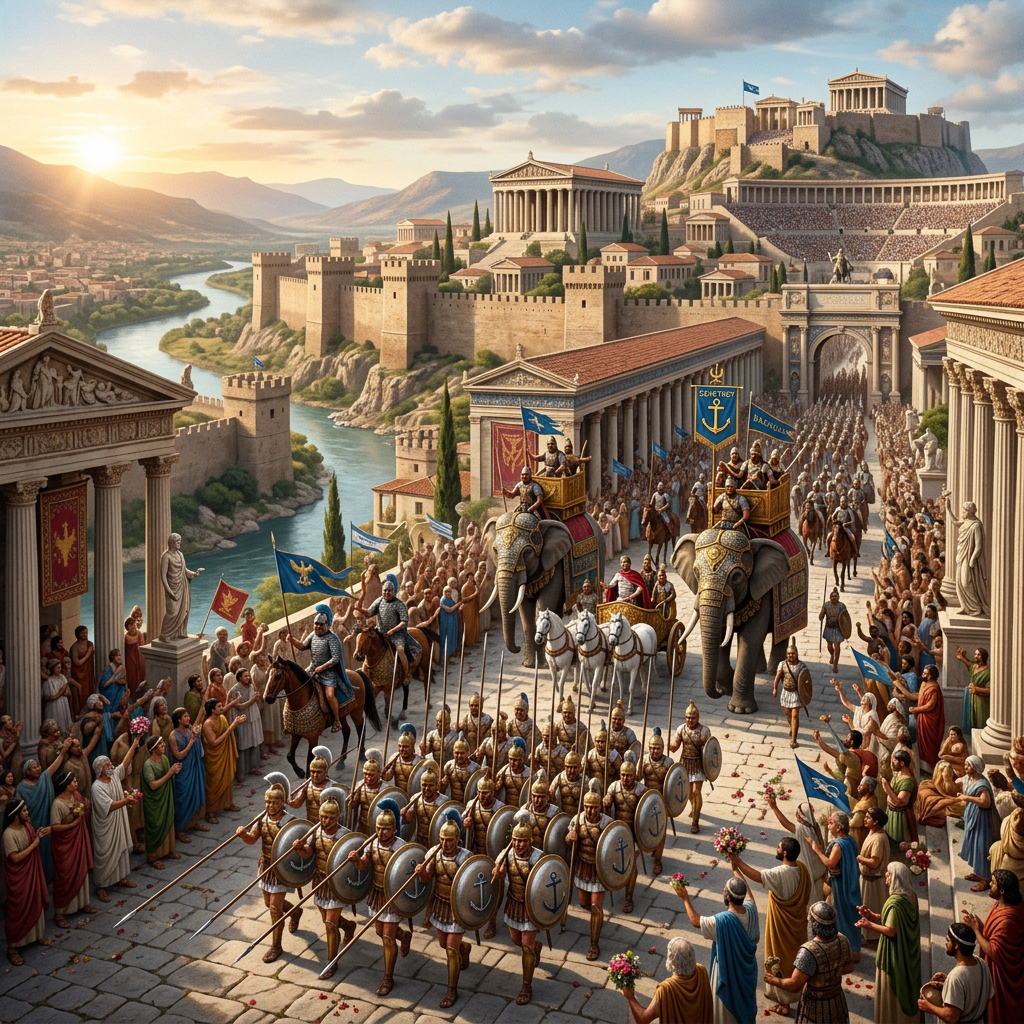
Introduction to the Seleucid Empire
The Seleucid Empire was one of the most powerful kingdoms of the ancient world, emerging after the death of Alexander the Great in 323 BC. Founded by Seleucus I Nicator, one of Alexander’s generals, this vast Hellenistic state controlled enormous territories across the Middle East and Central Asia. At its height, the Seleucid Empire stretched from parts of Asia Minor in the west to regions near the Indus River in the east.
The history of the Seleucid Empire is closely connected to the rise of Hellenistic civilization, the spread of Greek culture, and the political transformation of the former Persian Empire. Its rulers established cities, promoted trade, encouraged cultural exchange, and fought numerous wars to maintain control over their territories.
Despite its impressive beginnings, the Seleucid dynasty faced constant challenges, including rival Hellenistic kingdoms, internal power struggles, revolts, and the growing influence of Rome. Understanding the Seleucid Empire provides valuable insight into the political and cultural developments that shaped the ancient Mediterranean and the Near East.
The Founding of the Seleucid Empire
The Death of Alexander the Great
The origins of the Seleucid Empire can be traced to the death of Alexander the Great in Babylon in 323 BC. Alexander had conquered the Persian Empire and created a vast territory stretching from Greece and Egypt to parts of Central and South Asia. However, his sudden death left no capable adult successor ready to rule the entire empire.
His generals, known as the Diadochi, began competing for control of his territories. These conflicts, called the Wars of the Diadochi, lasted for decades and eventually divided Alexander’s empire into several independent Hellenistic kingdoms.
Among the most important successors was Seleucus I Nicator, whose name means “Seleucus the Victorious.” Initially serving as a senior officer under Alexander, Seleucus gradually established himself as a powerful military and political leader.
Seleucus I Nicator and the Birth of a Kingdom
Seleucus gained control of Babylon in 312 BC, a date traditionally associated with the beginning of the Seleucid era. Over the following years, he expanded his authority across much of the former Persian Empire.
His territories included Mesopotamia, Persia, and extensive eastern regions. Through military campaigns, strategic alliances, and political negotiations, Seleucus built one of the largest successor states created after Alexander’s death.
In 301 BC, Seleucus participated in the Battle of Ipsus, where a coalition of Alexander’s former generals defeated Antigonus I Monophthalmus. The victory helped Seleucus consolidate his power and acquire additional territories.
Seleucus also founded important cities, including Seleucia on the Tigris, which became a major administrative and commercial center. His achievements established the foundations of the Seleucid dynasty, which would rule much of the Near East for nearly two centuries.

The Geography and Extent of the Seleucid Empire
At its greatest extent, the Seleucid Empire controlled a remarkably diverse collection of territories. Its western regions included parts of Asia Minor and Syria, while its central lands encompassed Mesopotamia and the Iranian plateau. During its early expansion, Seleucid authority also extended into Bactria and territories bordering northwestern India.
This enormous geographical range gave the empire access to important trade routes connecting the Mediterranean world with Central Asia and the Indian subcontinent.
However, governing such a large territory was difficult. Mountain ranges, deserts, long distances, and different regional traditions complicated communication and administration. Local governors and regional elites played essential roles in maintaining political stability.
The empire’s borders also changed frequently because of wars with neighboring kingdoms and rebellions within its territories. Over time, eastern provinces gradually became independent, weakening the Seleucid rulers’ ability to maintain their original imperial ambitions.

The Greatest Seleucid Rulers
Antiochus I Soter
Antiochus I Soter succeeded his father, Seleucus I, in 281 BC. His reign was marked by efforts to preserve the empire’s territorial integrity while facing pressure from rival powers.
Antiochus dealt with conflicts in Asia Minor and challenges from expanding regional kingdoms. Although he could not prevent every territorial loss, he helped maintain the Seleucid state during a difficult period of transition.
Antiochus III the Great
One of the most important rulers in Seleucid Empire history was Antiochus III the Great, who reigned from 223 to 187 BC.
When Antiochus III came to power, the empire had already lost considerable territory. He launched military campaigns intended to restore Seleucid influence, earning a reputation as an ambitious and capable commander.
His eastern expedition, often called the Anabasis, helped reassert Seleucid authority over several regions, including parts of Iran and Central Asia. He also campaigned in the Levant, challenging the Ptolemaic Kingdom of Egypt.
In 200 BC, Seleucid forces defeated the Ptolemaic army at the Battle of Panium, helping Antiochus secure control over Coele-Syria, including much of the southern Levant.
However, his expansion into Greece brought him into conflict with Rome. Following the Roman victory at the Battle of Magnesia in 190 BC, Antiochus III was forced to accept the Treaty of Apamea in 188 BC. The settlement required territorial concessions in Asia Minor and a substantial financial indemnity.
These defeats marked a turning point in Seleucid history, severely limiting the empire’s western ambitions.
Antiochus IV Epiphanes
Antiochus IV Epiphanes, who ruled from 175 to 164 BC, remains one of the most controversial Seleucid monarchs.
He attempted to strengthen royal authority and promote the political and cultural unity of his kingdom. His reign also featured military campaigns against Egypt and major religious tensions in Judea.
His policies in Jerusalem, including restrictions on Jewish religious practices, contributed to the outbreak of the Maccabean Revolt in 167 BC. Led by the Maccabees, the rebellion eventually resulted in the establishment of an independent Jewish state under the Hasmonean dynasty.
The revolt demonstrated the limits of Seleucid power and the difficulty of imposing uniform policies across a culturally diverse empire.

Government, Society, and Culture in the Seleucid Empire
The Seleucid Empire was a major center of Hellenistic civilization, combining Greek and Macedonian political traditions with the established institutions of the former Persian Empire and local cultures throughout its territories.
Administration and Political Organization
The Seleucid kings governed through a combination of royal officials, regional governors, military commanders, and local authorities. Greek administrative practices existed alongside older regional institutions, particularly in Mesopotamia and Persia.
Royal power depended heavily on the army, taxation, diplomacy, and the loyalty of local elites. Because the empire was so large, rulers often had to negotiate with regional communities rather than exercise direct control over every settlement.
This flexible system helped the Seleucid state govern diverse populations, but it also created opportunities for powerful governors and regional leaders to challenge the monarchy.
Greek Culture and Hellenistic Cities
The Seleucids founded and developed numerous cities that promoted Greek language, education, architecture, and political institutions. Antioch on the Orontes, founded by Seleucus I’s dynasty and developed into a major royal capital, became one of the most important cities of the Hellenistic world.
Seleucia on the Tigris served as another major center of administration and commerce. These cities attracted merchants, soldiers, officials, artisans, and settlers from different parts of the empire.
Greek culture spread through urban life, coinage, public buildings, and education. Nevertheless, Hellenization was not a simple process of replacing local traditions. Greek customs interacted with Babylonian, Persian, Jewish, and other cultural practices, producing a complex and diverse society.
Trade and Economic Development
The Seleucid Empire occupied a strategic position between the Mediterranean and Central Asia. Its territories contained fertile agricultural lands, important river systems, and commercial routes connecting distant regions.
Merchants transported textiles, metals, agricultural products, luxury goods, and other commodities through the empire. Royal cities supported markets and workshops, while the use of coinage facilitated taxation, military payments, and commercial exchange.
Although the Seleucid economy benefited from its geographical position, warfare and political instability repeatedly disrupted trade. The loss of eastern provinces also reduced the empire’s control over some valuable routes and resources.

Major Wars and Conflicts of the Seleucid Empire
Military conflict was a defining feature of Seleucid history. The empire fought repeated wars against the Ptolemaic Kingdom, the Antigonid dynasty, independent regional rulers, and eventually the Roman Republic.
The Syrian Wars, a series of conflicts with the Ptolemies, were particularly important because both dynasties sought control over Coele-Syria and neighboring territories.
The Seleucid defeat at the Battle of Magnesia in 190 BC and the subsequent Treaty of Apamea weakened the empire’s position in the western Mediterranean world. Rome increasingly influenced political developments across the eastern Mediterranean.
Meanwhile, rebellions and separatist movements undermined Seleucid authority in the east. Bactria became independent under its Greek rulers, while the Parthians gradually expanded their power across northeastern Iranian territories.
These conflicts drained royal resources and made it increasingly difficult for Seleucid monarchs to defend their remaining lands.
The Decline and Fall of the Seleucid Empire
The decline of the Seleucid Empire was a gradual process caused by several interconnected factors.
First, the empire’s enormous size made effective administration difficult. Its rulers struggled to control distant provinces, especially when powerful regional leaders sought independence.
Second, repeated dynastic disputes weakened the monarchy. Rival claimants frequently fought for the throne, dividing the army and encouraging neighboring states to intervene.
Third, the rise of Parthia transformed the balance of power in the eastern territories. Under rulers such as Mithridates I, the Parthian kingdom expanded into important Seleucid lands, including much of Media and Mesopotamia over time.
Finally, Roman intervention and regional instability further reduced Seleucid influence. By the first century BC, the Seleucid state had been reduced largely to parts of Syria and surrounding territories.
The final phase of the kingdom was marked by competing monarchs and political fragmentation. In 64 BC, the Roman general Pompey reorganized Syria as a Roman province, traditionally marking the end of the Seleucid Kingdom.
The fall of the Seleucid Empire brought an end to one of the most significant Hellenistic dynasties, although Greek cultural influence continued throughout the eastern Mediterranean and the Near East.

The Legacy of the Seleucid Empire
The legacy of the Seleucid Empire extends far beyond its political collapse. Its rulers helped preserve and spread elements of Greek culture across regions that had previously belonged to the Persian Empire.
Seleucid cities became important centers of commerce, administration, education, and cultural exchange. Their urban institutions contributed to the development of the Hellenistic world, while their commercial networks connected the Mediterranean with regions farther east.
The Seleucid experience also illustrates the challenges of ruling a multicultural empire. Its kings attempted to combine Greek traditions with local customs, but the results varied across different regions and periods.
Furthermore, Seleucid history played an important role in the development of Jewish history, particularly through the events that led to the Maccabean Revolt. The empire’s conflicts with Rome also helped shape the political landscape that eventually brought much of the eastern Mediterranean under Roman control.
Today, the Seleucid Empire remains an essential subject for understanding Alexander the Great’s successors, the Hellenistic period, and the transformation of the ancient Near East.

Conclusion
The Seleucid Empire was one of the most influential kingdoms to emerge from the conquests of Alexander the Great. Founded by Seleucus I Nicator, it controlled vast territories, established important cities, supported international trade, and contributed to the spread of Hellenistic civilization.
Under rulers such as Antiochus III the Great, the empire experienced periods of renewed strength and expansion. However, internal divisions, regional rebellions, the rise of Parthia, and Roman military intervention gradually undermined its power.
Although the Seleucid dynasty ultimately disappeared in 64 BC, its historical significance remains considerable. The empire’s political struggles, cultural achievements, and connections between East and West make it a vital part of ancient history and an enduring subject for anyone interested in the ancient Greek world and the history of the Middle East.
Frequently Asked Questions About the Seleucid Empire
Who founded the Seleucid Empire?
Seleucus I Nicator founded the Seleucid Empire after gaining control of Babylon in 312 BC, following the death of Alexander the Great.
Where was the Seleucid Empire located?
The Seleucid Empire covered large areas of the ancient Near East, including parts of modern-day Syria, Türkiye, Iraq, Iran, and Afghanistan at different times. Its early territories extended toward Central Asia and northwestern India.
Who was the greatest Seleucid king?
Antiochus III the Great is often considered one of the most significant Seleucid rulers because of his military campaigns and efforts to restore the empire’s power.
Why did the Seleucid Empire fall?
The Seleucid Empire declined because of dynastic conflicts, territorial losses, regional rebellions, the expansion of Parthia, and Roman intervention.
When did the Seleucid Empire end?
The Seleucid Kingdom traditionally came to an end in 64 BC, when Pompey incorporated Syria into the Roman sphere of control as a Roman province.
What was the Seleucid Empire known for?
The Seleucid Empire was known for its vast territory, Hellenistic cities, Greek cultural influence, commercial networks, and its role in the political history of the ancient Near East.
Fortisetliber’s View
The Seleucid Empire was one of the most powerful kingdoms of the ancient world, founded by Seleucus I Nicator after the death of Alexander the Great in 323 BC. Stretching across vast territories of the Middle East and beyond, it became a symbol of military ambition, political power, and the enduring struggle to preserve an empire.
Yet the history of the Seleucid Empire reveals a timeless truth: strength alone cannot guarantee greatness, and power without unity is destined to weaken.
From the campaigns of Seleucus I to the ambitions of Antiochus III the Great, the Seleucid rulers sought to expand their influence and defend their territories. Their victories demonstrated courage, strategic intelligence, and determination. However, internal conflicts, political divisions, and resistance from conquered peoples gradually undermined their authority.
The Maccabean Revolt against Seleucid rule offers a particularly powerful lesson. It demonstrates how a determined community can resist a powerful empire in defense of its religious traditions and cultural identity. Against overwhelming odds, the struggle became a lasting symbol of resistance and the pursuit of freedom.
For Fortis et Liber — Strong and Free — the Seleucid Empire represents both the achievements and the dangers of power. True strength is not measured solely by the size of an army, the wealth of a kingdom, or the territories it controls. It is also measured by discipline, unity, courage, and the ability to withstand adversity without surrendering one’s principles.
The Seleucid Empire eventually fell in 64 BC, but its history continues to remind us that empires may rise through ambition and military strength, while their survival depends on stability, leadership, and the loyalty of those they govern.
Fortis et Liber: Be strong in adversity, stand firm in your principles, and remember that freedom is among the greatest victories worth defending.
References and Further Reading
For readers interested in exploring the history of the Seleucid Empire in greater depth, the following scholarly resources and historical works provide valuable information about its rulers, military campaigns, political institutions, cultural legacy, and eventual decline.
Academic References
- Encyclopaedia Iranica. “Seleucid Empire.” An extensive scholarly overview of Seleucid history, including its political development, administration, and bibliography.
https://www.iranicaonline.org/articles/seleucid-empire/ - Strootman, Rolf. “Seleucids.” The Encyclopedia of Ancient History, 2012. An academic introduction to the Seleucid dynasty and its place in the Hellenistic world.
https://doi.org/10.1002/9781444338386.wbeah09215 - Ceccarelli, Paola. “Seleucid Empire.” The Encyclopedia of Empire, 2016. An examination of Seleucid government, imperial organization, and cultural diversity.
https://doi.org/10.1002/9781118455074.wbeoe347
Further Reading: Books
- Sherwin-White, Susan, and Amélie Kuhrt. From Samarkhand to Sardis: A New Approach to the Seleucid Empire. University of California Press, 1993. A major scholarly study of Seleucid political history and relations between Greek and Near Eastern traditions.
- Kosmin, Paul J. The Land of the Elephant Kings: Space, Territory, and Ideology in the Seleucid Empire. Harvard University Press, 2014. An important modern study of imperial geography, territorial control, and Seleucid political identity.
- Grainger, John D. Seleukos Nikator: Constructing a Hellenistic Kingdom. Routledge, 1990. A detailed study of Seleucus I Nicator and the establishment of Seleucid power.
- Bar-Kochva, Bezalel. The Seleucid Army: Organisation and Tactics in the Great Campaigns. Cambridge University Press, 1976. A specialist work on Seleucid military organization, strategy, and warfare.
- Aperghis, G. G. The Seleukid Royal Economy: The Finances and Financial Administration of the Seleukid Empire. Cambridge University Press, 2004. An in-depth examination of taxation, royal finances, and economic administration.
Leave a Reply