
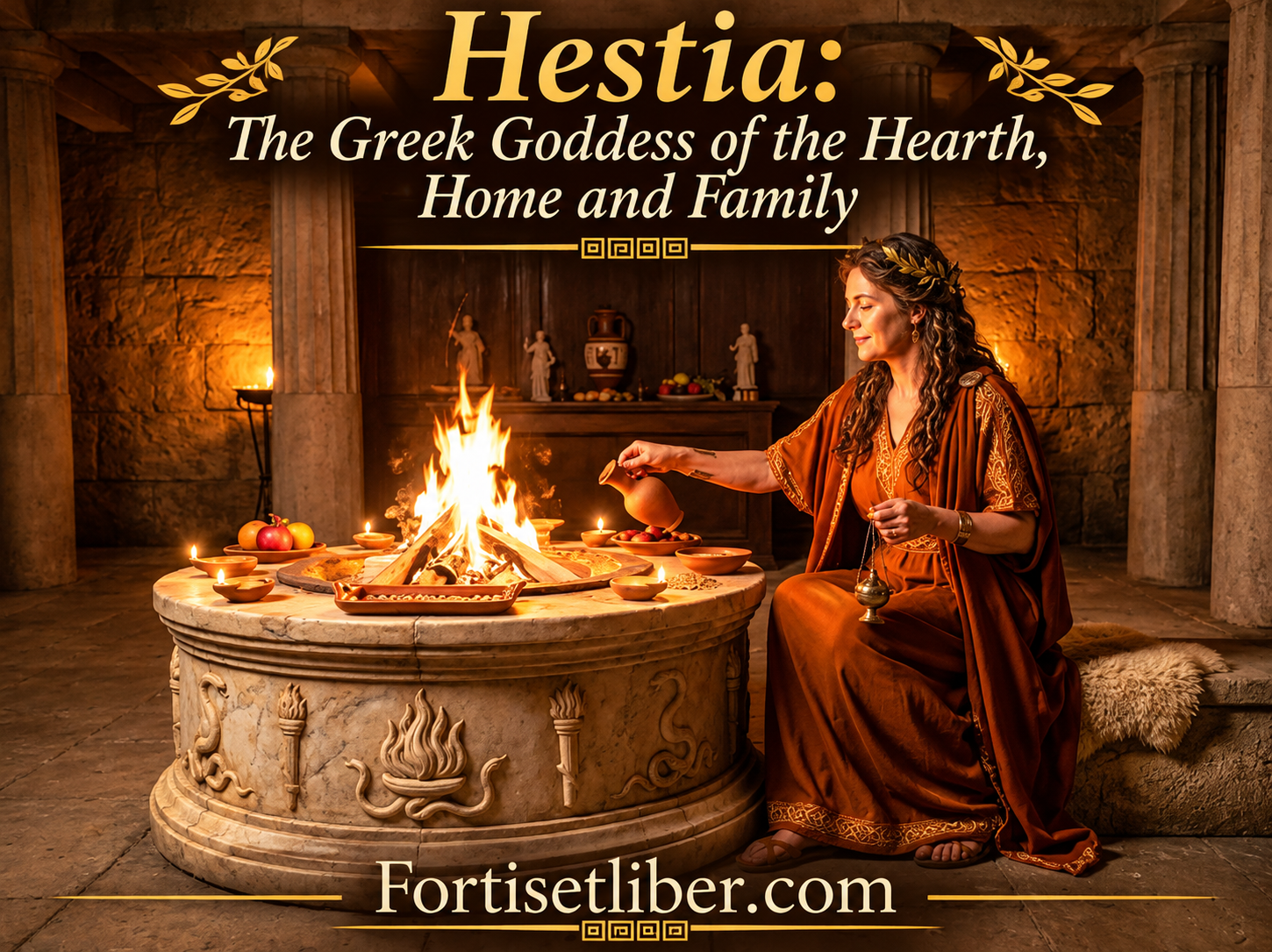
Among the fascinating figures of ancient Greek mythology, Hestia holds a particularly meaningful place. While gods such as Zeus, Poseidon and Ares are remembered for their extraordinary powers, dramatic adventures and conflicts, Hestia represents something quieter yet essential to human life: the warmth of home, the protection of family and the sacred importance of the hearth.
Hestia, the Greek goddess of the hearth, was one of the most respected deities in ancient Greece. She symbolised domestic harmony, hospitality, stability and the spiritual centre of family life. Unlike many other Olympian gods, she rarely appears in dramatic mythological adventures. Her importance, however, was deeply rooted in everyday Greek society, where the hearth was considered the heart of every household.
Understanding Hestia mythology offers a fascinating glimpse into ancient Greek beliefs about family, community, religious traditions and the meaning of home.
Who Was Hestia in Greek Mythology?
Hestia was the goddess of the hearth, domestic life and the sacred fire. She was one of the twelve major Olympian gods and goddesses, although ancient traditions sometimes differed regarding the composition of the Olympian twelve.
She was the eldest daughter of the Titans Cronus and Rhea and the sister of Zeus, Poseidon, Hades, Hera and Demeter.
According to Greek mythology, Cronus swallowed his children because he feared that one of them would overthrow him. Zeus eventually forced him to release them. Since Hestia was swallowed first and released last, some traditions describe her as both the eldest and youngest of the divine siblings.
The goddess Hestia was associated with peace, purity and permanence. She did not seek power through battles or romantic relationships. Instead, she represented the sacred and comforting presence that made a house a home.
Her influence extended beyond individual households. Every Greek city maintained a public hearth, symbolising the unity and continuity of the community.

Hestia and the Sacred Hearth
To understand the importance of Hestia, it is necessary to understand the role of the hearth in ancient Greek life.
In ancient Greek homes, the hearth was much more than a place for cooking or keeping warm. It was the central gathering point of the household. Families prepared meals, shared stories and performed religious rituals around its fire.
The hearth was also considered sacred because it represented the presence of the goddess Hestia.
Fire symbolised life, protection and continuity. As long as the household fire remained burning, it represented the stability and well-being of the family.
For this reason, Hestia was honoured through everyday domestic rituals. Families offered prayers and portions of food to her, recognising her importance in protecting their homes.
The sacred fire also had a public dimension. In Greek cities, a communal hearth was maintained as a symbol of civic identity. New settlements could carry fire from the mother city to establish their own sacred hearth, connecting the new community with its origins.
This tradition demonstrates why Hestia was not simply the goddess of the home. She was also a symbol of belonging, continuity and collective identity.
The Family of Hestia: Daughter of Cronus and Rhea
Hestia belonged to one of the most powerful divine families in Greek mythology.
Her father, Cronus, was a Titan ruler, while her mother, Rhea, was associated with motherhood and fertility.
Her siblings included some of the most famous figures in Greek mythology:
- Zeus: King of the Olympian gods and ruler of the sky.
- Poseidon: God of the sea, earthquakes and horses.
- Hades: Ruler of the Underworld.
- Hera: Goddess of marriage and queen of the gods.
- Demeter: Goddess of agriculture, grain and fertility.
Although Hestia was part of this powerful family, her character was very different from that of her siblings.
She avoided divine rivalries and conflicts, preferring a peaceful existence devoted to the hearth and the well-being of gods and mortals.
Her presence was associated with balance and harmony, making her an essential figure in the divine world.

Why Did Hestia Remain a Virgin Goddess?
One of the most distinctive aspects of Hestia mythology is her decision to remain unmarried and maintain eternal virginity.
According to ancient traditions, both Poseidon and Apollo sought her hand in marriage. However, Hestia rejected them and asked Zeus to allow her to remain a virgin forever.
Zeus granted her wish and gave her a special honour: she would receive a place of distinction in every household and temple.
This decision was significant because marriage and motherhood were central themes in ancient Greek mythology. Hestia, however, represented a different kind of feminine power.
Her independence was not associated with rebellion or conflict. Instead, it reflected her dedication to peace, domestic stability and sacred responsibility.
Hestia’s virginity symbolised purity, self-determination and freedom from romantic obligations.
She reminds us that strength does not always need to be expressed through dramatic actions. Sometimes, it can be found in the quiet confidence of knowing one’s purpose.

The Symbols of Hestia
The symbols associated with Hestia reflect her connection with domestic life, sacred fire and family unity.
The Sacred Flame
The most important symbol of Hestia is the flame of the hearth.
It represents warmth, protection, life and the continuity of the household. In ancient Greece, maintaining the sacred fire was a religious responsibility.
The Hearth
The hearth itself was the central symbol of the goddess. It represented the physical and spiritual centre of the home.
It was also a place of hospitality, where guests could receive food, shelter and protection.
The Veil
Hestia is sometimes depicted wearing a modest veil and long robes. These garments reflect her dignified, peaceful and reserved nature.
The Kettle and Domestic Objects
In some artistic representations, Hestia is associated with household objects, including vessels and cooking equipment, reinforcing her connection with domestic life.
Unlike other Greek gods, she is not commonly identified through a weapon or an animal companion.
Her symbolism is simple but powerful: the home, the fire and the family.

Hestia’s Role Among the Twelve Olympian Gods
Hestia is traditionally counted among the twelve Olympian deities, although some accounts replace her with Dionysus in the list.
Despite her peaceful character, she held an honoured position among the gods.
Ancient Greek religious traditions gave her a special place in sacrifices and prayers. She was often honoured first and last during religious offerings.
This practice reflected her importance as the goddess who connected the beginning and end of sacred ceremonies.
In the Homeric Hymn to Hestia, she is celebrated as a goddess who receives honour in the homes of mortals and in the temples of the gods.
Her position demonstrates that the ancient Greeks did not measure divine importance only through strength, authority or supernatural power.
The goddess who protected the hearth was equally deserving of respect.
Hestia and Hospitality in Ancient Greece
Hospitality was an important value in ancient Greek society. Welcoming guests, offering food and providing shelter were considered meaningful social and religious responsibilities.
Hestia was closely connected with this tradition because the hearth represented the welcoming centre of the household.
A guest who entered a home was received into a space under the protection of the sacred hearth.
This relationship between Hestia and hospitality reveals another dimension of her character. She represented not only the protection of family members but also the generosity and kindness extended to visitors.
The ancient Greek concept of hospitality, known as xenia, was also associated with Zeus, particularly Zeus Xenios, the protector of guests and strangers.
Together, these religious traditions emphasised the importance of treating visitors with respect and generosity.

Hestia and Her Roman Equivalent: Vesta
The influence of Hestia extended beyond ancient Greece.
In Roman mythology, her closest equivalent was Vesta, the goddess of the hearth, home and sacred fire.
Like Hestia, Vesta was associated with domestic stability and the protection of the community.
One of the most important religious institutions in ancient Rome was the Temple of Vesta, where the sacred fire was maintained by the Vestal Virgins.
These priestesses were responsible for preserving the flame, which symbolised the security and continuity of Rome.
Although Greek Hestia and Roman Vesta belonged to different religious traditions, their similarities demonstrate how important the sacred hearth was throughout the ancient Mediterranean world.
Both goddesses represented the idea that a stable home and a protected community were essential foundations of civilisation.
What Can Hestia Teach Us Today?
Although Hestia belongs to ancient mythology, her symbolism remains surprisingly relevant in modern life.
In a world often characterised by constant movement, competition and uncertainty, Hestia represents the importance of finding stability and creating a peaceful personal environment.
Her mythology reminds us of several timeless values:
The importance of home: A home is more than a physical building. It is a place of emotional security, belonging and connection.
The value of family: Hestia represents the relationships and everyday moments that create a sense of togetherness.
The beauty of simplicity: Her quiet character reminds us that happiness does not always require wealth, recognition or power.
Independence and personal choice: Her decision to remain unmarried demonstrates the importance of choosing one’s own path.
Hospitality and kindness: Her association with the hearth encourages generosity and respect towards others.
For modern readers interested in Greek mythology, Hestia offers a different perspective on divine power. She shows that care, stability and harmony can be just as meaningful as strength and authority.

Why Is Hestia One of the Most Important Greek Goddesses?
Hestia may not have the dramatic mythology of Athena, the beauty of Aphrodite or the extraordinary authority of Zeus, but her importance should never be underestimated.
She represented something fundamental to ancient Greek civilisation: the place where life began and where people found protection.
Every household needed warmth. Every family needed a gathering place. Every community needed a symbol of unity.
Hestia embodied all these things.
Her worship was integrated into everyday life, making her one of the most consistently present deities in ancient Greek religious practice.
While other gods were associated with extraordinary events, Hestia was connected with the daily experiences that gave meaning to human existence.
Conclusion: The Eternal Flame of Hestia
Hestia, the Greek goddess of the hearth, home and family, occupies a unique position in Greek mythology.
She represents peace rather than conflict, stability rather than ambition and devotion rather than personal glory.
Through her connection with the sacred flame, she became a symbol of family unity, hospitality, protection and the spiritual importance of home.
Her story reminds us that the most meaningful things in life are not always the most spectacular. Sometimes, they are found in the warmth of a familiar place, the comfort of family and the simple feeling of belonging.
Thousands of years after the ancient Greeks honoured her, Hestia remains a beautiful symbol of the timeless human desire for warmth, security and harmony.
Her sacred flame continues to represent an idea that transcends mythology and time: home is where life finds its centre.

Fortisetliber View
In the rich world of ancient Greek mythology, Hestia holds a special place as the goddess of the hearth, home and family. While other Olympian gods were celebrated for their power, adventures and dramatic stories, Hestia represented something more intimate and timeless: the warmth of home, the comfort of belonging and the quiet strength of inner peace.
Daughter of Cronus and Rhea, and sister of Zeus, Hera, Poseidon, Demeter and Hades, Hestia was one of the most respected goddesses of ancient Greece. She chose a life of eternal virginity, dedicating herself to the sacred flame and the protection of households and communities.
The hearth was the heart of every ancient Greek home. It was where families gathered, meals were prepared and prayers were offered. Its flame symbolised life, continuity and protection. Hestia was believed to inhabit this sacred space, bringing harmony and stability to the people gathered around it.
Unlike many Greek deities, Hestia did not seek attention or participate in conflicts. Her power was expressed through simplicity, dignity and devotion. She reminds us that true strength does not always require recognition or display.
At Fortis et Liber, Hestia represents an enduring philosophy: the importance of building a life grounded in balance, independence and inner strength. Her sacred flame is a beautiful reminder that, amid the noise and uncertainty of the world, we must preserve the light within ourselves.
Hestia teaches us that home is not merely a place. It is a feeling of peace, a source of strength and the foundation from which we face the world.
Her flame may belong to ancient mythology, but its meaning remains eternal.
References and Further Reading
- Hesiod – Theogony
An essential ancient Greek text describing the origins of the Olympian gods and the divine family of Hestia. - The Homeric Hymns – Hymn 24: To Hestia
A short hymn honouring Hestia and her sacred place in the ancient Greek religious tradition. - The Homeric Hymns – Hymn 29: To Hestia
A celebration of Hestia’s importance in the homes of mortals and the temples of the gods. - The Homeric Hymn to Aphrodite
An important source describing Hestia’s decision to remain unmarried and her honoured position among the Olympian goddesses.
Leave a Reply