
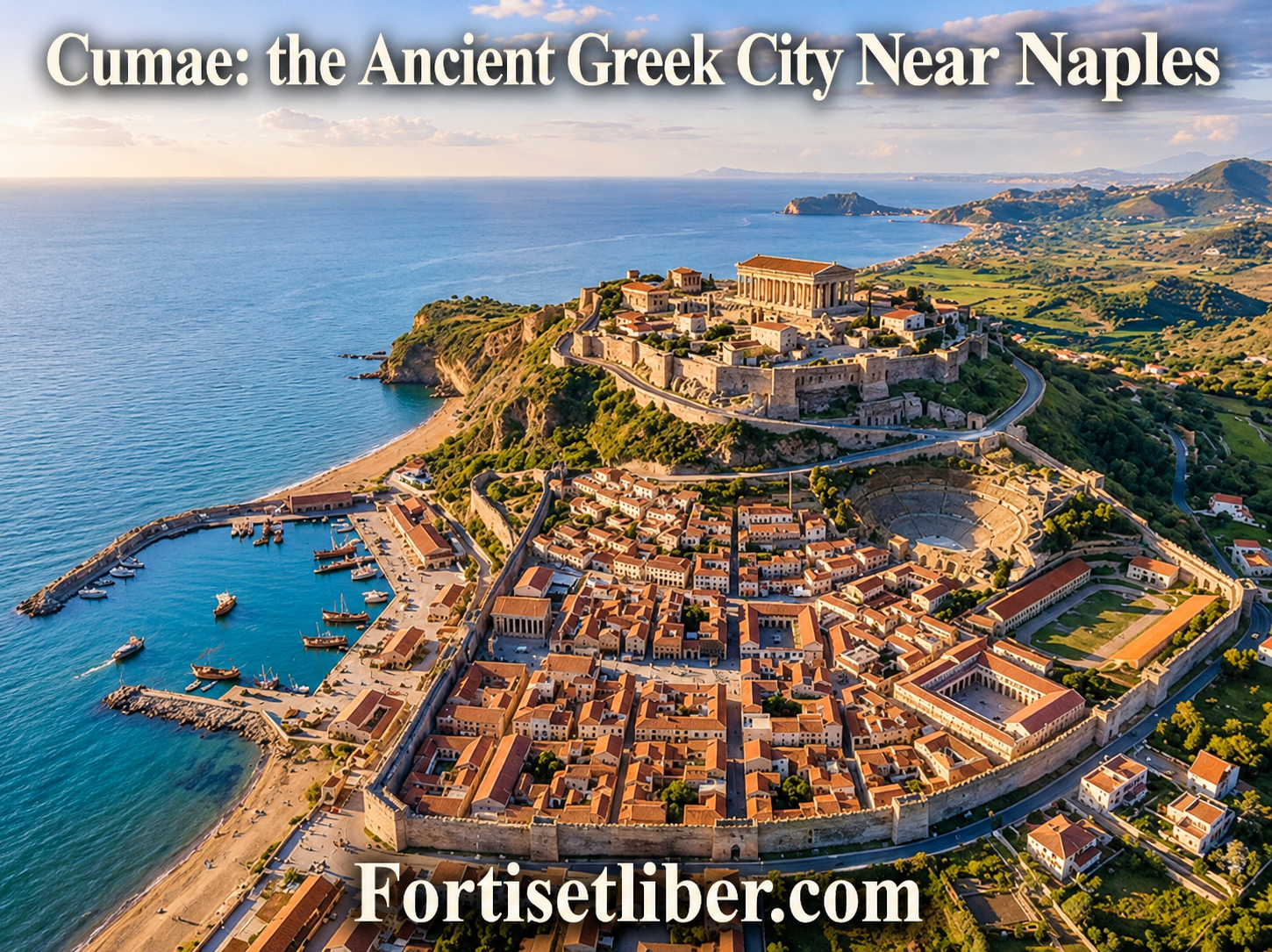
Cumae: One of the Oldest Greek Cities in Italy
Just a short distance from Naples, overlooking the beautiful coastline of the Tyrrhenian Sea, lies one of the most fascinating archaeological treasures of southern Italy: ancient Cumae.
Known today as Cuma, this remarkable archaeological site preserves the remains of one of the earliest Greek settlements established on the Italian mainland. Founded around 750 BC by Greek settlers from Euboea, Cumae became an important centre of commerce, culture, religion and political influence in the ancient Mediterranean world.
Yet Cumae is much more than an archaeological destination. It is a place where history and mythology meet. Its name is inseparably connected with the legendary Cumaean Sibyl, the mysterious priestess of Apollo whose prophecies became famous throughout the ancient world.
Today, visitors exploring the Cumae Archaeological Park can walk among ancient temples, discover the impressive remains of the acropolis and enter the extraordinary underground passage traditionally identified as the Cave of the Sibyl.
For anyone interested in ancient Greek civilisation, Roman history and Italian archaeological sites, Cumae is an unforgettable destination.

The Greek Origins of Ancient Cumae
The history of Cumae begins during the great period of Greek expansion across the Mediterranean.
Around the middle of the eighth century BC, Greek settlers from the island of Euboea established a colony on the fertile coastline of Campania. They were attracted by the area’s favourable geographical position, agricultural opportunities and access to important maritime trade routes.
Before the arrival of the Greeks, the territory was already inhabited by local populations. The establishment of the Greek settlement therefore marked the beginning of a long period of cultural interaction between Greek newcomers and the indigenous communities of southern Italy.
Cumae quickly developed into an influential city. Its strategic position allowed it to participate in commercial networks connecting Greece, southern Italy, Sicily and other Mediterranean territories.
The settlement became one of the most important centres of Magna Graecia, the name given by the Romans to the Greek-speaking cities and territories of southern Italy.
Greek language, religion, architecture and artistic traditions flourished in Cumae, influencing neighbouring communities and contributing to the development of ancient Italian civilisation.
The importance of Cumae was not limited to trade. Its cultural influence helped establish Greek traditions in the region, including religious practices and elements of writing and education.

Cumae and the Rise of Magna Graecia
During the sixth and fifth centuries BC, Cumae reached a particularly important position among the Greek cities of southern Italy.
Its prosperity was supported by agriculture, maritime commerce and its connections with other Greek settlements.
The city also became involved in the political and military struggles that shaped the ancient Mediterranean.
One of its most famous historical moments occurred in 474 BC, when Cumae, supported by the powerful Greek city of Syracuse, defeated an Etruscan fleet in a major naval battle.
This victory helped secure Greek influence along the Campanian coastline and demonstrated the military importance of Cumae.
However, the city’s independence did not last forever.
In 421 BC, Cumae was conquered by the Campanians, marking the end of its period as an independent Greek city.
Later, it became part of the expanding Roman world. Although its political identity changed, Cumae continued to preserve many of its Greek religious traditions and cultural characteristics.
Under Roman rule, the city developed further, acquiring public buildings, baths, religious monuments and other structures that reflected the architectural ambitions of the Roman Empire.

The Cave of the Sibyl: The Most Mysterious Attraction in Cumae
Perhaps the most famous monument in the entire archaeological area is the Antro della Sibilla, commonly known as the Cave of the Sibyl.
This extraordinary underground gallery is traditionally associated with the Cumaean Sibyl, one of the most celebrated prophetic figures in classical mythology.
According to ancient tradition, the Sibyl was a priestess of Apollo who possessed the ability to communicate divine prophecies. People travelled from distant regions to seek her advice about the future, war, politics and matters of personal destiny.
Her reputation became particularly important in Roman culture.
The Cumaean Sibyl is also closely connected with the story of Aeneas, the legendary Trojan hero who became the central figure of Virgil’s epic poem, the Aeneid.
In Book VI, Aeneas travels to Cumae to consult the Sibyl before descending into the Underworld. She becomes his guide on a supernatural journey through the realm of the dead, where he encounters the spirits of the past and receives revelations about the future of Rome.
This literary connection made Cumae famous throughout the Roman world and ensured that its legendary prophetess would remain an important figure in European cultural history.
The underground gallery itself is approximately 131 metres long and carved into the volcanic tuff rock of the area.
Its unusual trapezoidal shape, side openings and mysterious atmosphere make it one of the most distinctive archaeological features of Campania.
However, archaeology offers an interesting alternative to the traditional legend. Researchers believe the structure was originally an ancient defensive passage associated with the protection of the acropolis, dating to the late fourth or early third century BC. Its precise identification with the Sibyl’s legendary sanctuary remains debated.
Whatever its original function, walking through this remarkable passage is one of the most memorable experiences of visiting ancient Cumae.

The Acropolis of Cumae and the Temple of Apollo
Above the Cave of the Sibyl rises the ancient acropolis, the fortified upper part of the city.
This elevated area was the religious and strategic heart of Cumae. Its position offered commanding views over the surrounding countryside and the Tyrrhenian coastline.
The route leading towards the summit follows the ancient Sacred Way, passing through the remains of important religious structures.
One of the most significant monuments is the Temple of Apollo.
Apollo was among the most important gods in Greek religion and was particularly associated with prophecy, music, healing and divine knowledge.
His connection with Cumae is especially meaningful because of the city’s legendary Sibyl, whose prophetic powers were traditionally linked to the god.
Although only archaeological remains survive today, the temple provides an important insight into the religious life of the ancient Greek settlement and its later Roman development.
Further up the acropolis are the remains traditionally attributed to the Temple of Jupiter.
Jupiter, the Roman equivalent of the Greek Zeus, occupied a central position in Roman religious beliefs.
The presence of these religious structures illustrates the transformation of Cumae from an important Greek colony into a city integrated into Roman political and religious life.
The panoramic views from the acropolis are another highlight. On clear days, visitors can admire the surrounding landscape of the Campi Flegrei and the waters of the Tyrrhenian Sea.

The Roman City: Temples, Baths and the Ancient Forum
Although the Cave of the Sibyl and the acropolis attract most visitors, the archaeological importance of Cumae extends far beyond these monuments.
At the foot of the hill once stood the lower city, a substantial urban settlement containing public buildings, religious structures, commercial areas and residential districts.
Excavations have revealed important remains of the Roman Forum, the central public space where political, commercial and social activities took place.
The Forum was the heart of Roman urban life. Citizens gathered there to conduct business, discuss political affairs and participate in public events.
Archaeologists have also identified remains of the Capitolium, the main sanctuary traditionally dedicated to Jupiter, Juno and Minerva.
Other discoveries include ancient thermal baths, public buildings and sections of the city’s urban infrastructure.
These remains demonstrate how Cumae evolved over the centuries while retaining elements of its earlier Greek identity.
The lower city is particularly valuable for understanding the development of Roman urban planning in Campania and the relationship between Greek and Roman architectural traditions.
Not all archaeological areas are necessarily accessible during every visit, so it is worth checking the current arrangements before travelling.

The Roman Crypt and the Archaeological Heritage of Cumae
Another fascinating feature associated with the archaeological area is the Cripta Romana, an ancient underground passage connected with the wider infrastructure of Cumae.
Like many archaeological structures in the Campi Flegrei, it reflects the extraordinary relationship between ancient engineering and the region’s volcanic geology.
The Romans were skilled engineers who transformed the landscape through roads, tunnels, drainage systems and underground constructions.
Their work helped connect settlements, improve transportation and facilitate the movement of people and goods throughout the region.
Cumae’s archaeological remains offer a particularly interesting opportunity to understand how ancient communities adapted to a landscape shaped by volcanic activity.
The archaeological discoveries made here continue to contribute to our understanding of the city’s long history.
Excavations and research projects have revealed new information about its Greek foundations, Roman development, religious traditions and funerary monuments.

The Fall of Cumae and the End of an Ancient City
Like many ancient settlements in southern Italy, Cumae experienced centuries of political changes, invasions and economic transformations.
Although the city continued to exist during the Roman and late antique periods, its importance gradually declined.
During the early Middle Ages, the region experienced considerable instability, and Cumae became increasingly vulnerable to attacks.
The city was eventually destroyed in 1207 by forces from Naples, bringing an end to its existence as an important urban settlement.
Over the following centuries, the ancient ruins gradually disappeared beneath vegetation and accumulated earth.
It was only through archaeological investigations, particularly those conducted during the twentieth century, that the historical importance of Cumae began to be fully rediscovered.
The excavations led by archaeologist Amedeo Maiuri from the 1920s onwards played an important role in bringing the ancient acropolis and its monuments to wider public attention.
Today, the archaeological park protects an extraordinary collection of remains that illustrate more than two thousand years of Mediterranean history.

Visiting the Cumae Archaeological Park Today
For travellers visiting Naples and the surrounding Campania region, Cumae offers an excellent opportunity to discover a lesser-known side of Italy’s ancient heritage.
The archaeological park is located in the territory of Pozzuoli, within the fascinating volcanic landscape of the Campi Flegrei.
A visit allows you to explore the ancient acropolis, discover the Cave of the Sibyl, admire the remains of Greek and Roman temples and enjoy impressive views of the surrounding landscape.
The atmosphere is very different from the more crowded archaeological destinations of Pompeii and Herculaneum.
Cumae offers a quieter experience, where visitors can spend time appreciating the archaeological remains and imagining what life was like in one of the earliest Greek cities of Italy.
It is particularly interesting for lovers of archaeology, classical mythology, ancient architecture and cultural tourism.
Combining a visit to Cumae with other destinations in the Campi Flegrei, such as Pozzuoli, Baia and the surrounding archaeological attractions, can also make for a fascinating historical excursion.
Before visiting, check the official opening hours, ticket information and accessibility arrangements, as these can change.
Why Ancient Cumae Deserves a Place on Your Italian Travel Itinerary
Ancient Cumae is one of those extraordinary places where the past feels remarkably close.
Its Greek origins, Roman monuments, legendary Sibyl and fascinating underground architecture make it an exceptional destination for anyone interested in the history of Italy.
While many visitors concentrate on the famous ruins of Pompeii, the archaeological treasures of Cumae offer a different perspective on the ancient Mediterranean world.
Here, the story of Greek colonisation, the rise of Magna Graecia, the expansion of Rome and the enduring power of classical mythology come together in one remarkable location.
The Cave of the Sibyl remains its most evocative attraction, but the ancient temples, acropolis and remains of the Roman city are equally important in understanding its historical significance.
Cumae is not simply an archaeological site near Naples. It is a place where Greek civilisation first established deep roots in Italy, where Roman literature immortalised a legendary prophetess, and where thousands of years of history remain visible in the landscape.
For those willing to explore beyond Italy’s most famous tourist destinations, Cumae is a fascinating journey into the origins of Western Mediterranean civilisation.

Fortisetliber View
Founded around 750 BC by Greek settlers, ancient Cumae was one of the earliest Greek colonies in Italy and an important centre of culture and civilisation in the Mediterranean.
Located near Naples, this remarkable archaeological site is closely associated with the legendary Cumaean Sibyl, whose prophecies became immortalised in Virgil’s Aeneid. Her mysterious cave, carved into volcanic rock, remains one of the most fascinating reminders of the city’s ancient past.
Walking among the ruins of Cumae, its temples and ancient fortifications, we encounter the legacy of a civilisation that helped shape the cultural foundations of southern Italy and influenced the Roman world.
For Fortis et Liber, Cumae represents the enduring power of knowledge, heritage and cultural identity. Empires may disappear and cities may fall, but the ideas and achievements of great civilisations continue to speak across the centuries.
Cumae is more than an archaeological site. It is a reminder that history never truly disappears.
References and Further Reading
1. Treccani – Cuma: Historical and archaeological overview of the ancient Greek city.
Cuma – Enciclopedia Treccani
2. Treccani – The Greek Colonies of Magna Graecia: An introduction to the Euboean origins of Cumae and Greek colonisation in southern Italy.
The Sites of Magna Graecia – Euboean Colonies
3. Italian Ministry of Culture – Cuma Archaeological Park: Archaeological information about the acropolis, the Cave of the Sibyl and the ancient city.
Cuma Archaeological Heritage – Ministry of Culture
4. Virgil – The Aeneid, Book VI: The classical literary account of Aeneas’s encounter with the Cumaean Sibyl.
5. Amedeo Maiuri – Archaeological excavations at Cuma: Historical research into the archaeological discoveries and the Cave of the Sibyl.
Leave a Reply