
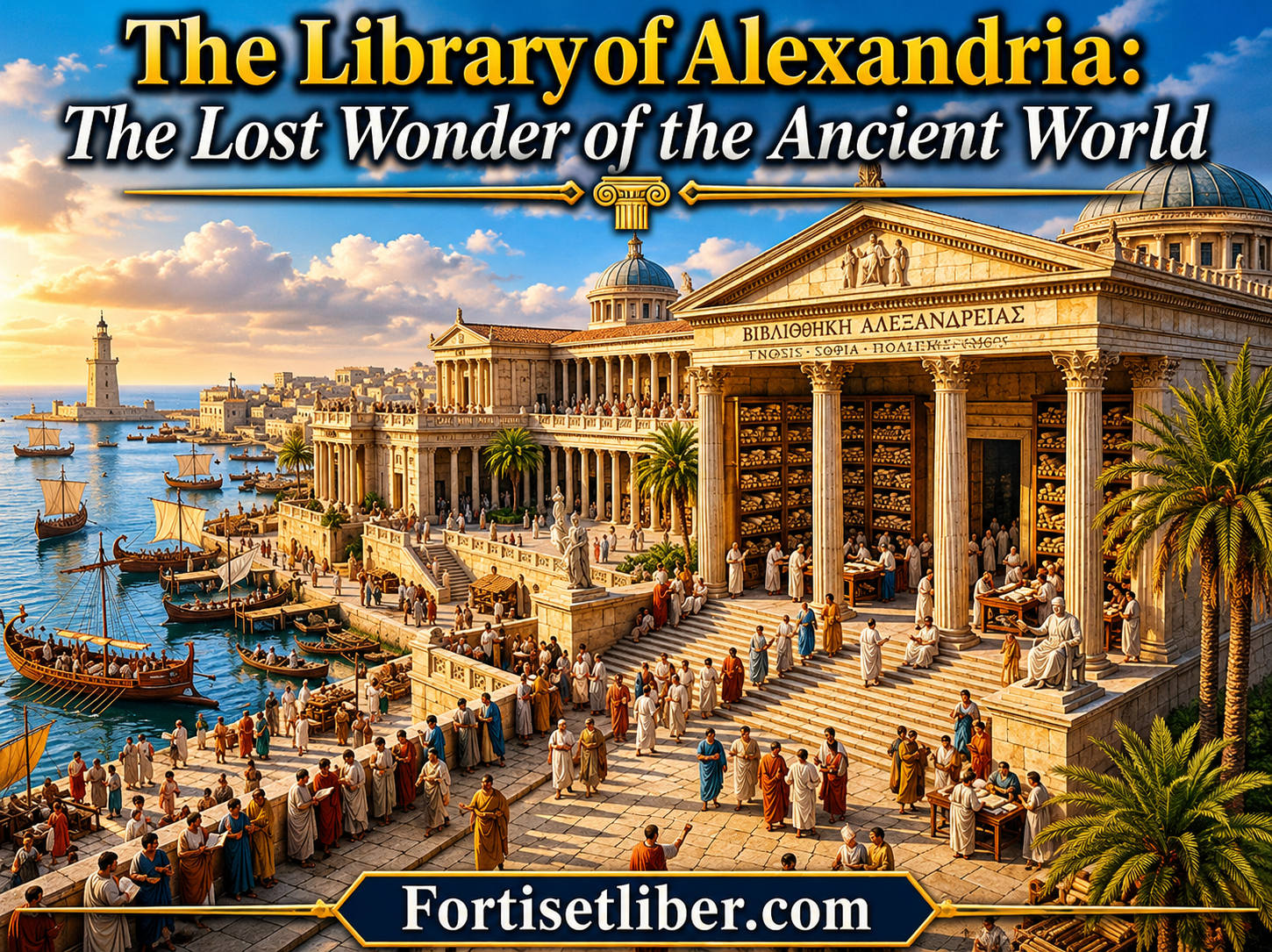
Imagine a place where the greatest minds of the ancient world gathered to study the stars, explore mathematics, investigate medicine, translate forgotten languages, and preserve the knowledge of entire civilizations. A place where thousands of scrolls contained the discoveries, philosophies, literature, and scientific achievements of humanity.
This extraordinary place once existed in ancient Egypt. It was known as the Library of Alexandria, one of the most remarkable intellectual institutions in human history.
For centuries, the Library of Alexandria represented humanity’s ambition to understand the world. It attracted scholars from different countries, preserved important writings, and helped shape the development of science, philosophy, literature, and mathematics.
Yet its story is surrounded by mystery. How was this legendary library created? What knowledge did it contain? Who were the famous scholars who worked there? And perhaps most intriguingly, what really happened to the Library of Alexandria?
Its disappearance remains one of history’s most fascinating mysteries.
The Origins of the Library of Alexandria
The Library of Alexandria was established in the early third century BC in the Egyptian city of Alexandria, during the reign of Ptolemy I Soter or shortly afterward, under the early Ptolemaic dynasty.
Alexandria itself had been founded by Alexander the Great in 331 BC. Located along Egypt’s Mediterranean coast, the city quickly developed into an important center of commerce, politics, culture, and intellectual activity.
Following Alexander’s death, his general Ptolemy I took control of Egypt and established the Ptolemaic Kingdom. His successors wanted Alexandria to become the cultural capital of the Mediterranean world.
The library was an essential part of this ambition.
The project is traditionally associated with Ptolemy I and his successor, Ptolemy II Philadelphus. It was closely connected to the Mouseion, an institution dedicated to the Muses, the ancient Greek goddesses of inspiration, literature, science, and the arts.
The Mouseion functioned somewhat like an ancient research institute. Scholars received support to study, write, debate, and exchange ideas.
The Great Library of Alexandria became the most famous part of this intellectual center.
Its mission was extraordinary: to collect and preserve as much written knowledge as possible from the known world.

A Collection of Knowledge from Across the Ancient World
One of the most fascinating aspects of the Library of Alexandria was its ambition to gather writings from different cultures and civilizations.
The Ptolemaic rulers reportedly encouraged the acquisition of manuscripts from across the Mediterranean and beyond. Ancient accounts describe efforts to obtain books from visiting travelers, merchants, and scholars.
The library’s collection included works associated with Greek literature, philosophy, mathematics, astronomy, medicine, history, and other fields.
Traditional accounts also describe how books arriving in Alexandria were copied, catalogued, and sometimes retained by the royal collection while copies were returned to their owners.
Although the exact number of scrolls is uncertain, ancient writers reported collections numbering in the hundreds of thousands. These figures should be treated cautiously because historical records are incomplete and may exaggerate the library’s size.
Nevertheless, there is little doubt that Alexandria became one of the ancient world’s most important centers of written knowledge.
Its ambition was not simply to collect books. It was to organize information, compare different ideas, and encourage the development of new discoveries.

The Famous Scholars of the Library of Alexandria
The Library of Alexandria became associated with some of the greatest intellectual figures of antiquity. Its wider scholarly community helped advance knowledge in mathematics, geography, astronomy, literature, and medicine.
Among its most celebrated scholars were:
Euclid
Euclid is one of the most influential mathematicians in history. His famous work, Elements, organized the principles of geometry into a systematic mathematical framework.
Although details of his life remain limited, he is traditionally associated with Alexandria during the reign of Ptolemy I. His work influenced mathematical education for more than two thousand years.
Eratosthenes
Eratosthenes was a Greek mathematician, geographer, and astronomer who became head of the Library of Alexandria in the third century BC.
He is particularly famous for calculating the Earth’s circumference using observations of the Sun’s shadows at different locations in Egypt.
His method was remarkably sophisticated for its time and demonstrated the extraordinary scientific potential of ancient scholarship.
Aristarchus of Samos
Aristarchus was an ancient Greek astronomer who proposed that the Earth revolves around the Sun rather than the other way around.
Although his heliocentric theory was not widely accepted in antiquity, it represented an important early attempt to understand the structure of the solar system.
Callimachus
Callimachus was a poet and scholar associated with the Alexandrian intellectual world. He is particularly remembered for developing the Pinakes, an extensive bibliographical catalogue that organized literary works and their authors.
This achievement represents an early milestone in the history of library science and information organization.
Hipparchus
Hipparchus was an influential Greek astronomer and mathematician whose work contributed significantly to the development of ancient astronomy. He is known for his star catalogue, studies of celestial movements, and contributions to trigonometry.
Together, these scholars demonstrate why Alexandria became synonymous with intellectual achievement.

What Did the Library of Alexandria Look Like?
Despite its worldwide reputation, surprisingly little is known about the exact physical appearance of the Great Library of Alexandria.
Archaeologists have not identified a universally accepted archaeological site for the original main library building.
Historical descriptions suggest that it was part of the larger Mouseion complex, which may have included lecture rooms, gardens, dining areas, and spaces for scholarly research.
Unlike modern libraries, which organize books on shelves, the Library of Alexandria primarily stored its written works on papyrus scrolls.
These scrolls were kept in containers or storage areas and identified through written catalogues.
The library’s collection was likely organized according to subjects, authors, and literary categories, although the precise arrangement remains uncertain.
It was not simply a quiet building filled with books. It was part of a larger intellectual environment where scholars could investigate, discuss, and develop new ideas.
This combination of research, education, and knowledge preservation made Alexandria an extraordinary institution for its time.

The Lighthouse of Alexandria and the Ancient City
The Library of Alexandria was part of a city that contained another famous ancient wonder: the Lighthouse of Alexandria, also known as the Pharos of Alexandria.
Built on the island of Pharos during the Ptolemaic period, the lighthouse guided ships safely into Alexandria’s busy harbor.
It was considered one of the Seven Wonders of the Ancient World and symbolized the city’s economic and technological importance.
The library and lighthouse represented two different expressions of Alexandria’s greatness.
The lighthouse helped travelers navigate the physical world, while the library helped scholars explore the intellectual world.
Together, they made ancient Alexandria one of the most extraordinary cities of the Mediterranean.
What Happened to the Library of Alexandria?
The destruction of the Library of Alexandria is one of the most debated subjects in ancient history.
For many years, popular accounts suggested that a single catastrophic event destroyed the entire library. However, modern historical research presents a more complicated picture.
There is no universally accepted date or explanation for the library’s disappearance.
Instead, historians generally consider several events that may have contributed to the decline or destruction of different parts of Alexandria’s scholarly institutions.
The Fire During Julius Caesar’s Campaign
One frequently mentioned event occurred in 48 BC, when Julius Caesar became involved in a conflict in Alexandria.
Ancient historical sources describe a fire involving ships in the harbor. The flames may have spread to buildings near the waterfront, potentially destroying books stored in warehouses.
However, historians disagree about the extent of the damage and whether the main library itself was destroyed.
Political and Social Changes
Alexandria experienced significant political and cultural transformations during the Roman period.
Changes in government, economic conditions, religious institutions, and scholarly patronage affected the city’s intellectual life.
Without consistent financial support and institutional stability, maintaining a major research and library complex would have become increasingly difficult.

The Destruction of the Serapeum in AD 391
Another important event occurred in AD 391, when the Serapeum, a major religious complex in Alexandria, was destroyed during conflicts involving pagan and Christian communities.
Some historical accounts associate a subsidiary library with the Serapeum.
However, the Serapeum was not necessarily the original Great Library, and historians continue to debate the relationship between the two institutions.
The Arab Conquest of Alexandria
A later popular story claims that Arab forces destroyed the remaining books in Alexandria following the conquest of Egypt in the seventh century.
However, historians generally regard this story as unreliable. The account appears in much later sources rather than contemporary records.
There is no convincing historical evidence that the Arab conquest resulted in the destruction of the original Great Library.
The most reasonable conclusion is that the Library of Alexandria declined over an extended period, with different collections and institutions disappearing at different times.
What Knowledge Was Lost?
Perhaps the most heartbreaking aspect of the Library of Alexandria’s history is the knowledge that may have disappeared with its collections.
Ancient manuscripts covered an enormous range of subjects, including mathematics, medicine, astronomy, philosophy, poetry, geography, engineering, and historical events.
Some works may have contained scientific observations and discoveries that were never copied elsewhere.
Others may have preserved writings from civilizations whose literary traditions are now only partially understood.
It is important to recognize that not every ancient text was stored exclusively in Alexandria. Books and manuscripts existed in other libraries, private collections, temples, and scholarly centers throughout the ancient world.
Some important works survived through copying and transmission across generations.
Nevertheless, the disappearance of Alexandria’s collections represents a significant loss in the history of human knowledge.
It reminds us that even the greatest intellectual achievements can be vulnerable when institutions, cultures, and political systems change.

The Legacy of the Library of Alexandria
Although the original Library of Alexandria disappeared, its influence continues to shape how people think about education, research, and the preservation of knowledge.
Its greatest achievement may not have been the number of scrolls it contained but the ambition behind its creation.
The library represented the idea that knowledge should be collected, organized, studied, and shared across cultural boundaries.
It brought together scholars from different backgrounds and encouraged the exchange of ideas at a time when communication between civilizations was far more difficult than it is today.
Its legacy also inspired modern cultural institutions.
One notable example is the Bibliotheca Alexandrina, inaugurated in 2002 in Alexandria, Egypt. This modern library was created as a tribute to the ancient institution and as a center for research, education, science, and cultural exchange.
Although it is not a reconstruction of the original building, it continues the spirit of intellectual curiosity associated with ancient Alexandria.
The Library of Alexandria: A Symbol of Humanity’s Search for Knowledge
The story of the Library of Alexandria is much more than the history of an ancient collection of books.
It is a story about human curiosity, scientific discovery, cultural exchange, and the desire to understand the universe.
For centuries, Alexandria attracted thinkers who challenged traditional beliefs, explored new ideas, and expanded the boundaries of human knowledge.
Its scholars helped develop mathematics, astronomy, geography, literature, and other disciplines that continue to influence modern civilization.
Although the fate of the Great Library remains uncertain, its symbolic importance has never disappeared.
Today, the Library of Alexandria stands as a powerful reminder of how valuable knowledge is and why preserving it matters.
Perhaps its greatest lesson is that civilizations are remembered not only for their monuments, armies, and wealth, but also for the ideas they create and the knowledge they leave behind.
The ancient Library of Alexandria may be lost, but its spirit continues to inspire generations of readers, historians, scientists, and dreamers around the world.

Fortisetliber View
There was once a place where the wisdom of the ancient world came together. The Library of Alexandria was more than a building filled with scrolls; it was a symbol of humanity’s endless desire to learn, discover, and understand the world.
Established in ancient Egypt during the third century BC, the Great Library attracted brilliant scholars, philosophers, mathematicians, and astronomers. It represented an extraordinary ambition: to gather the knowledge of civilizations and preserve it for future generations.
But history did not preserve everything.
The disappearance of the Library of Alexandria remains one of the most fascinating mysteries of the ancient world. Its decline was probably gradual, shaped by political conflicts, changing institutions, and periods of destruction. We may never know exactly how much knowledge vanished with its collections.
At Fortisetliber, we believe that the story of Alexandria carries a lesson that remains relevant today: knowledge is one of humanity’s greatest treasures, but it is never guaranteed to survive.
Books preserve ideas, ideas shape civilizations, and civilizations leave their legacy through what they teach the generations that follow.
The Library of Alexandria may have disappeared, but its spirit lives on in every library, every classroom, every research institution, and every curious mind searching for answers.
Because the greatest treasure of humanity is not gold or power. It is knowledge.
References and Further Reading
1. The Library of Alexandria – Mostafa El-Abbadi. The Life and Fate of the Ancient Library of Alexandria. A detailed historical study exploring the library’s origins, intellectual importance, and eventual decline.
2. Libraries in the Ancient World – Lionel Casson. Libraries in the Ancient World (2001). An insightful examination of ancient libraries, their collections, organization, and cultural significance.
3. The Vanished Library – Luciano Canfora. The Vanished Library: A Wonder of the Ancient World. An investigation into the historical accounts and legends surrounding the disappearance of Alexandria’s famous collection.
4. The Open University – The Library of Alexandria. An educational resource examining the library’s history and the different historical accounts of its destruction. Read the Open University study.
5. Oxford University Press – Libraries Before Alexandria. A scholarly examination of ancient Near Eastern library traditions and the historical context in which the Alexandrian collection emerged. Explore the academic publication.
6. Encyclopaedia and Historical Research – The Ancient Library of Alexandria. Further historical background on the institution, its scholars, and its relationship with the Mouseion. Read the historical research.
7. Bibliotheca Alexandrina – Alexandria, Egypt. The modern library established in 2002 as a tribute to the intellectual heritage of the ancient Library of Alexandria. Visit the official website.
Leave a Reply