
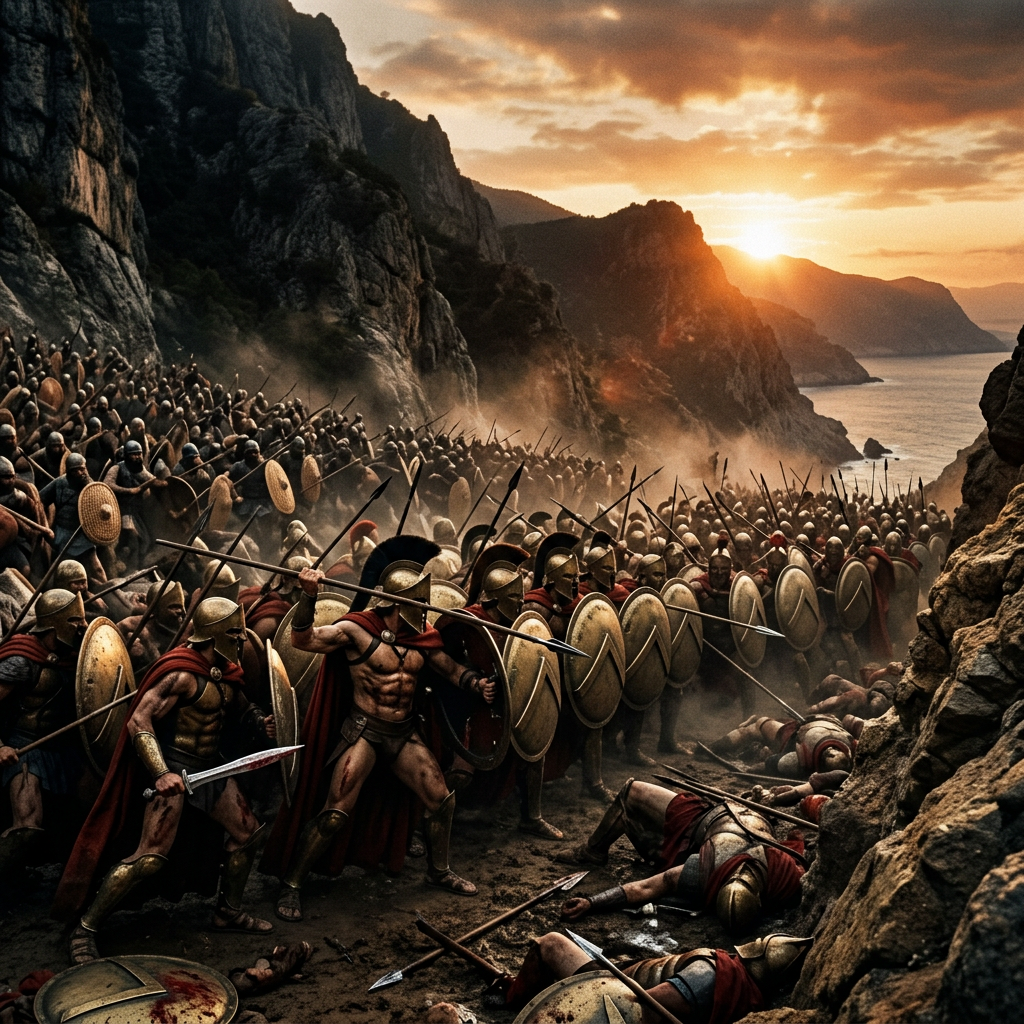
The Battle of Thermopylae, fought in August or September of 480 BCE, stands among the most iconic military engagements of the ancient world. Though a tactical victory for the Persian Empire, it became a defining symbol of courage, discipline, and resistance.
The stand of King Leonidas and his small coalition force against the vast army of Xerxes I has echoed through history as one of the greatest last stands ever recorded.
To understand Thermopylae fully, however, one must examine not only the dramatic final battle but also the political tensions, military preparations, strategic calculations, and wider campaign that shaped it.
Background: The Greco‑Persian Conflict
The Ionian Revolt and Persian Ambitions
The roots of the conflict lie in the Ionian Revolt (499–493 BCE), when Greek cities in Asia Minor rebelled against Persian rule. Athens and Eretria supported the revolt, provoking the wrath of King Darius I of Persia.
Darius sought to punish the mainland Greeks and expand Persian dominance westward. His first invasion culminated in the Battle of Marathon (490 BCE), where the Athenians achieved a stunning victory.
However, Persia was far from defeated.
Xerxes’ Massive Invasion
After Darius’ death, his son Xerxes I inherited the throne. Determined to complete his father’s mission, Xerxes spent years assembling one of the largest military expeditions the ancient world had ever seen.
Herodotus claims the Persian army numbered in the millions, though modern historians estimate it more realistically between 100,000 and 250,000 troops — still vastly larger than any Greek force.
The Persian army was multinational, including:
- Persians and Medes (core troops)
- Egyptians
- Babylonians
- Phoenicians
- Indians
- Scythians
- Thracians
- Anatolian Greeks
Xerxes also constructed remarkable engineering works:
- A pontoon bridge across the Hellespont (modern Dardanelles)
- A canal through Mount Athos to avoid dangerous sea routes
The invasion was not merely punitive — it was imperial. Greece was to be absorbed into the Persian Empire.

Greek Disunity and Alliance
Greece was not a unified nation but a collection of independent city‑states (poleis), often hostile to one another.
Athens was a naval power. Sparta was the dominant land power. Other states, such as Corinth, Thebes, and Thespiae, had varying loyalties.
Despite internal rivalries, a coalition of around 30 Greek city-states formed the Hellenic League to resist Persia. Sparta was given command of the land forces; Athens would dominate at sea.
The Greek strategy required blocking both:
- The Persian army on land
- The Persian navy at sea
Thus, Thermopylae (land) and Artemisium (naval engagement) were chosen as simultaneous defensive positions.
Why Thermopylae Was Chosen
Thermopylae, meaning “Hot Gates,” was named for its nearby sulfurous hot springs. In 480 BCE, the geography was different from today — the sea pressed much closer to the mountains, creating a narrow corridor in places only 15–20 meters wide.
This pass served as the main gateway from northern Greece into central Greece.
Its advantages:
- Neutralized Persian numerical superiority
- Prevented cavalry from operating effectively
- Forced attackers into narrow frontal assaults
- Allowed heavily armored Greek hoplites to dominate
It was a textbook example of terrain-based defensive strategy.
The Greek Forces
The Greek army numbered approximately 7,000 at the start, including:
- 300 Spartans (elite royal guard)
- 700 Thespians
- 400 Thebans
- Corinthians
- Phocians
- Locrians
- Arcadians
- Others
Why Only 300 Spartans?
The timing coincided with the Spartan religious festival of Carneia, during which military campaigns were traditionally restricted.
Leonidas, one of Sparta’s two kings, marched ahead with his 300 royal bodyguards — all chosen because they had living sons (to preserve family lines). More Spartan troops were expected later, but events unfolded too quickly.
It is critical to understand: Thermopylae was not only “300 Spartans.” It was a coalition effort, though Spartan discipline and leadership became central to its legend.

Persian Arrival and Psychological Warfare
When Xerxes arrived at Thermopylae, he reportedly waited four days, expecting the Greeks to flee.
Instead, he observed Spartans calmly exercising, grooming their hair, and preparing.
When told that Spartans combed their hair before battle, Xerxes was astonished. It was a ritual signifying readiness for death.
A famous exchange occurred when Xerxes demanded surrender:
Persians: “Lay down your arms.” Leonidas: “Molon labe” — “Come and take them.”
Another famous remark attributed to Leonidas: When warned that Persian arrows would blot out the sun, a Spartan replied: “Then we shall fight in the shade.”
The First Two Days of Battle
Persian Assaults
Xerxes first sent waves of Medes and Cissians. They were repelled.
The Greek phalanx proved devastating:
- Overlapping shields (aspis)
- Long spears (doru)
- Bronze helmets and breastplates
- Tight formation discipline
Persian troops were more lightly armored and relied on mobility and archery, which were ineffective in confined terrain.
The Immortals Fail
Frustrated, Xerxes deployed his elite unit — the Immortals, 10,000 strong under Hydarnes.
Even they could not break the Greek line.
The narrow pass prevented encirclement and forced the Persians into brutal frontal combat.
Greek tactics included:
- Feigned retreats
- Rotating fresh troops
- Maintaining tight cohesion
By the end of the second day, Persian casualties were severe.
Ephialtes’ Betrayal
A local Greek named Ephialtes revealed a mountain path (the Anopaea Path) that could outflank the Greeks.
Phocian troops had been stationed there but were surprised by Persian forces advancing at night.
Upon learning of the encirclement, Leonidas faced a decision:
- Withdraw and preserve forces
- Stay and delay the Persians
He chose to remain.

The Final Day: The Last Stand
Leonidas dismissed most Greek forces, though:
- 300 Spartans remained
- 700 Thespians refused to leave
- 400 Thebans stayed (possibly unwillingly)
The final battle moved beyond the narrow wall and into more open ground.
Leonidas was killed early in the fighting. A fierce struggle erupted over his body.
After their spears broke, the Greeks fought with:
- Swords
- Daggers
- Bare hands
Eventually, they retreated to a small hill and were overwhelmed by missile fire.
Herodotus reports that Xerxes ordered Leonidas’ body beheaded and crucified — a rare act of anger for a Persian king.
Casualties
Precise numbers are debated:
Estimated Persian losses: 10,000–20,000
Greek losses: approximately 2,000–4,000 total
The Persian army suffered disproportionately due to the terrain.
Strategic Impact
Though Persia won the field:
- The Greek fleet withdrew from Artemisium in coordination.
- The stand bought crucial time for Greek mobilization.
- Athens was evacuated.
- The Greek navy prepared for a decisive battle at Salamis.
Later in 480 BCE:
- The Greek navy defeated Persia at Salamis.
- In 479 BCE, the Greeks won at Plataea and Mycale.
These victories ended the invasion.
Thermopylae delayed Xerxes long enough for these later successes to become possible.

Cultural and Historical Legacy
The epitaph by Simonides immortalized the fallen:
“Go tell the Spartans, stranger passing by,
That here, obedient to their laws, we lie.”
Thermopylae became a symbol of:
- Duty over survival
- The law above individual life
- Collective resistance
- Military discipline
In later centuries, it inspired:
- Roman admiration
- Renaissance humanism
- Enlightenment political thought
- Modern nationalist narratives
Separating Myth from Reality
Modern scholarship clarifies:
- It was not just 300 Spartans.
- Persian numbers were large but not millions.
- The battle was part of a larger coordinated strategy.
Yet the legend persists because of its emotional power.
Conclusion
The Battle of Thermopylae was more than a clash of armies — it was a clash of political systems, military cultures, and visions of power.
The Persian Empire represented centralized imperial rule. The Greek city-states represented fragmented but fiercely independent communities.
Though defeated militarily, the defenders of Thermopylae shaped history through their example. Their sacrifice helped preserve the Greek world, which would later influence philosophy, politics, science, and culture across the Western tradition.
Thermopylae remains one of history’s enduring reminders that even in defeat, courage can echo louder than victory.

Fortisetliber’s View
At Fortisetliber, Thermopylae is not merely a story of heroic death — it is a lesson in civilizational resolve.
The battle reminds us that freedom is rarely preserved by comfort. It is defended by discipline, unity, and the willingness of individuals to subordinate personal survival to a higher law. The Spartans and their allies did not fight because victory was certain; they fought because retreat would have meant surrendering the principle of autonomy itself.
Thermopylae also exposes a deeper truth: numbers alone do not determine history. Moral conviction, strategic intelligence, and cultural cohesion can offset overwhelming material force. Though the Persians won the field, they failed to break the Greek spirit — and that spirit ultimately reshaped the Mediterranean world.
For us, Thermopylae represents the eternal tension between centralized power and self‑governing communities. It stands as a reminder that civilizations endure not only through triumph but through sacrifice.
Leave a Reply